

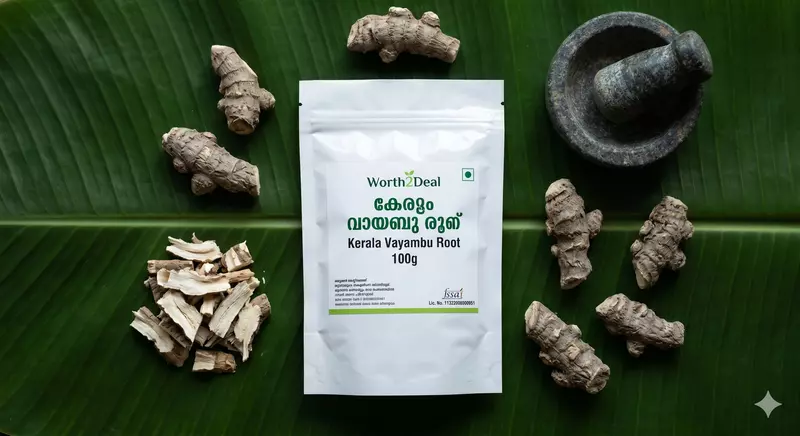


Buy Kerala Vayambu Root (Sweet Flag / Vacha Root) — 100g Whole Dried Rhizome | Acorus Calamus | For Babies, Brain & Digestion
Available Offer
Share :
Vayambu Root — also known as Vacha (Sanskrit), Vasambu (Tamil), Sweet Flag (English) and Acorus calamus (botanical) — is Ayurveda's most celebrated herb for speech, brain and digestive fire. Worth2Deal's Kerala Vayambu Root is sun-dried whole rhizome sourced from the natural wetlands of Wayanad and Idukki, Kerala — the same waterlogged forest margins where Acorus calamus has grown wild for centuries. Each 100g sealed pouch carries FSSAI Lic. No. 21317233000044 and is free from synthetic additives, artificial fragrance and starch fillers. Free pan-India delivery. Traditional Ayurvedic herb. Not a pharmaceutical drug.
What Is Vayambu Root?
Vayambu (Acorus calamus L.) is a semi-aquatic perennial rhizome herb used in Kerala Ayurveda for over 3,000 years. The dried underground stem — called the rhizome — is the medicinal part. It is harvested from marshy wetlands, cleaned and sun-dried without heat processing to preserve its volatile oil content. The distinctive camphor-spice aroma is the primary quality indicator of authentic Vayambu.
Worth2Deal sources this root from the natural wetlands of Wayanad and Idukki — Kerala's most biodiverse herb-growing districts — where the plant grows in its native habitat along stream banks, paddy field bunds and forest pond margins. No farm chemicals. No artificial drying. Pure traditional harvest.
Why Kerala Wetland-Sourced Vayambu Is Different
Most Vayambu sold online in India is sourced from undisclosed origins — often bulk traders with no traceability. Kerala wetland-sourced Vayambu is considered premium for three reasons.
Kerala's year-round humidity and warm temperatures produce rhizomes with higher volatile oil density — the oils responsible for Vayambu's distinctive aroma and therapeutic activity. The Indian variety (Acorus calamus, diploid 2n=24) contains beta-asarone and alpha-asarone, the primary bioactive phenylpropanoids. Roots from Kerala's natural wetlands are harvested at full maturity — unlike commercially cultivated roots harvested early for volume.
Our root passes the three-point quality check: strong unmistakeable camphor-spice aroma on breaking, white-cream fibrous interior (not brown or chalky), and regular knobbly nodes along the rhizome surface.
Traditional Uses — What Kerala Families Use Vayambu For
For Babies — Urasu Marunnu (The Kerala Infant Tradition)
The most culturally significant use of Vayambu in Kerala homes. The dried root is rubbed on a clean rough stone (granite or laterite) with a few drops of water or breast milk until a thin aromatic paste forms. A pin-head trace of this paste is applied around the infant's navel for colic relief, or on the tongue tip for gas and digestive discomfort. This is a genuine micro-dose — a fraction of a gram. This traditional practice has been used in Malabar households across generations for newborn care.
Important: The Urasu Marunnu dose is only the trace paste formed on the stone surface from rubbing. It is not a teaspoon, not a pinch of powder, not a decoction. Never give adult doses to infants.
For Speech Development in Children
Vacha's Sanskrit name literally means "speech" or "voice." Classical Ayurvedic texts (Charaka Samhita, Ashtanga Hridayam) prescribe Vacha as the first herb for speech delay, aphasia and language dullness in children. Modern pharmacology confirms its beta-asarone compounds enhance cholinergic neurotransmission — the neural system underlying language processing and memory consolidation. Used under qualified BAMS Ayurvedic paediatrician guidance alongside speech therapy.
For Brain, Memory and Mental Clarity (Adults)
Vacha is one of Charaka's four classical Medhya Rasayanas — herbs that directly enhance intellect and cognition — alongside Brahmi, Shankhpushpi and Mandukaparni. Short-course use (4–6 weeks) of Vacha churna or decoction supports memory retention, mental focus and cognitive clarity. Particularly relevant for students, teachers, writers and professionals experiencing brain fog or cognitive fatigue.
For Digestive Fire (Agni) and Gut Health
Vayambu is Katu (pungent) and Ushna (heating) — it directly stimulates digestive fire (Agni), relieves bloating, reduces flatulence, improves appetite and clears Ama (toxin accumulation). Its Deepana-Pachana dual action makes it Ayurveda's most effective gut fire rekindler. Combined with fermented rice preparations like Pazhankanji, it creates a complementary digestive support system — one rebuilds the gut ecosystem, the other rekindles the fire.
For Respiratory Health
Volatile oils — particularly cineole and camphene — give Vayambu powerful expectorant properties, loosening and clearing Kapha accumulated in the respiratory tract. Classical use for chronic cough, sinus congestion and bronchitis accompaniment. Also used in Nasya (nasal oil) preparations for sinus clearing in adults.
How to Use — Preparation Methods
Method 1 — Urasu Marunnu for Babies
Wash the root. Rub firmly on a clean rough stone in circular motion with 3–4 drops of water or breast milk. Continue 1–2 minutes until a thin cream-coloured paste forms. Collect paste from stone surface — pin-head amount total. Apply around navel for colic, or touch trace to tongue tip for gas. This is the complete dose for infants.
Method 2 — Vacha Churna for Adults
Dry-roast Vayambu root pieces on low flame for 3–5 minutes until aromatic. Cool completely. Grind to fine powder. Store in airtight glass jar away from light. Adults: ¼–½ teaspoon (1–2g) with raw honey or cow ghee before meals, twice daily. Course: 4–6 weeks. Take 4-week break before repeating.
Method 3 — Decoction
Crush 2–3g of dried root into coarse pieces. Boil in 200ml water until reduced to 100ml. Strain and drink warm. Suitable for digestive complaints, respiratory support and adult cognitive use.
Method 4 — Nasya Oil (Adults Only)
Infuse crushed Vayambu in warm sesame oil for 2 weeks. Strain. Apply 2 drops in each nostril every morning on empty stomach, lie down 5 minutes. For mental clarity, voice quality and sinus health.
Dosage Guide
Newborn–12 months — Urasu Marunnu paste (stone-rubbed) — Pin-head trace from stone — As needed for colic only
1–3 years — Urasu Marunnu paste — Rice-grain amount — Once daily if prescribed by practitioner
3–5 years — Churna with honey — Pinch (0.25g) — Once daily
5–12 years — Churna with honey — 0.5g (⅛ tsp) — Once daily
Adults — Churna or decoction — 1–3g (¼–½ tsp) — Twice daily before meals
Elderly — Churna with Saraswatarishta — 1g — Twice daily after meals
Do not exceed 6–8 weeks of continuous use without Ayurvedic practitioner guidance.
Safety — Who Must Not Use Vayambu
Pregnant women — Absolute contraindication. Vacha has documented uterotonic properties that can stimulate uterine contractions. Avoid all forms at every stage of pregnancy.
Nursing mothers — Avoid. Volatile oils may transfer to breast milk. Limited safety data available.
Active peptic ulcer — Ushna (heating) nature aggravates gastric ulcer and high Pitta conditions.
Pre-surgical patients — Stop 2 weeks before any surgery. Mild anticoagulant and CNS-interactive properties.
Known bleeding disorders — Use only under direct medical supervision.
This product is a traditional Ayurvedic herb, not a pharmaceutical drug. Not intended to diagnose, treat, cure or prevent any disease. Consult a registered BAMS Ayurvedic practitioner or paediatrician before use, especially for infants and children.
How to Identify Genuine Vayambu — 5-Point Quality Check
Our roots pass all five markers. Verify yours on arrival:
- Aroma — Break a small piece. Genuine Vayambu has an intense camphor-spice aroma. Faint or absent aroma means degraded volatile oil content.
- Interior colour — Fresh cut reveals white-cream fibrous interior. Brown or chalky inside means degraded root.
- Texture — Firm, slightly fibrous, shows string-like fibres when snapped. Chalky-dry and brittle means old stock.
- Nodes — Regular ring-like marks at 0.5–1cm intervals along the root surface. Uniformly smooth rods without nodes may be a different species.
- Label — Botanical name "Acorus calamus" clearly stated. FSSAI Lic. No. 21317233000044. No synthetic additives declared.
Product Specifications
Product — Kerala Vayambu Root (Whole Dried Rhizome)
Botanical Name — Acorus calamus L.
Family — Acoraceae
Common Names — Vayambu (Malayalam), Vasambu (Tamil), Vacha / Bach (Sanskrit/Hindi), Sweet Flag (English), Calamus Root (Trade)
Source Region — Wayanad & Idukki Wetlands, Kerala, India
Part Used — Dried rhizome (underground stem)
Processing — Sun-dried, no heat processing, no artificial drying
Net Weight — 100g
Packaging — Sealed plastic pouch with label
Additives — None — pure whole dried root only
Price — ₹169
SKU — W2D-AYU-VAY-100
FSSAI Lic. No. — 21317233000044
Manufacturer — Worth 2 Deal, 7/330 A, Shanthi Nagar, Kokkur, Malappuram, Kerala — 679591
Delivery — Free pan-India delivery
Storage — Cool, dry place away from direct sunlight. Keep sealed when not in use. Shelf life: 12 months from packaging.
FREQUENTLY ASKED QUESTIONS
What is Vayambu root used for?
Vayambu root (Acorus calamus) is used in Ayurveda for infant colic relief, speech development in children, brain and memory enhancement in adults, digestive fire stimulation, and respiratory health support. It is Kerala's most important traditional infant care herb.
What is the English name for Vayambu?
The English name for Vayambu is Sweet Flag. It is also called Calamus Root or Rat Root. The botanical name is Acorus calamus.
Is Vasambu and Vayambu the same?
Yes. Vasambu (Tamil) and Vayambu (Malayalam) are the same plant — Acorus calamus. Both refer to the dried rhizome of the Sweet Flag herb used across South India for infant care, speech and digestion.
Is Vayambu safe for newborn babies?
Traditional Urasu Marunnu micro-dose — a pin-head trace rubbed from stone — has been used safely for generations for newborn colic. Never give adult doses to infants. Always inform your paediatrician before use.
How do you use Vayambu for babies?
Rub the dried root on a clean rough stone with a few drops of water or breast milk for 1–2 minutes until a thin paste forms. Apply a pin-head amount around the navel for colic, or touch a trace to the tongue for gas. This is the complete traditional dose — called Urasu Marunnu.
What is Urasu Marunnu?
Urasu Marunnu is Kerala's traditional infant care practice of rubbing Vayambu root on a stone to produce a micro-dose paste for treating baby colic, gas and digestive discomfort. "Urasu" means rubbed in Malayalam.
Can Vayambu help with speech delay in children?
Vayambu (Vacha) is classical Ayurveda's primary herb for speech delay. Its Sanskrit name means "speech." Its beta-asarone compounds support cholinergic neurotransmission related to language processing. Use under qualified BAMS Ayurvedic paediatrician guidance alongside speech therapy — not as a standalone cure.
What is the adult dose of Vayambu?
Adults: ¼ to ½ teaspoon (1–3g) of Vacha churna with honey or cow ghee, twice daily before meals. Maximum course: 6–8 weeks without break. Start with the lowest dose and observe.
What is the difference between Vayambu and Brahmi?
Vayambu (Vacha) targets speech, voice clarity and short-term cognitive boost — best for Kapha brain fog and speech delay. Brahmi (Bacopa monnieri) targets long-term memory, anxiety and ADHD support. Vayambu is heating; Brahmi is cooling. Many classical formulas combine both.
Is Vayambu banned in India?
No. Vayambu (Acorus calamus) is a fully recognised Ayurvedic medicinal plant in India, listed in the Indian Pharmacopoeia and numerous CDSCO-approved formulations. The 1968 USA FDA food-additive ban does not apply in India.
Is beta-asarone in Vayambu dangerous?
Beta-asarone caused tumours in rats at very high, lifetime doses in a 1968 study. Traditional Ayurvedic short-course use at 1–3g dose for 4–8 weeks is not equivalent to those experimental doses. Indian regulatory bodies continue to recognise Vacha as a therapeutic herb.
Can pregnant women take Vayambu?
No. Vayambu is absolutely contraindicated during pregnancy. It has documented uterotonic properties that can stimulate uterine contractions. Avoid all forms at every stage of pregnancy.
How do I identify real Vayambu root?
Break a small piece — genuine Vayambu has a strong camphor-spice aroma. The interior is white-cream and fibrous. The exterior has regular ring-like nodes at 0.5–1cm intervals. No aroma means degraded or adulterated root.
What does Vayambu smell like?
Vayambu has a strong distinctive camphor-spice aroma — a combination of camphor, ginger, warm spice and something slightly sweet-woody. This aroma is the primary quality indicator of genuine root.
What is the shelf life of dried Vayambu root?
Properly stored dried Vayambu root lasts 12 months from packaging. Store in a sealed pouch in a cool dry place away from direct sunlight. Degradation shows as fading aroma and browning of the interior.
Can Vayambu be used for digestion?
Yes. Vayambu is one of Ayurveda's most powerful Deepana-Pachana herbs — it stimulates digestive fire (Agni), relieves bloating, reduces gas and clears Ama (toxin accumulation). It directly addresses sluggish digestion and digestive heaviness.
What is Vacha in Ayurveda?
Vacha is the Sanskrit name for Vayambu (Acorus calamus). It is one of Charaka's four classical Medhya Rasayanas — herbs that enhance intellect and cognition — alongside Brahmi, Shankhpushpi and Mandukaparni. Vacha means "speech" in Sanskrit.
Can Vayambu be grown at home?
Yes. Vayambu grows easily in Kerala's climate. Plant rhizome sections in a large pot with rich moist soil, keep sitting in a water tray always, and place in full sun. Leaves emerge in 2–3 weeks. Medicinal roots are ready after 12–18 months.
What is sweet flag essential oil used for?
Sweet flag essential oil is used in aromatherapy diffusers for mental clarity, in Nasya therapy for sinus clearing and voice quality, in scalp massage oil for hair health, and as a natural insect repellent. Never ingest sweet flag essential oil.
Is Vayambu good for memory?
Yes. Vacha is a classical Medhya Rasayana — Ayurveda's category of intellect-promoting herbs. Beta-asarone enhances cholinergic neurotransmission supporting memory consolidation and focus. Traditional use: short course before exams or mentally demanding work.
What is the price of Vayambu root in India?
Worth2Deal Kerala Vayambu Root (100g whole dried rhizome) is priced at ₹169 with free pan-India delivery. Kerala wetland-sourced, FSSAI-certified, pure root with no additives.
Where can I buy genuine Vayambu root online?
Worth2Deal (worth2deal.com) sells Kerala Vayambu Root — whole dried rhizome sourced from Wayanad and Idukki wetlands, 100g sealed pouch, FSSAI Lic. No. 21317233000044, free pan-India delivery. No fillers, no synthetic additives.
What is the Arabic name for Vayambu?
In Arabic, Vayambu (Acorus calamus) is called Waj (وج) or Qasab al-Dharira. It is used in Unani medicine for cognitive enhancement and digestive health. Kerala diaspora in Gulf countries frequently order it from Kerala suppliers.
Can I use Vayambu for anxiety?
Yes. Vacha's calamenol and sesquiterpene content produces mild anxiolytic effects — specifically for Vata-driven anxiety with racing thoughts and scattered focus. It calms nervous system hyperactivity without causing drowsiness. Not a replacement for professional mental health support.
What is the spiritual significance of Vayambu in Kerala?
Vayambu is considered protective and purifying in Kerala tradition. Dried roots are placed in rice granaries to repel pests. The herb is used in infant naming ceremonies (Namakarana) and rice-feeding ceremonies (Annaprashana). Its Sanskrit name Vacha connects it to Saraswati, goddess of speech and learning.
Is Vayambu the same as Calamus root?
Yes. Calamus root is the trade and historical English name for Vayambu (Acorus calamus). Sweet Flag, Calamus Root and Vayambu all refer to the same dried rhizome. The Indian variety contains beta-asarone; the North American Acorus americanus has negligible beta-asarone.
How is Worth2Deal's Vayambu root processed?
Harvested at maturity from Kerala wetlands, cleaned of soil and surface debris, and sun-dried without heat or chemical processing to preserve volatile oil content. No artificial drying agents, no sulphur fumigation, no synthetic preservatives.
Can I use Vayambu in cooking?
Vayambu is not a culinary spice in modern cooking — it is a traditional medicinal herb. Historically used in small quantities in Ayurvedic food preparations and rice granaries. For culinary and therapeutic herb combinations, see our Nannari Sharbat and Pathimugam listings.
What should I check when buying Vayambu powder online?
Check that the product states "Acorus calamus" botanical name, carries a valid FSSAI licence number, declares no starch fillers or additives, has an aromatic smell (not odourless), and provides full manufacturer name and address. Avoid unmarked bulk sellers.
Is Vayambu safe for children over 5 years?
Small oral doses of Vacha churna — 0.5g (⅛ teaspoon) with honey once daily — are the classical dose for children aged 5–12 years. Use under qualified BAMS Ayurvedic practitioner guidance, especially for speech delay or cognitive support.
Pathimugam — Kerala Sappanwood — Kerala's traditional red herbal water for blood purification and digestive health. Often paired with Vayambu in classical Ayurvedic digestive protocols.
Nannari Sharbat — Indian Sarsaparilla Syrup — Kerala's cooling herbal drink for body heat, urinary health and skin clarity. The cooling counterbalance to Vayambu's heating nature.
Kerala Desi Cow Ghee — Bilona A2 — The classical Anupana (carrier vehicle) for Vacha churna in Ayurvedic practice. Cow ghee enhances bioavailability of Ayurvedic herbs including Vayambu.
Complete Vayambu Guide — Benefits, Baby Dosage, Safety & Buying — Paithrka.com, Kerala's ancestral wellness reference. 30 FAQs, dosage tables, Urasu Marunnu tradition, beta-asarone safety explained.
Available with free delivery across India including Kochi, Thiruvananthapuram, Kozhikode, Thrissur, Malappuram, Kannur, Palakkad, Kollam, Kottayam, Ernakulam, Wayanad, Chennai, Coimbatore, Madurai, Bengaluru, Mysuru, Hyderabad, Mumbai, Pune, Delhi, Kolkata, Ahmedabad, Jaipur, Surat, Lucknow, Nagpur, Bhopal, Chandigarh, Guwahati. International enquiries via WhatsApp: +91 79071 68550.
Worth 2 Deal
7/330 A, Shanthi Nagar, Kokkur, Malappuram, Kerala — 679591
worth2deal.com@gmail.com
+91 9846294242
WhatsApp: +91 79071 68550
FSSAI Lic. No. 21317233000044
DISCLAIMER
This product is a traditional Ayurvedic food herb. It is not a pharmaceutical drug and is not intended to diagnose, treat, cure or prevent any disease. All traditional use information reflects classical Ayurvedic knowledge and is provided for educational purposes only. Consult a registered BAMS Ayurvedic practitioner or paediatrician before use, particularly for infants, children, elderly or medically compromised individuals. Pregnant women must not use this product under any circumstances. Worth2Deal products comply with FSSAI Lic. No. 21317233000044. Individual results may vary.