



Buy Authentic Pathimugam Sarsaparilla Online — Kerala Sappanwood Herbal Water Chips | Free Pan-India Delivery
Available Offer
Share :
The Pink Water in Every Kerala Kitchen Has a Name
In Kerala, colourless water is the exception at mealtimes — not the rule. Walk into any traditional Kerala household, any roadside hotel in Malabar, any Ayurvedic clinic from Thiruvanantapuram to Kozhikode, and you will be served a glass of softly pink, faintly earthy, warm herbal water before or after your meal. That pink colour is not a dye. It is not a flavouring. It comes from a single ingredient that Kerala has been using for centuries — Pathimugam.
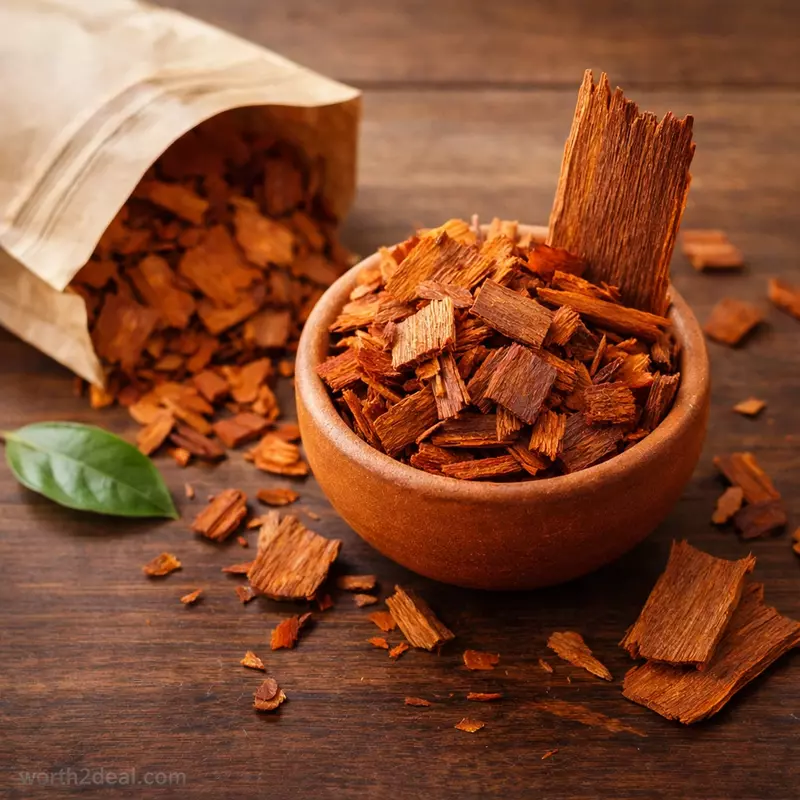
Worth2Deal Pathimugam Sarsaparilla is the same authentic Sappanwood heartwood that produces that water. Sourced directly from Kerala farms, cleaned by hand, and packed in Malabar with nothing added and nothing removed — 200 g of pure Caesalpinia sappan heartwood chips ready to brew in your kitchen in under five minutes.
What Is Pathimugam — The Complete Story
Pathimugam is the Malayalam name for Sappanwood — the dried heartwood of Caesalpinia sappan Linn, a thorny medicinal tree of the Fabaceae family that grows natively across Kerala, South India, and Southeast Asia. It is known by different names across India and beyond: Pathimugam in Malayalam, Patunga in Hindi, Sappanga in Kannada, Pathang in Marathi, Patang in Gujarati, and Sappan Wood or East Indian Rosewood in English.
The heartwood — the dense inner core of the tree — contains a bioactive compound called Brazilin, which is responsible for the deep natural red-pink colour it imparts to water when boiled. Brazilin is the same pigment historically used to dye textiles, colour Ayurvedic formulations, and tint traditional foods across South and Southeast Asia.
In Ayurveda, Pathimugam is classified as a Dahashamani — a thirst-quenching, body-cooling herb — and is one of the foundational ingredients of traditional Kerala drinking water. It appears in classical Ayurvedic texts as a treatment for blood disorders, skin diseases, digestive complaints, urinary conditions, and inflammatory ailments. The water made by boiling Pathimugam chips is called Pathimugam water, Pathimugam kanji vellam, or simply Kerala pink water — and in most traditional Kerala and Malabar homes, it replaces plain drinking water entirely as the daily beverage of choice.
Worth2Deal sources Pathimugam heartwood chips from farms in Kerala — authenticated, farm-sourced, with no synthetic dyes, no chemical processing, and no artificial additives of any kind.
For Malayali Families Living Outside Kerala — The Water You Miss
If you grew up in Kerala — in Malabar, in Palakkad, in Thrissur, in Kozhikode, in Thiruvanantapuram — there is a specific taste and colour to the water you drank every day. Not the flat, colourless water that comes out of the tap in Bengaluru, Delhi, Mumbai, or Chennai. A warm, softly pink, mildly earthy water that smelled faintly of wood and felt different going down. The water your grandmother had boiling on the stove when you walked in.
Worth2Deal delivers authentic Pathimugam Sarsaparilla chips to Malayali households across every major Indian city — Bengaluru, Delhi, Mumbai, Kolkata, Chennai, Hyderabad, Pune, Ahmedabad, Nagpur, Chandigarh, Jaipur, Surat, Lucknow, Bhopal, Indore, Noida, Mysuru, Coimbatore, Kochi, and Thiruvanantapuram — with free pan-India delivery and no minimum order. The 200 g pack makes approximately 30 to 40 litres of Pathimugam water — roughly a full month of daily drinking water for one person, or one to two weeks for a family.
The Science Behind Pathimugam — What Brazilin Actually Does
The active compound in Pathimugam heartwood is Brazilin — a naturally occurring flavonoid that gives the wood its red pigment and is responsible for the majority of its documented biological activity. Published research has confirmed the following properties of Brazilin and related compounds in Caesalpinia sappan extract:
Antioxidant activity: Brazilin is a potent free-radical scavenger. Regular consumption of Pathimugam water significantly reduces oxidative stress — the cellular damage linked to premature ageing, chronic inflammation, and degenerative disease. Studies identify Protosappanin A, another compound in Pathimugam, as specifically protective against the oxidative and nitrative stress pathways associated with Alzheimer's and Parkinson's disease.
Antimicrobial properties: Pathimugam water has demonstrated antibacterial activity against Streptococcus mutans — the oral bacterium responsible for tooth decay — as well as against bacteria responsible for food poisoning, skin infections, and joint inflammation. Boiling drinking water with Pathimugam has historically served as a traditional water purification method in Kerala, helping prevent water-borne diseases including cholera and typhoid.
Anti-inflammatory action: Multiple compounds in Sappanwood — including Brazilin, Saponin, and Protosappanin — exhibit anti-inflammatory properties that reduce swelling and pain, traditionally applied as a wound wash and used to treat piles, skin inflammation, and joint conditions.
Blood glucose management: Research has documented that Pathimugam extract can significantly reduce blood glucose levels. A clinical study involving menopausal women who consumed Pathimugam water showed measurable reductions in blood sugar. Its vasorelaxant properties additionally help lower blood pressure — meaningful for the millions of Indians managing hypertension and Type 2 diabetes simultaneously.
Antiplatelet and cardiovascular support: The Brazilin compound in Pathimugam inhibits platelet aggregation — reducing the risk of blood clot formation and improving overall blood circulation. Regular consumption supports cardiovascular health through this antiplatelet pathway.
Anticancer research: Research has identified DSC and Brazilin compounds in Pathimugam as active against multiple cancer cell lines — including colorectal, colon, oesophageal, cervical, lung, breast, liver, and glioblastoma cells — in in vitro studies. This research is early stage and does not constitute medical advice. Consult your healthcare provider for any medical condition.
Note: Pathimugam water is a traditional Ayurvedic beverage with a long history of use. It is not a substitute for medical treatment. Pregnant women and breastfeeding mothers should avoid Pathimugam water. People on medication for diabetes or hypertension should consult their doctor before regular consumption as it may interact with those medications.
Pathimugam and Skin Health — The Kerala Beauty Secret Most People Outside Kerala Do Not Know About
Kerala women have been washing their faces with Pathimugam water for generations — and modern dermatology now offers a partial explanation for why it works. The Brazilein compound in Pathimugam extract inhibits Propionibacterium acnes — the bacteria primarily responsible for acne and eyelid inflammation. Pathimugam's antioxidant content protects the skin from UV-induced oxidative damage and combats the free-radical activity linked to premature skin ageing.
The traditional Kerala practice: brew Pathimugam water, let it cool to lukewarm, and use it as a daily face wash in place of plain water. Regular consumption as a drinking water also improves skin complexion — attributed in Ayurvedic literature to its blood purifying and detoxifying properties, which reduce the internal triggers that surface as skin problems.
Pathimugam as Kerala's Daily Drinking Water — How the Tradition Works
In most traditional Kerala and Malabar households, Pathimugam is not an occasional health supplement. It is the standard daily drinking water. Hotels and restaurants across Malabar and Palakkad serve it warm before meals as a matter of course — the equivalent of the glass of water placed at the table in any other cuisine.
The reasoning in Ayurveda is straightforward: boiling water with Pathimugam both purifies the water and adds therapeutic compounds to it. The result is a daily beverage that quenches thirst more effectively than plain water, cools the body during Kerala's humid heat, aids digestion before and after meals, and delivers a continuous low-level dose of Brazilin and related antioxidants to the body throughout the day.
This is different from consuming Pathimugam as a medicinal supplement — the daily water tradition is a maintenance practice, not a treatment. It is the equivalent of choosing Vadi Matta rice over polished white rice for everyday cooking — a habit-level choice that compounds into measurable wellness outcomes over months and years. If you are looking for a complementary herbal beverage to pair with your daily Pathimugam water, our Nannari Sharbat — another classic Malabar cooling drink made from Indian Sarsaparilla root — is the perfect companion, especially during summer months.
How to Prepare Pathimugam Water at Home
Basic Daily Drinking Water — Standard Method
Bring 2 litres of water to a full boil. Add 1 teaspoon — approximately 3 to 4 g — of Worth2Deal Pathimugam chips. Continue boiling for 3 to 5 minutes until the water turns a clear light pink. Switch off flame, cover, and allow to steep for 5 minutes. Strain through a fine strainer or muslin cloth to remove wood chips. Serve warm or store in a flask for the day.
Strong Infusion — for Skin Wash or Concentrated Use
Use 2 teaspoons of chips per litre of water. Boil for 8 to 10 minutes. Strain. Use warm as a face wash, body wash, or dilute further for drinking.
Family Pot Method — Traditional Malabar Way
Add 5 litres of water to a large vessel. Add 1 heaped tablespoon of chips. Bring to a rolling boil and maintain on low flame for 10 minutes. Strain into a clay pot or steel vessel. This is the standard method used in Kerala households and hotel kitchens — the resulting water is used for all drinking throughout the day.
With Dahashamani Herbs
For the full traditional Kerala herbal water experience, combine Pathimugam chips with karingali, coriander seeds, dried ginger, vetiver, and cardamom — the classic Dahashamani combination. Worth2Deal Pathimugam is clean and additive-free, making it ideal as a base for this combination.
Storage: Prepared Pathimugam water can be stored for up to 24 hours at room temperature in a covered vessel or 48 hours refrigerated.
Storage and Shelf Life
Store Worth2Deal Pathimugam chips in a cool, dry, airtight container away from direct sunlight and moisture. The chips are dry-processed and stable — they do not require refrigeration before brewing. Best used within 12 months of packing date for maximum potency and colour intensity. Do not expose to moisture before brewing — damp chips lose potency and may develop surface mould during storage.
Product Details
Common Names: Pathimugam, Pathimukham, Sappanwood, East Indian Rosewood, Chappangam, Patunga, Sappanga, Pathang, Patang Botanical Name: Caesalpinia sappan Linn — Fabaceae family Part Used: Dried heartwood chips Net Weight: 200 g Form: Dried heartwood chips — raw, unprocessed Origin: Kerala, India — farm-sourced Artificial Colour: None Preservatives: None Additives: None Processing: Sun-dried, hand-cleaned Shelf Life: 12 months from date of packing — stored dry and sealed Packed by: Worth2Deal, 7/330 A, Shanthi Nagar, Kokkur, Malappuram, Kerala — 679591 FSSAI Licence No.: 21317233000044 Contact: worth2deal.com@gmail.com | +91 9846294242
Order Worth2Deal Pathimugam Sarsaparilla Now
200 g of authentic Kerala Sappanwood heartwood chips — farm-sourced, additive-free, hygienically packed in Malabar — delivered free to your door anywhere in India within 4 to 7 working days. Join thousands of health-conscious families, Ayurveda practitioners, and Malayali households across Bengaluru, Delhi, Mumbai, Chennai, Kolkata, and every corner of India who have made Worth2Deal their trusted source for authentic Kerala herbal products since 2017.
Order Worth2Deal Pathimugam Sarsaparilla Now — Free Pan-India Delivery →
Worth2Deal
7/330 A, Shanthi Nagar, Kokkur, Malappuram, Kerala — 679591
FSSAI Licence No.: 21317233000044
Email: worth2deal.com@gmail.com
Phone: +91 9846294242
Website: www.worth2deal.com
FAQ
Q1. What is pathimugam and what is it used for in Kerala?
Pathimugam is the dried heartwood of Caesalpinia sappan — a medicinal tree native to Kerala and Southeast Asia known in English as Sappanwood or East Indian Rosewood. In Kerala and Malabar, Pathimugam chips are boiled in drinking water to produce the traditional Kerala pink herbal water — a daily beverage consumed in most households and served in restaurants and hotels across the region. The active compound Brazilin gives the water its natural pink colour. In Ayurveda, Pathimugam is classified as a Dahashamani — a thirst-quenching, body-cooling herb — traditionally used for blood purification, detoxification, digestive support, skin health, and water purification. Worth2Deal sources authentic farm-direct Pathimugam chips from Kerala with no additives. FSSAI Lic. No.: 21317233000044.
Q2. What are the health benefits of drinking pathimugam water daily?
Pathimugam water has a well-documented profile of traditional and research-backed benefits: blood purification and improved circulation through antiplatelet activity; antioxidant protection from Brazilin and Protosappanin A; blood glucose and blood pressure management — with studies showing measurable reductions in both; antimicrobial activity against bacteria responsible for tooth decay, food poisoning, and skin infection; anti-inflammatory relief for piles, joint conditions, and skin inflammation; digestive support and antiulcer protection; body cooling and thirst-quenching effects; and skin health improvement including acne management through Brazilein's antibacterial action. It also prevents water-borne diseases including cholera and typhoid when used as daily drinking water. Note: Pathimugam water is not a medical treatment. Consult your healthcare provider before using it to manage any diagnosed condition. FSSAI Lic. No.: 21317233000044.
Q3. Is pathimugam the same as sarsaparilla?
They are related but distinct plants. Indian Sarsaparilla — Hemidesmus indicus — is the plant commonly called Nannari in Kerala and South India, and produces the classic Nannari Sharbat cooling drink. Pathimugam — Caesalpinia sappan — is Sappanwood, a different species, though both are used in Ayurvedic and Siddha medicine as cooling, blood-purifying herbs. In common usage across Kerala and among online herbal sellers, the two names are sometimes used interchangeably, leading to confusion. Worth2Deal Pathimugam Sarsaparilla is authentic Caesalpinia sappan heartwood chips — the Sappanwood that produces Kerala pink water, not the Nannari root that produces the sweet cooling sherbet. If you want both, Worth2Deal also offers authentic Nannari Sharbat — the companion cooling drink to Pathimugam water.
Q4. Is pathimugam water good for diabetes and blood sugar control?
Research has shown that Pathimugam extract can significantly reduce elevated blood glucose levels. In a documented clinical study, menopausal women who consumed Pathimugam water showed measurable reductions in blood sugar. The vasorelaxant properties of Pathimugam also help lower blood pressure — relevant for the significant overlap between Type 2 diabetes and hypertension in Indian adults. Pathimugam water as a daily beverage replaces plain water without adding sugar, calories, or artificial ingredients — making it a naturally low-impact hydration choice for people managing blood sugar through diet. Important: Pathimugam may interact with diabetes and hypertension medications. If you are on prescribed medication for either condition, consult your doctor before making Pathimugam water your regular daily drink.
Q5. I found pink water in a Kerala restaurant — what was it and how do I make it at home?
That was Pathimugam water — also called Kerala pink water, Dahashamani water, or simply Pathimugam kanji vellam. It is made by boiling Sappanwood chips in drinking water until the water turns a clear light pink. To make it at home: bring 2 litres of water to a full boil, add 1 teaspoon of Worth2Deal Pathimugam chips, boil for 3 to 5 minutes, cover and steep for 5 minutes, then strain through a fine cloth or strainer. The result is a warm, mildly earthy, faintly sweet-woody herbal water that replaces plain drinking water in most traditional Kerala households. It can be drunk warm throughout the day or stored in a flask. Some households combine it with karingali, vetiver, coriander seeds, and dried ginger for the full traditional Dahashamani blend.
Q6. Is pathimugam water safe to drink every day — are there any side effects?
Pathimugam water has been consumed daily across Kerala households for centuries with no documented widespread side effects at standard usage levels. The standard preparation — 1 teaspoon of chips per 2 litres of water — is considered safe for healthy adults for daily use. However, pregnant women and breastfeeding mothers should avoid Pathimugam water — animal studies have noted reproductive toxicity from Brazilin at high doses, and the precautionary principle applies. People on medication for diabetes, hypertension, or blood thinning conditions should consult their doctor before daily use, as Pathimugam may interact with these medications. People with kidney conditions should not change their water consumption habits without medical guidance. Moderation is the key — the daily drinking water usage level is safe; very concentrated therapeutic doses are a different matter and require professional guidance.
Q7. How much pathimugam should I use per litre of water?
The standard household ratio is half a teaspoon to 1 teaspoon of Pathimugam chips per 2 litres of water. For 5 litres — the traditional large-pot method used in Kerala homes and restaurants — use 1 heaped tablespoon. For a concentrated face wash or skin treatment infusion, use 2 teaspoons per litre and boil for 8 to 10 minutes. The colour of the water is a practical guide — a light clear pink is the standard drinking level, a deeper red-pink indicates a stronger infusion suited to skin applications or diluted consumption. With Worth2Deal's 200 g pack, you can produce approximately 30 to 40 litres of daily drinking water — roughly a full month's supply for one person.
Q8. What is the difference between pathimugam and karingali — can I use them together?
Both Pathimugam and Karingali are key ingredients in the traditional Kerala Dahashamani herbal water blend. Pathimugam is Caesalpinia sappan — Sappanwood — which provides the pink colour, blood-purifying properties, and antioxidant load. Karingali is Acacia catechu — Cutch wood — which has astringent, antibacterial, and digestive-toning properties and contributes a darker, more tannic note to the water. Together they form the foundation of most traditional Kerala herbal drinking water preparations. Worth2Deal Pathimugam chips are clean and additive-free — they can be combined freely with karingali, vetiver, dried ginger, coriander seeds, and cardamom for the full Dahashamani preparation.
Q9. How is Worth2Deal Pathimugam different from branded pathimugam products like KP Namboodiri or other commercial brands?
Most commercial Pathimugam products — including branded retail packs — contain powdered or very finely ground chips with added binding agents or anticaking additives. Worth2Deal Pathimugam is pure dried heartwood chips — no powder, no additives, no processing beyond cleaning and drying. This matters because heartwood chips release Brazilin more slowly and evenly during boiling, producing a cleaner, more natural infusion compared to powder-based preparations which can cloud the water and deliver an inconsistent concentration. Worth2Deal also sources directly from Kerala farms with no middlemen — which means fresher stock, faster turnover, and traceability back to source. Farm-direct, Malabar-packed, FSSAI certified. FSSAI Lic. No.: 21317233000044.
Q10. Can I use pathimugam water on my face for acne and skin issues?
Yes — this is a traditional Ayurvedic and Kerala folk practice with research-backed support. The Brazilein compound in Pathimugam extract inhibits Propionibacterium acnes — the bacteria primarily responsible for inflammatory acne. Pathimugam's antioxidant content also protects against UV-induced oxidative skin damage and combats the free radical activity linked to premature skin ageing. For topical use: brew a strong infusion — 2 teaspoons per litre, boiled 8 to 10 minutes — allow to cool to lukewarm, and use as a daily face wash. For best results, combine with oral consumption of standard Pathimugam drinking water. Traditional Kerala practice involved both internal consumption and external application as complementary practices for skin health.
Q11. Does Worth2Deal deliver pathimugam to Bengaluru, Delhi, Mumbai, and other cities across India?
Yes — free pan-India delivery on all orders with no minimum order value. Worth2Deal regularly ships Pathimugam Sarsaparilla to Bengaluru, Delhi, Mumbai, Kolkata, Chennai, Hyderabad, Pune, Kochi, Thiruvanantapuram, Coimbatore, Ahmedabad, Nagpur, Chandigarh, Jaipur, Surat, Lucknow, Bhopal, Indore, Mysuru, and Noida — and to thousands of pin codes across every state in India. Delivery typically takes 4 to 7 working days. Cash on Delivery is available for eligible pin codes. Orders are dispatched within 1 to 2 business days from our Malabar facility. For Malayali families and Ayurveda enthusiasts outside Kerala, Worth2Deal is your direct connection to authentic Kerala herbal products since 2017.
Q12. Will pathimugam water become mainstream in Indian urban wellness culture the way green tea and kombucha did?
It is already happening. Searches for Kerala pink water, Sappanwood health benefits, and pathimugam online have grown significantly over the past three years across Google India, driven by urban India's expanding interest in traditional Indian wellness practices over imported wellness trends. The case for Pathimugam as a daily beverage is stronger than most wellness drinks currently occupying urban kitchen shelves: it is zero-calorie, caffeine-free, backed by centuries of Ayurvedic use and modern research, inexpensive, and rooted in an Indian tradition with a deep cultural story. What green tea did for the morning routine, Pathimugam water is doing for everyday hydration in health-conscious households from Bengaluru to Delhi. Worth2Deal has been at the centre of this shift since 2017, bringing authentic Kerala Sappanwood directly to homes across India.