

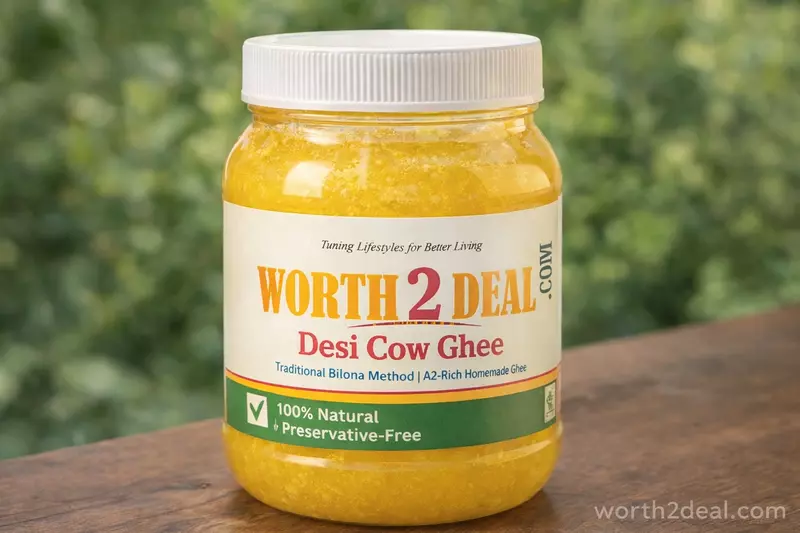


Buy Pure A2 Desi Cow Ghee Online — Bilona Kerala Ghee 500g
Available Offer
Share :
Desi Cow Ghee — also called A2 Ghee, Bilona Ghee, or Pure Homemade Cow Ghee — is clarified butter made from the milk of indigenous Indian cows using the traditional bilona method: the milk is first set into curd, the curd is hand-churned into white butter, and that butter is slow-heated until pure golden ghee separates out. Worth2Deal's Kerala Desi Cow Ghee is made from the milk of grass-fed desi cows using exactly this process — no factory shortcuts, no cream-based processing, no preservatives. Every batch is packed in a food-grade glass jar and shipped free across India. FSSAI Lic. No. 21317233000044.
What Is Desi Cow Ghee?
Desi cow ghee is clarified butterfat produced exclusively from the milk of indigenous Indian cow breeds through the traditional bilona process — a multi-stage fermentation and slow-clarification method that has remained unchanged in Indian households for over 5,000 years.
Stage 2 — Churning : The set curd is hand-churned using a traditional wooden bilona churner at room temperature until white butter separates and rises to the surface. Room-temperature churning is critical — it preserves the probiotic activity and prevents heat damage to the fat-soluble vitamins.
Stage 3 — Clarification : The collected white butter is transferred to a heavy-bottomed vessel and heated on a low, controlled flame. As the temperature rises slowly, water evaporates, milk solids sink and caramelise at the bottom, and pure golden ghee separates cleanly above.
Stage 4 — Straining and Setting : The golden ghee is strained through a fine muslin cloth to remove all milk solids. What remains is pure clarified butterfat — zero lactose, zero casein, rich in butyric acid, fat-soluble vitamins, and natural Omega-3 fatty acids.
This four-stage process takes three to five days per batch and requires 20 to 25 litres of A2 desi cow milk to yield one kilogram of finished ghee. It is the reason authentic bilona ghee costs what it costs — and why it delivers what commercial cream-based ghee cannot.
Worth2Deal's desi cow ghee is made using exactly this process — from Kerala grass-fed desi cows, in small controlled batches, packed in food-grade glass jars. FSSAI Lic. No. 21317233000044.
What Is A2 Milk and Why Does It Matter?
This is the question everyone has after seeing "A2" on a ghee label — and almost no seller explains it clearly. Here it is in plain language.
Cow milk contains a protein called beta-casein. There are two types — A1 and A2. The type your cow produces depends entirely on the breed of the cow.
A1 milk comes from foreign hybrid breeds — Holstein, Jersey, and most commercial dairy cows. When A1 beta-casein is digested, it releases a small protein fragment called BCM-7 (beta-casomorphin-7). Research has linked BCM-7 to bloating, digestive discomfort, and inflammation in sensitive individuals.
A2 milk comes from indigenous Indian cow breeds — Gir, Sahiwal, Red Sindhi, and local desi cows. A2 milk does not produce BCM-7 during digestion. It is significantly gentler on the gut, especially for people who experience discomfort with regular dairy.
Worth2Deal's ghee is made from the milk of indigenous Kerala desi cows — naturally A2 milk producing breeds. This is not a marketing label. It is a breed characteristic.
Key Takeaway: A2 ghee = made from desi Indian cow milk = easier to digest = what Indian households have been using for centuries before hybrid dairy breeds arrived.
Traditional Bilona Method vs Factory Ghee — The Real Difference
Most ghee sold in supermarkets — including by major Indian dairy brands — is not made by the bilona method. It is made by a faster, cheaper commercial process called the cream method:
- Cream is separated from milk by centrifuge
- Cream is directly churned into butter by machine
- Butter is melted at high heat to produce ghee
This process takes hours. Bilona takes days. And that time difference matters enormously for what ends up in the jar.
| Bilona Ghee | Factory / Cream Method Ghee | |
|---|---|---|
| Starting point | Whole milk set into curd | Centrifuge-separated cream |
| Churning | Hand-churned at room temperature | Machine-churned |
| Heat level | Slow, low heat | High industrial heat |
| Time | 3–5 days total process | Same day production |
| Probiotic activity | Natural lacto-fermentation from curd stage | None — no fermentation step |
| Aroma | Deep, rich, nutty | Mild, flat |
| Colour | Deep golden-yellow | Pale yellow |
| Texture | Natural granular (danedar) in cold | Smooth, uniform |
| Price | Higher — reflects real milk cost | Lower — reflects industrial process |
Why does the curd step matter? When milk is set into curd before churning, beneficial bacteria ferment the milk proteins and fats. This pre-digestion makes the resulting ghee easier to absorb. The slow heating at low temperature preserves heat-sensitive vitamins and the natural butyric acid content. High industrial heat destroys both.
If your ghee costs ₹200 for 500g, it was not made by the bilona method. It takes 20–25 litres of A2 milk to produce 1 kg of bilona ghee. Do the arithmetic — the raw milk alone costs more than the cheap ghee on the shelf.
Desi Cow Ghee Nutrition — What Is Actually Inside
| Nutrient | Per 1 tablespoon (15g) | What It Does |
|---|---|---|
| Calories | 135 kcal | High energy — clean fuel for the body |
| Total Fat | 15g | Natural fat — not hydrogenated |
| Saturated Fat | 9g | Short and medium chain — easily digested |
| Butyric Acid | ~1.2g | Feeds gut lining cells, reduces inflammation |
| Vitamin A | ~438 IU | Eye health, skin, immunity |
| Vitamin E | ~0.4mg | Antioxidant, skin protection |
| Vitamin K2 | ~1.5mcg | Bone health, calcium metabolism |
| Omega-3 fatty acids | Present | Anti-inflammatory |
| Lactose | Zero | Safe for most lactose-intolerant people |
| Casein | Zero | Safe for casein-sensitive people |
| Cholesterol | ~33mg | Natural dietary cholesterol |
The butyric acid is the most important nutritional point. Butyric acid is a short-chain fatty acid that directly feeds the cells lining your gut wall. Healthy gut lining = better digestion, stronger immunity, and reduced inflammation. Traditional Ayurveda identified ghee as a digestive food thousands of years before scientists isolated butyric acid and confirmed why.
10 Benefits of Pure Desi Cow Ghee
1. Supports Digestion : The butyric acid in desi cow ghee directly nourishes gut lining cells, stimulates digestive enzyme secretion, and supports healthy gut motility. Ayurveda has recommended ghee as a digestive aid for thousands of years — modern nutrition science confirmed the mechanism.
2. High Smoke Point — Safe for Indian Cooking : Pure bilona desi cow ghee has a smoke point of approximately 250°C — significantly higher than butter (175°C), cold-pressed coconut oil (177°C), and most refined oils. At high cooking temperatures where other fats break down and produce harmful free radicals, pure ghee remains stable. It is the safest fat for Indian high-heat cooking.
3. Suitable for Lactose-Intolerant People : The bilona process removes virtually all lactose and casein from the ghee during clarification. The milk solids — where lactose and casein concentrate — are filtered out. Most people with lactose intolerance can consume pure bilona ghee without any reaction. (Always check with your doctor for confirmed lactose intolerance.)
4. Supports Brain Function : Ghee is rich in fat-soluble vitamins A, D, E, and K, which require dietary fat for absorption. The brain is approximately 60% fat by dry weight — dietary fat quality directly affects cognitive function. Omega-3 fatty acids naturally present in grass-fed cow ghee support neurological health.
5. Natural Energy Source : The medium and short-chain fatty acids in desi cow ghee are metabolised differently from long-chain fats — they go directly to the liver and are converted to energy rapidly. This makes ghee a clean, fast-burning energy source, particularly useful before physical activity or in the morning.
6. Good for Skin and Hair : Applied topically, desi cow ghee has been used in Kerala and across India as a natural moisturiser, wound healer, and lip balm. The fat-soluble vitamins A and E, combined with natural emollients in the ghee, make it one of the oldest and most effective natural skincare ingredients.
7. Safe for Children and Infants : In traditional Indian households, a small amount of ghee is one of the first foods introduced to weaning babies — and for good reason. The fat profile of desi cow ghee closely mirrors the fat composition of breast milk. It provides dense nutrition in a small, easily digestible quantity.
8. Supports Weight Management — Not Weight Gain : This surprises people. Pure ghee contains medium-chain triglycerides (MCTs) that are burned for energy rather than stored as body fat. The butyric acid content improves metabolic efficiency. Eaten in appropriate quantities — 1 to 2 teaspoons daily — desi cow ghee supports weight management rather than impeding it.
9. Anti-Inflammatory Properties : Butyric acid actively reduces inflammatory signals in the gut and systemic inflammation throughout the body. The Omega-3 content of grass-fed cow ghee adds additional anti-inflammatory effect. Regular moderate consumption is associated with reduced markers of chronic inflammation.
10. Ayurvedic Classification — Tridoshic : Ayurveda classifies pure desi cow ghee as tridoshic — it balances Vata, Pitta, and Kapha simultaneously. This means it is suitable for all body types and all seasons. It is the most universally recommended food fat in Ayurvedic medicine and one of the very few foods with no Ayurvedic contraindication in moderate use.
Note: All health benefit information above is for general wellness and educational purposes only. Consult your doctor before making significant dietary changes, especially if you are managing a specific health condition.
How to Check the Purity of Desi Cow Ghee at Home
Before we tell you about our ghee — here is how to verify the purity of any ghee you buy, from any seller.
Test 1 — The Heat Test (Most Reliable) : Place a small amount of ghee in a metal spoon and heat over a flame for 30 seconds. Pure ghee melts immediately, turns clear golden, and does not splutter. Adulterated ghee with added vegetable fat will splutter, foam, or turn dark more quickly.
Test 2 — The Palm Test : Place a teaspoon of ghee on your palm. Pure ghee melts immediately from body heat alone — within 5 to 8 seconds. If the ghee stays solid or takes more than 15 seconds to melt, it likely contains added starch, vegetable fat, or animal tallow.
Test 3 — The Colour Test : Pure desi cow ghee from grass-fed cows is deep golden-yellow, not pale yellow or white. The yellow colour comes from beta-carotene in the grass the cow eats. Factory ghee from grain-fed cows is pale because the cows eat minimal beta-carotene-rich grass.
Test 4 — The Granular Test : When stored at room temperature in a cool environment (below 20°C), pure bilona ghee develops natural granular (danedar) texture — small visible crystals or grains throughout the jar. This granularity is caused by slow crystallisation of the natural fat. Smooth, uniform ghee at all temperatures often indicates processing with vegetable fat which does not crystallise.
Test 5 — The Smell Test : Pure bilona desi cow ghee has a rich, nutty, slightly caramel aroma — the result of slow, careful heating during preparation. Factory ghee has a flat, mild, sometimes slightly chemical smell. If your ghee smells like neutral vegetable oil, it has likely been adulterated.
How to Use Desi Cow Ghee — Practical Guide
In daily cooking: Add one teaspoon of ghee to cooked rice, dal, or roti just before serving. The ghee melts instantly over hot food and distributes through the dish. It also works as a cooking fat for sautéing vegetables, tempering spices (tadka), and shallow frying. Use in place of refined oil for any Indian cooking application.
The Ayurvedic morning ritual: One teaspoon of pure desi cow ghee in a cup of warm water, taken on an empty stomach in the morning. Traditional Ayurvedic practitioners recommend this for gut health, joint lubrication, and skin clarity. The warm water helps the ghee absorb quickly and coat the digestive tract before the day's first meal.
For children: A small amount mixed into warm milk or applied to chapati. Traditional practice across India since ancient times. Start with a small quantity for infants being introduced to ghee.
For skin: Apply a small amount to dry skin, cracked heels, or chapped lips. Ghee is one of the most effective natural emollients for dry skin conditions.
For hair: Warm a small amount and apply to hair as a pre-wash treatment. Leave for 30–60 minutes before washing. Traditional Kerala households have used ghee and coconut oil as hair conditioning treatments for generations.
How to Store Desi Cow Ghee Correctly
Room temperature — always. Do not refrigerate unless you are in an extremely hot climate (above 38°C regularly). Refrigeration is not needed because the clarification process that creates ghee removes all the water content that causes spoilage. At room temperature, properly made pure ghee lasts 12 months or more.
Always use a dry spoon. Introducing even a small amount of water into the jar accelerates rancidity. Keep a dedicated dry spoon next to the jar and never use a wet spoon.
Keep away from sunlight. Store in a cupboard or pantry away from direct light. UV exposure degrades the fat-soluble vitamins and can cause off-flavours over time.
Granular texture is purity, not spoilage. When the temperature drops below approximately 20°C, pure bilona ghee develops a natural grainy texture. This is the crystallisation of natural fats — it confirms that no vegetable fat or additive is present. The ghee is perfectly fine. It will return to liquid at room temperature.
Who Should Buy Worth2Deal Desi Cow Ghee
- Anyone transitioning from refined oil to a traditional, natural cooking fat
- People with lactose intolerance wanting to include dairy in their diet safely
- Families with young children wanting natural nutrition from the first foods
- People following Ayurvedic diet practices
- Health-conscious buyers who want to know exactly what is in their cooking fat
- Malayali diaspora families across India who want the taste of Kerala cooking
- Anyone who has been buying commercial ghee and wants to taste the real difference
Why Worth2Deal — Specifically
Worth2Deal has been sourcing and selling traditional Kerala food products from Malabar since 2017. Every product on worth2deal.com is chosen because we use it ourselves — not because it fills a category gap in our catalogue.
This ghee is made in small batches. The batch size is limited by how much fresh A2 milk our desi cow source produces, not by how much we want to sell. When a batch runs out, we wait for the next one. We do not blend or extend with commercial ghee.
The glass jar you receive has been filled, sealed, and checked before despatch. The FSSAI number on the jar — Lic. No. 21317233000044 — is our food safety certification and legal accountability.
If you open the jar and it does not smell rich, nutty, and genuinely different from the ghee you have been buying — contact us. That is the only standard we hold ourselves to.
Internal Links
- Buy Kerala Matta Rice — the perfect ghee companion for traditional rice meals: worth2deal.com/buy-kerala-matta-rice-online
- Buy Organic Vadi Matta Rice: worth2deal.com/buy-organic-vadi-matta-rice-online
- Buy Kerala Manga Uppilittathu — traditional salted mango to pair with ghee rice: worth2deal.com/buy-manga-uppilittathu-online-kerala
- Read about traditional Kerala food and cooking: paithrka.com
FAQs
Q: What is desi cow ghee?
A: Desi cow ghee is clarified butter made from the milk of indigenous Indian cow breeds — not hybrid foreign breeds. The milk is set into curd, hand-churned into butter using the bilona method, and the butter is slow-heated until pure golden ghee separates out. It contains zero lactose, zero casein, and is rich in butyric acid, fat-soluble vitamins, and Omega-3 fatty acids. Worth2Deal's desi cow ghee is made from Kerala grass-fed desi cows — FSSAI Lic. No. 21317233000044.
Q: What is the bilona method of making ghee?
A: Bilona method is the traditional Vedic process of making ghee. Step 1: Fresh A2 desi cow milk is boiled and cooled. Step 2: A spoonful of curd is added and the milk is set overnight to form curd. Step 3: The curd is hand-churned using a wooden churner (bilona) until white butter separates and floats to the top. Step 4: The white butter is collected and slow-heated on a low flame until all water evaporates and pure golden ghee remains. This process takes 3 to 5 days total and uses 20 to 25 litres of milk per kilogram of ghee.
Q: What is the difference between bilona ghee and normal ghee?
A: Normal commercial ghee is made by the cream method — cream is centrifuged from milk and directly converted to butter, then melted at high heat. Bilona ghee starts from whole milk, involves a curd fermentation step, hand-churning, and slow low-heat clarification. The curd fermentation step adds probiotic activity and pre-digests proteins. The slow low heat preserves butyric acid and fat-soluble vitamins that high industrial heat destroys. Bilona ghee has a richer aroma, deeper colour, granular texture, and measurably different nutritional profile compared to commercial cream-based ghee.
Q: What is the difference between A1 and A2 desi cow ghee?
A: The difference is in the type of beta-casein protein in the milk. A1 milk from hybrid cows produces BCM-7 during digestion — a protein fragment linked to bloating and gut discomfort. A2 milk from indigenous desi cows does not produce BCM-7. A2 ghee is made from desi Indian cow breeds and is significantly gentler on digestion. Worth2Deal's ghee comes from Kerala desi cows — naturally A2 milk producing.
Q: Is desi cow ghee good for lactose intolerant people?
A: Yes — for most people with lactose intolerance. The clarification process that creates ghee removes virtually all lactose and casein, which are concentrated in the milk solids that are filtered out during ghee making. The result is a nearly lactose-free fat. Most people with lactose intolerance can consume pure bilona ghee without reaction. If you have confirmed severe lactose intolerance or dairy allergy, consult your doctor before introducing ghee.
Q: What are the health benefits of desi cow ghee?
A: Pure desi cow ghee is rich in butyric acid (which feeds gut lining cells and reduces inflammation), fat-soluble vitamins A, D, E, and K, Omega-3 fatty acids, and medium-chain triglycerides. Benefits include improved digestion, a high smoke point safe for Indian cooking, support for brain function, natural energy, skin nourishment, and Ayurvedic tridoshic classification — meaning it is suitable for all body types. Always consume in moderation and consult a doctor for specific health conditions.
Q: Can I eat desi cow ghee on an empty stomach in the morning?
A: Yes — this is a traditional Ayurvedic practice. One teaspoon of pure desi cow ghee in warm water on an empty stomach is used to support digestion, gut health, joint lubrication, and skin health. The warm water helps the ghee absorb quickly and coat the digestive tract before the first meal. Start with half a teaspoon and increase gradually.
Q: How much desi cow ghee should I eat per day?
A: The traditional Ayurvedic recommendation is 1 to 2 teaspoons (5–10g) per day for adults. This quantity provides meaningful nutritional benefit without excessive caloric addition. Athletes and people doing heavy physical work can safely consume up to 2 tablespoons daily. Children above 6 months can have a small amount mixed into food. Consult a doctor for specific quantities if you have cardiovascular conditions.
Q: Does eating desi cow ghee increase weight?
A: Desi cow ghee eaten in appropriate quantities (1–2 teaspoons daily) does not cause weight gain for most people. The medium-chain triglycerides (MCTs) in ghee are metabolised for energy rather than stored as body fat. The butyric acid supports metabolic efficiency. Research on traditional Indian diets where ghee is consumed daily does not associate moderate ghee consumption with weight gain. Consuming ghee in large quantities along with high-calorie diets can contribute to weight gain — the same is true of any calorie-dense food.
Q: What is the smoke point of desi cow ghee?
A: Pure bilona desi cow ghee has a smoke point of approximately 250°C. This makes it one of the most stable cooking fats available for high-heat Indian cooking including deep frying, stir frying, and tempering. For comparison: butter smokes at 175°C, cold-pressed coconut oil at 177°C, and most refined vegetable oils at 200–230°C. At temperatures above the smoke point, fats break down and produce harmful compounds. Pure ghee's high smoke point means it is stable for virtually all Indian cooking applications.
Q: How do I check if my desi cow ghee is pure?
A: Five home tests: (1) Heat test — pure ghee melts clear and does not splutter. (2) Palm test — pure ghee melts in your hand within 5–8 seconds from body heat. (3) Colour — pure grass-fed cow ghee is deep golden-yellow, not pale. (4) Granular texture in cold — natural fat crystallisation confirms no vegetable fat added. (5) Aroma — pure bilona ghee has a rich, nutty, caramel smell. Flat, oily, or chemical smell indicates adulteration.
Q: Why is pure desi cow ghee so expensive?
A: Because making it properly costs more than most people realise. It takes 20 to 25 litres of A2 desi cow milk to produce 1 kilogram of bilona ghee. A2 milk from desi cows costs more than commercial hybrid cow milk. The bilona process takes 3 to 5 days and requires hand-churning — not machines. The yield is low. If a 500g jar of "bilona A2 ghee" costs ₹200–₹300, it is not bilona ghee made from A2 milk. Worth2Deal's pricing reflects the actual cost of making genuine bilona ghee from Kerala desi cows.
Q: Why does my desi cow ghee become grainy or solid?
A: Granular (danedar) texture is a sign of purity — not spoilage. When pure bilona ghee cools below approximately 20°C, the natural fats crystallise and form visible grains throughout the jar. This crystallisation does not occur in adulterated ghee because the added vegetable fats do not crystallise the same way. Your ghee will return to liquid at room temperature. You can use it in either state — granular or liquid — it makes no difference to cooking.
Q: Can I give desi cow ghee to my baby?
A: Yes — ghee is one of the recommended first foods for weaning babies in Indian tradition and is supported by paediatric nutritionists for infants above 6 months when solid foods are introduced. A small amount (one quarter to half a teaspoon) mixed into rice or dal provides dense nutrition in an easily digestible form. Consult your paediatrician for specific guidance on quantities and timing for your child.
Q: How should I store desi cow ghee to keep it fresh?
A: Store at room temperature in the glass jar provided, away from direct sunlight. Always use a dry spoon — even one drop of water introduced into the jar accelerates rancidity. Do not refrigerate — it is not needed and causes unnecessary temperature cycling. Properly stored pure ghee lasts 12 months without refrigeration. If stored in a very hot location (above 38°C consistently), refrigeration is acceptable — expect the ghee to solidify completely but remain safe.
Q: Can desi cow ghee be used for skin and hair?
A: Yes. Pure ghee has been used in Kerala and across India as a natural moisturiser, wound healer, chapped lip remedy, and hair conditioning treatment for centuries. The fat-soluble vitamins A and E provide antioxidant and moisturising properties. Apply a small amount to dry skin, cracked heels, or lips. For hair, warm slightly and apply as a pre-wash treatment 30–60 minutes before shampooing. These are traditional wellness uses — consult a dermatologist for specific skin conditions.
Q: Is desi cow ghee good for digestion?
A: Yes. Butyric acid — the key short-chain fatty acid in desi cow ghee — directly nourishes the cells lining the gut wall, supports healthy bowel movement, and reduces gut inflammation. Ayurveda has classified ghee as a digestive food (deepana — stimulates digestive fire) for thousands of years. Modern gut health research on butyric acid confirms this traditional understanding. One teaspoon with meals is the standard recommendation for digestive support.
Q: Can I use desi cow ghee for deep frying?
A: Yes — ghee's smoke point of approximately 250°C makes it suitable for deep frying. Traditional Indian sweets like halwa, lapsi, and ladoo are commonly made by frying in ghee. The stability of ghee at high temperatures means fewer harmful compounds are produced during frying compared to many refined oils. However, ghee used for frying should not be reused multiple times as repeated heating degrades the fat quality over time.
Q: Which cow breed gives the best ghee?
A: Indigenous Indian breeds — Gir, Sahiwal, Red Sindhi, and local desi varieties — produce naturally A2 milk and make the best bilona ghee. These breeds have a distinctive hump (Bos indicus) and are adapted to Indian climate and grazing conditions. Worth2Deal's ghee is sourced from local Kerala desi cow breeds — naturally A2 milk producing, grass-fed in Kerala's climate. The deep golden colour of the ghee comes directly from the beta-carotene in the grass these cows eat.
Q: Where can I buy pure A2 desi cow ghee online in India?
A: Worth2Deal (worth2deal.com) sells authentic Kerala bilona A2 desi cow ghee — 500g glass jar, grass-fed desi cows, traditional bilona process, preservative-free, FSSAI Lic. No. 21317233000044, free pan-India shipping. Available for delivery across Mumbai, Delhi, Bangalore, Chennai, Hyderabad, Pune, Kochi, Kozhikode, Thrissur, Ahmedabad, Kolkata, Jaipur, Lucknow, and all major cities. When buying from any seller, verify: FSSAI number on label, glass (not plastic) packaging, deep golden colour, stated A2 desi cow source, and price that reflects the actual cost of genuine production.
NAP BLOCK
Sold by: Worth2Deal 7/330 A, Shanthi Nagar, Kokkur, Malappuram, Kerala — 679591 Email: worth2deal.com@gmail.com | Phone: +91 9846294242 | WhatsApp: +91 79071 68550 Website: www.worth2deal.com FSSAI Lic. No. 21317233000044
Worth2Deal Pure A2 Desi Cow Ghee is available for delivery across India — Mumbai, Delhi, Bangalore, Chennai, Hyderabad, Pune, Kolkata, Ahmedabad, Kochi, Thiruvananthapuram, Kozhikode, Thrissur, Mysore, Coimbatore, Jaipur, Lucknow, Surat, Bhopal, Indore, Patna, Nagpur, Vadodara, and all major cities and Tier-2 towns. Free shipping on all orders.