

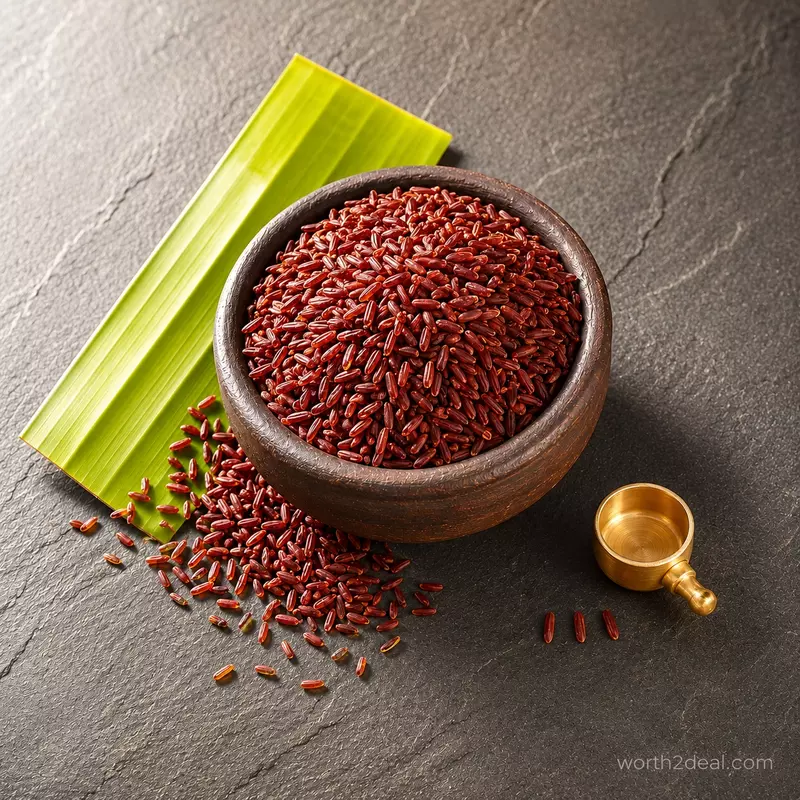


Buy Organic Rakthashali Rice Online — Kerala's Ancient Ayurvedic Red Rice, Rich in Iron and Antioxidants | Worth2Deal
Available Offer
Share :
What Is Rakthashali Rice?
Rakthashali Rice is one of the rarest and most ancient red rice varieties in the world — native to Kerala and documented in Ayurvedic texts over 2,000 years old.
The name says it all: "Raktha" means blood-red in Sanskrit, "Shali" means rice. This is literally the Red Blood Rice of Kerala — named for its deep crimson grain and its documented Ayurvedic role in building blood, strengthening the body, and healing the gut.
The Charaka Samhita — Ayurveda's most authoritative classical text — ranks Rakthashali as the finest among all rice varieties (Shali Dhanya), superior even to other medicinal rices for its cooling, nourishing, and tridosha-balancing properties.
Worth2Deal sources genuine organic Rakthashali Rice from traditional Kerala farming communities — bran intact, unpolished, chemical-free, and exactly as it has been cultivated for centuries across Malabar.
Why Is Rakthashali Rice So Special?
Think of it this way. White rice is to Rakthashali what tap water is to coconut water — technically the same category, completely different in what it does for your body.
Here is what makes Rakthashali Rice genuinely extraordinary:
- Ancient GI-linked origin — grows only in specific Kerala soil conditions; cannot be replicated elsewhere
- Deepest red bran of any Kerala rice — the crimson pericarp layer is packed with anthocyanins, the same antioxidant family found in blueberries and pomegranates
- Classified as tridoshic in Ayurveda — meaning it balances Vata, Pitta, and Kapha simultaneously, which almost no other food achieves
- Documented in Charaka Samhita as the best rice for recovery from illness, weakness, and anaemia
- Naturally cooling — suited to Kerala's hot climate and to people with Pitta imbalance
- Not commercially cultivated at scale — grown in small traditional plots, which is why authentic Rakthashali is genuinely rare and why fakes exist in the market
Rakthashali Rice Nutrition — What Is Actually Inside
| Nutrient | Per 100g Cooked | Why It Matters |
|---|---|---|
| Iron | 3.5–5mg | Builds haemoglobin, fights anaemia naturally |
| Anthocyanins | High | Powerful antioxidants — reduce oxidative stress |
| Dietary Fibre | 3.5g | Supports digestion, gut health, satiety |
| Glycemic Index | ~50–55 (Low) | Safe for diabetics — slow glucose release |
| Magnesium | ~45mg | Heart health, nerve function, bone density |
| Vitamin B Complex | B1, B2, B3, B6 | Energy metabolism, nerve health |
| Calcium | Higher than white rice | Bone strength |
| Zinc | Present | Immunity, wound healing |
| Calories | ~130–140 kcal | Lower than white rice per serving |
Every nutrient above is retained because Worth2Deal's Rakthashali Rice is unpolished and bran-intact. Polishing strips the bran — and with it, most of these nutrients. You are not just buying rice. You are buying 2,000 years of nutritional wisdom in intact form.
10 Health Benefits of Rakthashali Rice
1. Builds Blood and Fights Anaemia
Rakthashali is one of the richest plant sources of bioavailable iron among rice varieties. Traditional Ayurvedic practice used Rakthashali kanji specifically for post-illness recovery and anaemia. The iron content, combined with the rice's natural Vitamin C precursors, supports haemoglobin production more effectively than white rice.
2. Controls Blood Sugar — Safe for Diabetics
With a low glycemic index of approximately 50–55, Rakthashali releases glucose slowly and steadily into the bloodstream. No spike. No crash. For people managing Type 2 diabetes or pre-diabetes, Rakthashali is one of the most practical traditional rice options available — it does not require abandoning rice, only switching to the right one.
3. Supports Weight Management
Lower calories than white rice (~130–140 kcal per 100g cooked). Higher fibre that keeps you full longer. Slower carbohydrate digestion that prevents cravings. These three properties together make Rakthashali a rice you can eat daily while actively managing your weight — without feeling deprived.
4. Powerful Antioxidant Protection
The deep red colour of Rakthashali is not decoration — it is anthocyanins, the same antioxidant pigments in blueberries, red grapes, and pomegranates. These molecules fight free radicals, reduce chronic inflammation, and are linked in research to lower risk of cardiovascular disease. Eat the colour. The colour is the medicine.
5. Balances All Three Doshas (Tridoshic)
Ayurveda classifies most foods as beneficial for one or two doshas. Rakthashali is classified as tridoshic — it balances Vata (movement), Pitta (fire/heat), and Kapha (water/earth) simultaneously. This is extraordinarily rare in any single food and explains why it was the rice of choice in classical Ayurvedic healing protocols.
6. Supports Skin Health
The anthocyanin antioxidants in Rakthashali's red bran are deeply anti-inflammatory and have been traditionally linked to clearer skin, reduced acne, and slower skin ageing. Rakthashali rice water — the liquid left after soaking or boiling — has been used in Kerala as a natural skin toner for generations.
7. Strengthens the Digestive System
The dietary fibre (3.5g per 100g) in Rakthashali promotes healthy gut motility, feeds beneficial gut bacteria (prebiotic effect), and supports regular bowel movement. The Charaka Samhita specifically notes Rakthashali as easy to digest compared to other rice varieties — an important point for people with sensitive digestion.
8. Post-Illness and Recovery Nutrition
Rakthashali kanji (thin rice porridge made from Rakthashali) is the classic Ayurvedic recovery meal after surgery, fever, or prolonged illness. It is gentle, highly digestible, iron-rich, and deeply nourishing — delivering micronutrients exactly when the body needs them most.
9. Heart Health Support
Magnesium (~45mg per 100g) supports cardiac muscle function. Dietary fibre helps reduce LDL cholesterol. Anthocyanins reduce arterial inflammation. These three properties together make Rakthashali a genuinely heart-supportive daily grain.
10. Natural Cooling Food
Kerala's Ayurvedic tradition classifies Rakthashali as having a naturally cooling (sheeta virya) energy — reducing internal heat, supporting people who experience frequent hot flashes, acidity, skin inflammation, or heat-related fatigue. Eating it regularly during Kerala's hot season is as much tradition as medicine.
Rakthashali vs Other Rice Varieties
| Property | Rakthashali | Matta Rice | Brown Rice | White Rice |
|---|---|---|---|---|
| GI | ~50–55 | ~55 | ~55 | ~72 |
| Iron | Very High | Moderate | Moderate | Low |
| Anthocyanins | Very High | Moderate | Low | None |
| Ayurvedic Rank | Highest (Charaka) | Traditional | Not classified | Not classified |
| Rarity | Very rare | Common | Common | Very common |
| Medicinal use | Documented | Limited | Limited | None |
| Taste | Earthy, slightly nutty | Earthy | Mild | Neutral |
| Best for | Recovery, anaemia, diabetes | Daily meals, pazhankanji | General health | None specific |
How to Cook Rakthashali Rice
Pressure Cooker Method (recommended):
- Soak 1 cup of Rakthashali Rice for 4–6 hours (minimum) — longer than regular Matta Rice because of the denser bran
- Drain and add 3 cups of fresh water
- Pressure cook on medium flame for 5–6 whistles
- Allow natural pressure release — do not open forcibly
- Fluff gently and serve
Open Pot / Traditional Method:
- Soak for 4–6 hours
- Use 1:4 ratio (rice to water)
- Bring to a rolling boil, reduce to medium-low
- Cook uncovered for 30–35 minutes
- Drain excess water (this is your Rakthashali rice water — do not discard)
- Cover and steam on low heat for 5 more minutes
For Rakthashali Kanji (Ayurvedic healing porridge):
- Use 1 cup rice to 6–8 cups water
- Cook uncovered until grains fully break down into a thick gruel
- Do not drain — the liquid is the medicine
- Add a pinch of salt and a piece of fresh ginger
- Serve warm — traditionally for post-illness recovery or morning gut reset
Cooking Note: Rakthashali requires more soaking and more cooking time than regular Matta Rice. The dense bran needs time to absorb water. Do not skip the soak. The 4-hour minimum soak is not optional — it is what unlocks the texture and nutrition. First-time cooks: your first batch may be slightly firmer than expected. By the third time, you will have it perfect.
How to Identify Authentic Rakthashali Rice
Authentic Rakthashali is rare. Fakes are common — often just ordinary red-dyed rice or inferior varieties passed off as Rakthashali. Here is how to verify:
The Water Test:
Soak 10 grains in cold water for 60 seconds. Authentic Rakthashali releases a very deep, naturally rich red tinge — deeper and more intense than regular Matta Rice. Dyed rice bleeds bright artificial colour almost instantly and the colour is unnaturally uniform.
The Grain Shape:
Genuine Rakthashali grains are short to medium length, slightly plump, with a very deep crimson-red bran — almost maroon in colour. Significantly darker than regular red Matta Rice.
The Smell:
Authentic Rakthashali has a distinctive earthy, slightly medicinal, nutty aroma even when raw — different from the milder smell of regular Matta Rice.
FSSAI Verification:
Any genuine food product sold in India must carry a valid FSSAI number. Worth2Deal's is FSSAI Lic. No. 21317233000044 — on every pack.
Rakthashali Rice Water — Do Not Throw It Away
The deep red water left after soaking or cooking Rakthashali is not waste — it is one of the richest natural anthocyanin solutions you will ever have in your kitchen.
Traditional Kerala and Ayurvedic uses for Rakthashali rice water:
- Skin toner — apply with cotton to face; reduces redness, tightens pores, brightens over time
- Hair rinse — rinse hair after washing; traditional conditioning treatment for stronger, shinier hair
- Digestive drink — warm the water, add a pinch of rock salt; supports gut motility and hydration
- Recovery drink — for post-illness hydration; rich in electrolytes and water-soluble B vitamins
The science behind it: Rakthashali rice water contains dissolved anthocyanins, B vitamins, starch fractions, and minerals — all in easily absorbable form. It is not a cosmetic marketing claim. It is 2,000 years of documented traditional use now being confirmed by modern research.
Who Should Eat Rakthashali Rice?
- People managing diabetes or pre-diabetes — low GI, steady glucose release
- People with anaemia or low haemoglobin — highest iron content of any traditional Kerala rice
- People in post-illness or post-surgery recovery — the classical Ayurvedic recovery food
- People managing weight — lower calories, high satiety, prevents cravings
- People with skin conditions or inflammation — anti-inflammatory anthocyanins
- People interested in Ayurvedic diet and tridoshic balance
- Malayali diaspora families seeking authentic taste and medicinal heritage
- Anyone switching from white rice to a genuinely healthier alternative
- Buy Kerala Matta Rice (Vadi & Unda varieties): worth2deal.com/buy-kerala-matta-rice-online
- Buy Organic Vadi Matta Rice: worth2deal.com/buy-organic-vadi-matta-rice-online
- Buy Organic Unda Matta Rice: worth2deal.com/buy-organic-unda-matta-rice-online
- Read about Kerala's traditional medicinal foods: paithrka.com
FAQs
Q: What is Rakthashali rice?
A: Rakthashali Rice (രക്തശാലി അരി) is an ancient red rice variety native to Kerala, documented in Ayurveda's Charaka Samhita as the finest cereal grain for health and healing. The name means "blood-red rice" in Sanskrit — a reference to its deep crimson bran and its Ayurvedic role in building blood and restoring strength. It is significantly rarer than regular Matta Rice and is classified as tridoshic, meaning it balances all three doshas. Worth2Deal sources authentic organic Rakthashali Rice from traditional Kerala farming communities — FSSAI Lic. No. 21317233000044.
Q: What are the health benefits of Rakthashali rice?
A: Rakthashali rice benefits include: very high iron content that builds haemoglobin and fights anaemia; a low glycemic index (~50–55) that controls blood sugar; powerful anthocyanin antioxidants that reduce inflammation and protect the heart; high dietary fibre (3.5g/100g) that supports digestion and weight management; tridoshic Ayurvedic classification that balances Vata, Pitta, and Kapha; natural cooling properties suited to Kerala's climate; and documented use in post-illness recovery. The Charaka Samhita ranks it the best rice for overall health among all Shali Dhanya (rice varieties).
Q: What is Rakthashali rice price per kg in India?
A: Rakthashali Rice is genuinely rare — small-batch, traditionally cultivated, and not commercially grown at scale. This makes it more expensive than regular Matta Rice or white rice. Authentic organic Rakthashali Rice from traceable Kerala sources is priced between ₹250–₹400 per kg depending on the seller, certification, and pack size. Worth2Deal offers fairly priced authentic Rakthashali Rice with free pan-India shipping and FSSAI Lic. No. 21317233000044. Check the current price on our product page.
Q: Is Rakthashali rice good for diabetics?
A: Yes — it is one of the best traditional rice options for people managing diabetes. Rakthashali has a low glycemic index of approximately 50–55, which means it releases glucose slowly and steadily without the sharp blood sugar spike that white rice (GI ~72) causes. The high dietary fibre in the intact bran further slows carbohydrate absorption. Traditional Ayurvedic practitioners have recommended Rakthashali for Pitta-related metabolic conditions for centuries. Always consult your doctor for personalised dietary advice for diabetes management.
Q: What is the glycemic index of Rakthashali rice?
A: The glycemic index of Rakthashali Rice is approximately 50–55, placing it firmly in the low GI category. Foods with a GI below 55 are considered low GI — they digest slowly, release glucose gradually, and do not cause insulin spikes. White rice sits at GI ~72 (medium-high). Even regular Matta Rice is ~55. Rakthashali's lower GI is due to its very dense, intact bran layer and its unique starch structure — both of which slow digestion naturally.
Q: Why is Rakthashali rice used in Ayurvedic medicine?
A: Rakthashali has been classified in the Charaka Samhita — Ayurveda's foundational medical text — as the best among all rice varieties (Shali Dhanya) for its therapeutic properties. Ayurveda values it for three primary reasons: it is tridoshic (balancing for all three doshas), it has a naturally cooling (sheeta virya) energy that reduces Pitta-related conditions, and it is highly digestible even for weakened or recovering patients. It is used classically in Ayurvedic treatment for anaemia, fever recovery, weakness, and digestive complaints.
Q: Why is Rakthashali rice so rare and expensive?
A: Three reasons. First, Rakthashali is a traditional cultivar that grows only in specific Kerala soil and climate conditions — it cannot be mass-produced in other states or substituted with hybrid varieties. Second, it has a lower yield than modern commercial rice varieties, making large-scale cultivation economically challenging for farmers. Third, demand has grown significantly as Ayurvedic and health-conscious consumers rediscover it — while supply remains limited. This genuine scarcity is also why fake and mislabelled Rakthashali is common in the market. Always buy from FSSAI-certified sources with traceable Kerala origin.
Q: How to make Rakthashali kanji for health and recovery?
A: Rakthashali kanji is the classic Ayurvedic healing porridge. To make it: (1) Soak 1 cup Rakthashali Rice for 4 hours. (2) Add 6–8 cups of water. (3) Cook in an open pot on medium heat until the grains fully break down into a thick, smooth gruel — approximately 35–40 minutes. (4) Do not drain the water — it contains dissolved iron, anthocyanins, and B vitamins. (5) Add a pinch of rock salt and fresh ginger. (6) Serve warm. Traditional uses: post-illness recovery, post-surgery nutrition, fever management, anaemia treatment, and daily morning gut reset. A simpler version with less water and shorter cooking time makes a thicker porridge for regular breakfast use.
Q: How to cook Rakthashali rice perfectly?
A: Soak 1 cup Rakthashali Rice for a minimum of 4 hours — 6 hours is better. Do not skip soaking. Add 3 cups of fresh water. Pressure cook on medium flame for 5–6 whistles. Allow natural pressure release before opening. Fluff gently. The grains will be firm and slightly chewy — this is correct. If you want softer grains, add an extra half cup of water and 1–2 additional whistles. Rakthashali takes longer to cook than regular Matta Rice because of its denser bran. First batch may be firmer than expected — adjust water and whistles from the second batch onwards.
Q: Should I soak Rakthashali rice before cooking?
A: Yes — and this is not optional. Soak for a minimum of 4 hours, ideally 6 hours. Rakthashali's bran is significantly denser and more intact than regular Matta Rice. Without soaking, the outer bran does not soften sufficiently, resulting in unevenly cooked, hard-centred grains even after 6 whistles. The soak also begins the process of breaking down phytic acid in the bran — which increases mineral bioavailability. In traditional Ayurvedic preparation, Rakthashali was soaked overnight before cooking. A 4–6 hour daytime soak is the practical modern equivalent.
Q: What is the difference between Rakthashali and Navara rice?
A: Both are ancient Kerala medicinal rice varieties documented in Ayurveda, but they are distinct in profile. Rakthashali is a larger-grained, deep-red rice classified primarily for blood building, anaemia, and tridoshic balance. Navara is a much smaller, yellow-red grain classified specifically for Panchakarma therapy, muscle strength, and neurological support — it is the rice used in Navarakizhi (the Ayurvedic massage treatment). Navara is even rarer and more expensive than Rakthashali. For everyday dietary use as a health rice, Rakthashali is the practical choice. For specific Ayurvedic therapeutic treatment, Navara is prescribed by practitioners.
Q: Is Rakthashali rice healthier than Basmati rice?
A: In terms of nutritional density and medicinal value — yes, significantly. Basmati has a slightly lower GI than white rice (~57–63) but it is polished, has minimal iron, no anthocyanins, and no documented Ayurvedic therapeutic classification. Rakthashali has a lower GI (~50–55), very high iron, powerful anthocyanin antioxidants, 3.5g dietary fibre per 100g, and 2,000 years of documented Ayurvedic medicinal use. For daily health eating, Rakthashali outperforms Basmati in every nutritional category that matters. Basmati wins only on flavour neutrality and cooking convenience.
Q: Is Rakthashali rice good for weight loss?
A: Yes, for three practical reasons. First, it is lower in calories (~130–140 kcal per 100g cooked) compared to white rice (~200 kcal). Second, its very high dietary fibre content triggers satiety hormones, keeping you full significantly longer after a meal. Third, its low GI (~50–55) prevents the blood sugar crash that triggers cravings and overeating after a white rice meal. Rakthashali does not require you to give up rice for weight management — it requires switching to the right rice.
Q: Is Rakthashali rice good for boosting haemoglobin?
A: Yes — this is one of its most documented traditional benefits. Rakthashali has the highest iron content of any traditional Kerala rice variety, with approximately 3.5–5mg per 100g. Traditional Ayurvedic practitioners prescribed Rakthashali kanji specifically for anaemia, post-partum blood loss, and general blood-building. The anthocyanin pigments in the red bran are also associated with improved blood health. For best iron absorption from Rakthashali, eat it alongside a source of Vitamin C — a squeeze of lime, raw mango pickle, or a tomato-based curry significantly increases iron bioavailability.
Q: Can I cook Rakthashali rice in a pressure cooker?
A: Yes — pressure cooker is actually the recommended method for Rakthashali because of its dense bran. Use 3 cups of water per cup of rice (after soaking for 4–6 hours) and cook on medium flame for 5–6 whistles. Always allow natural pressure release. If using an open pot, use a 1:4 ratio and cook for 30–35 minutes uncovered. The pressure cooker method is faster and produces a more consistent result. The open-pot method is traditional and preserves the rice water — which is rich in dissolved anthocyanins and minerals.
Q: What can I do with Rakthashali rice water?
A: Rakthashali rice water — the deep red liquid from soaking or cooking — is a traditional Ayurvedic and Kerala beauty ingredient. Uses: (1) Skin toner — apply to face with cotton to reduce redness, tighten pores, and even skin tone; (2) Hair rinse — pour over hair after shampooing for natural conditioning; (3) Digestive drink — warm with rock salt for gut health; (4) Recovery hydration — drink warm after illness for electrolytes and B vitamins. The colour of the water comes from anthocyanins — natural antioxidants that are beneficial both internally and topically.
Q: How to identify original Rakthashali rice?
A: Four checks: (1) Water test — soak 10 grains in cold water; authentic Rakthashali releases a very deep, rich natural red colour that is distinctly darker than regular Matta Rice water. Fakes bleed unnaturally bright red immediately. (2) Grain colour — genuine Rakthashali is deep crimson-maroon, almost dark red. Much darker than regular red Matta Rice. (3) Aroma — raw Rakthashali has a distinctive earthy, slightly medicinal smell. (4) FSSAI number on pack — mandatory for all legitimate food products in India. Worth2Deal's is FSSAI Lic. No. 21317233000044.
Q: What are Rakthashali rice's Ayurvedic properties (tridosha)?
A: In classical Ayurveda, Rakthashali is classified as: Rasa (taste) — Madhura (sweet); Guna (quality) — Laghu (light), Snigdha (unctuous); Virya (potency) — Sheeta (cooling); Vipaka (post-digestive effect) — Madhura (sweet); Dosha effect — tridoshic, meaning it pacifies all three doshas (Vata, Pitta, Kapha) simultaneously. The Charaka Samhita places it first among all Shali Dhanya (superior rice varieties). Its cooling potency makes it especially beneficial for Pitta conditions — inflammation, acidity, skin issues, and heat-related fatigue.
Q: Where can I buy organic Rakthashali rice online?
A: Worth2Deal (worth2deal.com) sells authentic organic Rakthashali Rice sourced from traditional Kerala farming communities — bran intact, unpolished, chemical-free, and FSSAI certified (Lic. No. 21317233000044). Available in 500g, 1 kg, and 2 kg packs with free pan-India shipping. When buying from any seller, verify: FSSAI licence number on the pack, stated Kerala origin, unpolished or bran-intact specification, and no artificial colouring claim. The genuine grain should be significantly darker and more crimson than regular red rice.
Q: Where can I buy Rakthashali rice internationally (outside India)?
A: Worth2Deal currently ships pan-India with free delivery. For international shipments to the Middle East, US, UK, or Europe — contact us directly at worth2deal@gmail.com or WhatsApp +91 79071 68550. Worth2Deal has existing Middle East export experience and can advise on the best shipping method for your region. International Malayali diaspora families note: authentic Rakthashali Rice is almost impossible to source outside India — ordering directly from Kerala is the only way to guarantee genuine grain.
NAP BLOCK
Sold by: Worth2Deal 7/330 A, Shanthi Nagar, Kokkur, Malappuram, Kerala — 679591 Email: worth2deal.com@gmail.com | Phone: +91 9846294242 | WhatsApp: +91 79071 68550 Website: www.worth2deal.com FSSAI Lic. No. 21317233000044
Rakthashali Rice is available for delivery across India — Mumbai, Delhi, Bangalore, Chennai, Hyderabad, Pune, Kolkata, Ahmedabad, Kochi, Thiruvananthapuram, Kozhikode, Thrissur, Palakkad, Mysore, Coimbatore, Jaipur, Lucknow, Surat, Indore, Patna, and all major cities and Tier-2 towns. Free shipping on all orders.