

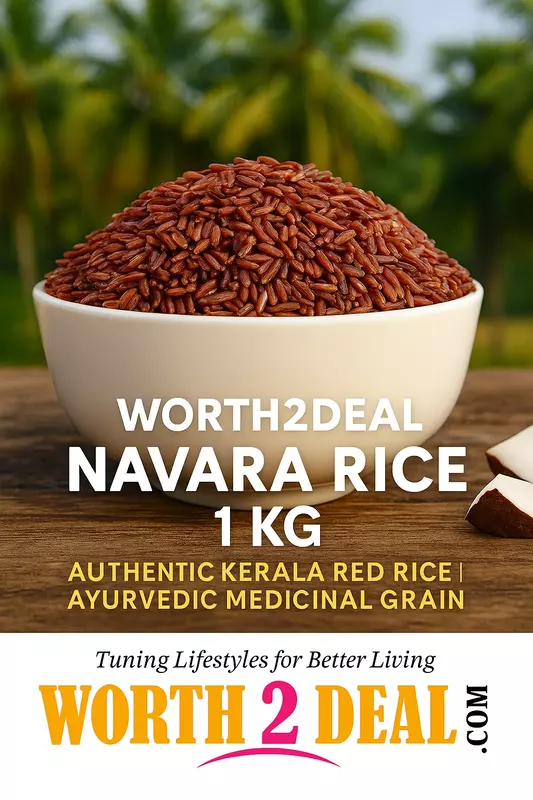


Buy Kerala Navara Rice Online — GI-Tagged Medicinal Grain from the Thrissur Belt
Available Offer
Share :
Kerala Navara Rice (also written Njavara or Navara Ari) is one of India's most celebrated medicinal rice varieties. Holding a Geographical Indication (GI) tag, this ancient grain originates from Kerala's rice-growing heartland and has been documented in Ayurvedic texts for over 2,000 years. Worth2Deal sources its Navara directly from the Thrissur belt — the traditional cultivation zone in Kerala — bringing you the authentic grain, unpolished and naturally sun-dried, packed and shipped free across India under FSSAI Lic. No. 21317233000044.
What Makes Navara Rice Unique
Navara belongs to the Oryza sativa species and is classified as a Shashtika (60-day) rice — one of the fastest-maturing medicinal rice varieties in Ayurveda. Its short, reddish-brown grain is naturally unpolished, retaining the full bran layer which holds iron, antioxidants, and B-vitamins that polished white rice loses during milling. Unlike ordinary Kerala red rice (Matta/Rosematta), Navara is never sold as a commodity grain — it is grown specifically for nutritional and therapeutic purposes, which is why its availability is limited and its price reflects that rarity.
Navara exists in two known ecotypes: the golden-husk variety and the black-husk variety. The grain sold at Worth2Deal is the traditionally cultivated red-bran type from the Thrissur belt.
Navara Rice Health Benefits
Navara is one of the few food grains that Ayurveda explicitly classifies as both food and medicine. Here is why it belongs in your kitchen:
For Diabetics: Navara has a naturally low glycemic index (GI), meaning blood sugar rises slowly and steadily after a meal — unlike polished white rice, which causes spikes. It is one of the safest rice options for Type 2 diabetic patients seeking a traditional, whole-grain alternative.
For Babies & Toddlers: Boiled Navara rice is a traditional first weaning food in Kerala households. Its soft texture when cooked, combined with high iron content and easy digestibility, makes it ideal for infants from 6 months onwards. Navara rice porridge (kanji) cooked in cow's milk is a traditional weight-gain food for underweight babies.
For Pregnant & Lactating Women: Regular consumption of Navara Kanji cooked in cow's milk is a time-honoured practice in Malabar and central Kerala for postpartum recovery. Ayurvedic texts document Navara's role in increasing milk production in lactating mothers and aiding uterine recovery post-delivery.
For Skin Health: Navara rice is rich in antioxidants including gamma-oryzanol and ferulic acid, which protect skin cells from oxidative stress. Ayurvedic practitioners use Navara paste (lepanam) topically to treat psoriasis and skin lesions. Regular dietary consumption is associated with improved complexion — the source of the "Kerala glow" often attributed to traditional rice-based diets.
For Muscle & Nerve Health (Navara Kizhi): Navara is the primary ingredient in Navarakizhi — one of the most revered Panchakarma treatments in Kerala Ayurveda. In this therapy, cooked Navara rice boluses dipped in medicated milk are applied to the body to strengthen muscles, treat rheumatoid arthritis, and support paralysis rehabilitation. This therapeutic use is unique to Navara among all rice varieties.
For Immunity: Navara Kanji (rice gruel) prepared with rock salt and buttermilk is a traditional immunity-building meal consumed during Karkidakam month (monsoon season) in Kerala — a practice that aligns with Karkidaka Kanji traditions. Read more about the healing traditions of monsoon season on our blog: Karkidaka Kanji — Kerala's Ancient Monsoon Healing Porridge at Paithrka.com.
Navara Rice Nutritional Profile (Per 100g, Approximate)
| Nutrient | Navara Rice | Polished White Rice |
|---|---|---|
| Glycemic Index | ~52–55 (Low) | ~72–78 (High) |
| Iron | Higher | Depleted by milling |
| Antioxidants | Rich (bran intact) | Negligible |
| Fibre | 2–3g | <1g |
| Protein | ~7–8g | ~6.5g |
How to Cook Navara Rice
Method 1 — Pressure Cooker (Recommended)
Rinse Navara rice 2–3 times in cold water. Soak for 30 minutes. Use a 1:2.5 water ratio (1 cup rice : 2.5 cups water). Cook on medium flame for 3 whistles. Let pressure release naturally. Navara cooks slightly firmer than regular rice — this is normal and desired for daily consumption.
Method 2 — Navara Kanji (Rice Gruel)
Boil 1 cup Navara rice in 5–6 cups water until very soft. Add a pinch of rock salt. Serve warm. For babies and postpartum recovery, replace water with full-fat cow's milk and simmer on low heat until creamy.
Method 3 — Navara Payasam (Kerala Dessert)
Cook Navara rice in jaggery syrup with coconut milk, cardamom, and ghee. A traditional offering in Kerala temples and a festival dessert.
Do You Need to Soak Navara Rice?
Yes — soaking for a minimum of 30 minutes (ideally 1 hour) before cooking reduces cooking time, improves digestibility, and ensures even softening of the unpolished bran layer.
Navara Rice vs Ordinary Red Rice — Know the Difference
Many sellers pass off ordinary Kerala Matta rice, Rosematta, or generic red rice as "Navara." Here is how to identify authentic Navara:
True Navara grain is shorter and rounder than Matta rice. When cooked, it has a faintly sweet, earthy aroma. It does not fluff or separate like Basmati — it becomes soft and slightly sticky, typical of Shashtika-type medicinal rice. The bran is reddish-brown, not dark purple. Worth2Deal sources only from the Thrissur belt, the GI-designated cultivation zone.
If you want to compare Navara with other Kerala rice varieties in our store, see our Organic Vadi Matta Rice and Palakkadan Unda Matta Rice — both traditional Malabar staples with distinct characteristics from Navara.
Who Should Eat Navara Rice?
Navara rice is recommended for all age groups. It is particularly beneficial for:
Infants from 6 months onwards as a weaning food; diabetic patients seeking a low-GI rice option; pregnant and breastfeeding mothers; elderly individuals with joint pain, muscle weakness, or recovering from illness; anyone with skin conditions such as psoriasis or eczema; and people looking to replace polished white rice with a nutritionally superior traditional grain.
Why Buy Navara Rice from Worth2Deal?
Worth2Deal has been delivering authentic Kerala food products since 2017. We are FSSAI licensed (Lic. No. 21317233000044) and source Navara directly from traditional cultivators in the Thrissur belt — not through intermediaries. Every batch is packed fresh, naturally dried, and shipped free across India. Unlike many sellers who add delivery charges or have minimum order thresholds, we ship your order of even a single 250g pack to any pin code in India at zero extra cost.
Product Details
| Field | Detail |
|---|---|
| Product Name | Kerala Navara Rice (Njavara Rice / Navara Ari) |
| Variety | GI-Tagged Medicinal Rice (Shashtika / 60-day) |
| Source | Thrissur Belt, Kerala |
| Processing | Unpolished, natural sun-dried |
| Available Sizes | 250g / 500g / 1kg |
| Shelf Life | 6 months from packing date |
| Storage | Store in a cool, dry place in an airtight container |
| SKU | W2D-NVR-001 |
| FSSAI Lic. No. | 21317233000044 |
| Delivery | Free Pan-India Delivery |
| Return Policy | 10-day return policy |
Shipping & Returns
Free pan-India delivery on all orders. Orders are processed and dispatched within 1–2 business days. Standard delivery takes 4–7 working days depending on your location. We offer a 10-day return policy — if your product arrives damaged or is not as described, contact us and we will resolve it immediately.
Delivery Cities — Navara Rice Available Across India
We deliver Navara Rice free to all major cities including Mumbai, Delhi, Bengaluru, Chennai, Hyderabad, Kolkata, Pune, Ahmedabad, Surat, Jaipur, Lucknow, Kanpur, Nagpur, Indore, Bhopal, Patna, Vadodara, Ghaziabad, Ludhiana, Agra, Nashik, Faridabad, Meerut, Rajkot, Kalyan, Vasai-Virar, Varanasi, Srinagar, Aurangabad, Dhanbad, Amritsar, Allahabad, Ranchi, Haora, Coimbatore, Jabalpur, Visakhapatnam, Madurai, Thiruvananthapuram, Kochi, Kozhikode, and all pin codes across Kerala.
NAP Block
Worth2Deal
7/330 A, Shanthi Nagar, Kokkur, Malappuram, Kerala — 679591
📧 worth2deal@gmail.com
📞 +91 9846294242
💬 WhatsApp: +91 79071 68550
FSSAI Lic. No. 21317233000044
www.worth2deal.com
FAQ — Navara Rice
What is Navara rice?
Navara rice (also spelled Njavara or called Navara Ari in Malayalam) is a GI-tagged medicinal rice variety native to Kerala, India. It belongs to the Shashtika (60-day maturation) class of grains documented in Ayurvedic texts. It is short-grained, unpolished, reddish-brown in colour, and valued for its low glycemic index and high antioxidant content.
What is Navara rice called in English?
There is no direct English name for Navara rice. It is typically referred to as Kerala Medicinal Rice, Njavara Rice, or Shashtika Rice in English-language Ayurvedic literature. Scientifically, it belongs to Oryza sativa.
What is Navara rice called in Malayalam?
In Malayalam, it is called നവര അരി (Navara Ari) or ഞവര (Njavara). Both spellings are in common use.
What are the health benefits of Navara rice?
Navara rice offers multiple evidence-based and Ayurvedic health benefits: it has a low glycemic index suitable for diabetics; it is rich in iron and antioxidants; it is used as a weaning food for underweight babies; it supports postpartum recovery and lactation in mothers; it is used therapeutically in Navarakizhi Ayurvedic treatment for arthritis, paralysis, and muscle wasting; and it is traditionally consumed as Kanji (porridge) for immunity during monsoon season.
Is Navara rice good for diabetes?
Yes. Navara rice has a naturally low glycemic index (approximately 52–55), compared to polished white rice (GI 72–78). This means it causes a slower, more gradual rise in blood sugar after eating, making it one of the safest traditional rice choices for people managing Type 2 diabetes. Always consult your physician for personalised dietary guidance.
Is Navara rice good for weight loss?
Navara rice can support weight management as part of a balanced diet. Its higher fibre content (due to the intact bran layer), low GI, and higher protein content compared to polished white rice help you feel full longer and reduce post-meal blood sugar spikes — both of which support healthy weight management. It is not a substitute for a calorie-controlled diet.
Is Navara rice good for babies?
Yes, Navara rice is one of the most recommended traditional weaning foods in Kerala. Boiled Navara rice or Navara rice porridge (kanji) cooked in cow's milk is given to infants from 6 months onwards, particularly to support healthy weight gain in underweight babies. Its iron content and easy digestibility make it suitable for developing digestive systems.
How to cook Navara rice?
Rinse and soak Navara rice for 30–60 minutes. In a pressure cooker, use a 1:2.5 ratio of rice to water and cook for 3 whistles on medium flame. For Navara Kanji, boil 1 cup rice in 5–6 cups water or milk until soft and creamy. Add rock salt or jaggery per preference. Do not expect the fluffy separated texture of Basmati — Navara naturally cooks soft and slightly sticky.
How many whistles for Navara rice in a pressure cooker?
3 whistles on medium flame with a 1:2.5 water-to-rice ratio gives perfectly cooked Navara rice. Let pressure release naturally before opening. If you prefer softer rice (for porridge), increase water to 1:3 and cook for 4 whistles.
Do I need to soak Navara rice before cooking?
Yes. Soaking for at least 30 minutes before cooking is recommended. This reduces cooking time, ensures the unpolished bran layer softens evenly, and improves nutrient absorption. For Navara Kanji, a 1-hour soak before slow-cooking gives the creamiest result.
Is Navara rice good for pregnant women?
Yes. Navara rice is a traditional food in Kerala pregnancy and postpartum diets. Navara Kanji cooked in cow's milk is believed to aid postpartum uterine recovery and increase milk supply in breastfeeding mothers. Its iron content also helps address postpartum anaemia. Always check with your gynaecologist for personalised advice.
What is Navara Kizhi?
Navarakizhi (also called Shashtika Shali Pinda Sveda) is a traditional Kerala Ayurvedic therapy where cooked Navara rice is tied into cloth boluses, dipped in a medicated milk decoction, and massaged over the body. It is prescribed for rheumatoid arthritis, muscle wasting, nerve damage, paralysis rehabilitation, and general body strengthening. Navara is the only rice variety traditionally used for this therapy.
Can Navara rice cure rheumatoid arthritis?
Navara rice is used therapeutically in Navarakizhi Panchakarma treatment for rheumatoid arthritis and joint pain under the supervision of qualified Ayurvedic physicians. While dietary consumption alone cannot cure arthritis, the anti-inflammatory compounds in Navara's bran and its use in Kizhi therapy have documented Ayurvedic efficacy. Consult a certified Ayurvedic doctor for a personalised treatment plan.
Why is Navara rice used in paralysis treatment?
In Kerala Ayurveda, Navarakizhi — a fomentation therapy using Navara rice boluses — is used in the rehabilitation of conditions including hemiplegia and partial paralysis. The combination of heat, medicated milk decoctions, and the specific phytochemicals in Navara rice is believed to strengthen muscles, improve nerve function, and increase blood circulation in affected limbs.
Is Navara rice the same as red rice?
No. Navara is often confused with ordinary Kerala red rice (Matta, Rosematta, or Palakkadan Matta), but they are completely different varieties. Navara is a specific medicinal cultivar with a GI tag, grown in a 60-day cycle, and classified as Shashtika rice in Ayurveda. Matta rice is a large-grained, parboiled everyday staple. Navara grain is shorter, rounder, and more nutritionally dense than ordinary red rice.
Does eating Navara rice improve skin?
Yes. Navara rice is rich in gamma-oryzanol and ferulic acid — antioxidants found in the bran layer that protect skin from oxidative damage. Dietary consumption is associated with improved skin tone and reduced inflammation. In Ayurveda, Navara rice paste (lepanam) is applied topically to treat psoriasis and skin lesions. It is one of the few food grains with both internal and external skin applications.
How to prepare Navara Kizhi at home?
A home version of Navara Kizhi can be prepared by cooking Navara rice in a mixture of cow's milk and medicinal herbs (such as Dashamool decoction or ashwagandha). The cooked rice is tied tightly in a cotton cloth to form boluses (kizhi), warmed in milk, and gently pressed over sore joints or muscles. For therapeutic use (paralysis, severe arthritis), always consult a qualified Ayurvedic physician.
How to make Navara rice powder for babies?
Dry-roast raw Navara rice on low flame until slightly golden and aromatic. Cool completely. Grind in a dry mixer to a fine powder. Store in an airtight glass container. To serve, mix 1–2 tablespoons of powder with warm water, breast milk, or cow's milk and cook on low heat, stirring continuously, until a smooth porridge forms. Add no salt or sugar for babies under 1 year.
Why is Navara rice more expensive than regular rice?
Navara rice is expensive for three reasons: it is a heritage variety cultivated only in Kerala with a very limited growing area covered by its GI tag; it matures in just 60 days with lower per-acre yield than commercial rice; and it is grown without chemical inputs by traditional farmers. Most of the crop is also procured by Ayurvedic manufacturers for Kizhi treatments, leaving less available for food retail. At Worth2Deal, we price Navara fairly — starting from ₹129 for 250g — significantly lower than many branded alternatives.
What is the price of Navara rice?
At Worth2Deal, Navara rice is available in three sizes: 250g at ₹129, 500g at ₹229, and 1kg at ₹329 — all with free pan-India delivery and no minimum order.
Where can I buy authentic Navara rice online in India?
You can buy GI-tagged authentic Navara rice from the Thrissur belt directly at worth2deal.com. We ship free to all pin codes across India. FSSAI Lic. No. 21317233000044.
What is Navara Kanji and how to make it for immunity?
Navara Kanji is a traditional rice gruel made by slow-cooking Navara rice in water or cow's milk until creamy. It is a staple Karkidakam season (monsoon month) remedy in Kerala for boosting immunity, strengthening digestion, and recovering from seasonal illnesses. To make it: boil 1 cup soaked Navara rice in 6 cups water for 30–45 minutes, add a pinch of rock salt, and serve warm. For a richer version, cook in cow's milk with a pinch of turmeric and jaggery.
Navara rice vs Karuppu Kavuni — which is healthier?
Both are medicinal heritage grains, but they serve different purposes. Navara (red bran, low GI) is primarily recommended for babies, diabetics, and Ayurvedic treatments like Kizhi. Karuppu Kavuni (black rice) is higher in anthocyanin antioxidants and better suited for cardiac health and anti-ageing. Navara's Ayurvedic credentials and GI tag are unmatched among Indian medicinal rice varieties. For everyday Ayurvedic eating, Navara is the traditional Kerala choice.