

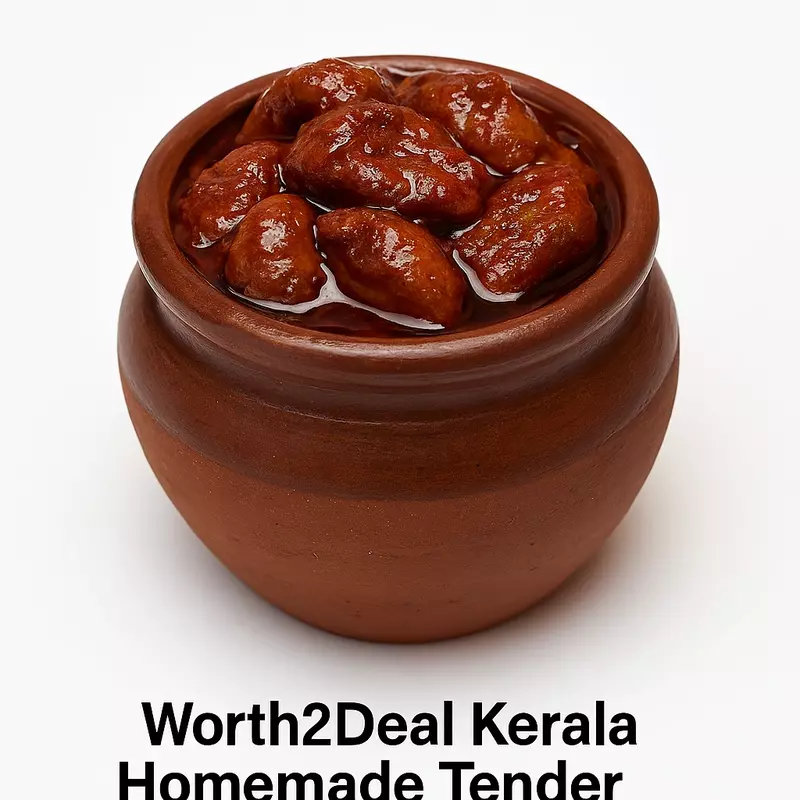


Buy Worth2Deal Kerala Tender Mango Pickle Online — Authentic Namboodiri Kannimanga Achar, 9-Month Brine-Aged, No Preservatives
Available Offer
Share :
Worth2Deal Kerala Tender Mango Pickle — Kannimanga Achar — is made by a Namboodiri Brahmin family from Palakkad, Kerala, following an ancestral Mana recipe that has not changed in generations. The mangoes used are true Kannimanga — the smallest, hardest, first-of-season baby mangoes harvested before they touch the ground — preserved first in sealed rock-salt brine for nine months, then finished in cold-pressed sesame oil with slow-roasted whole spices. No vinegar. No Class II preservatives. No added colour. What arrives in your hands is the same pickle that has sat at Kerala Sadhya tables for centuries — bold, layered, intensely sour, and unmistakably Malabar.
The 9-Month Brine Secret — Why Most Pickles Cannot Match This
Most commercial kannimanga achar reaches the shelf within weeks of preparation. Worth2Deal's pickle does not. After the mangoes are cleaned and dried, they rest in sealed rock-salt brine for a full nine months. This slow maturation is what creates the deep, layered sourness that distinguishes a Palakkad-style achar from anything made in a factory. During this period, natural lacto-fermentation develops — the same process that makes traditional fermented foods a source of beneficial gut enzymes. No shortcut, no vinegar, no acetic acid to fake the tang. Nine months. That is the difference.
The Namboodiri Mana Method — A Heritage of Purity
Namboodiri Brahmin families of Palakkad follow strict standards of preparation that date back centuries — only natural ingredients, only traditional vessels, only cold-pressed oils. Worth2Deal sources this pickle directly from one such Mana, where the family method has been handed down without modification. The ingredients are minimal and exact: Kannimanga (tender baby mangoes), red chilli powder, fenugreek powder, mustard seeds, asafoetida, rock salt, and cold-pressed sesame oil (gingelly oil). Nothing else. The Namboodiri recipe forbids vinegar as a preservative — the rock salt and oil together do what synthetic acid cannot: they preserve the mango's natural character while allowing it to deepen over months.
What Is Kannimanga — Why These Mangoes Specifically
Kanni means virgin or first-of-season in Malayalam. Kannimanga refers to the smallest, hardest green baby mangoes harvested at the very beginning of the mango season, before any sweetness develops in the fruit. These mangoes are picked by hand before they fall — contact with the ground bruises the skin and changes fermentation. This specificity matters: a tender mango pickle made with slightly older or larger fruit will be softer, less tangy, and will not hold its texture through nine months of brining. The Namboodiri recipe demands Kannimanga precisely because their firmness and acidity make them the only variety capable of surviving and improving through the full brine maturation cycle.
Ingredients
Tender mango (Kannimanga), red chilli powder, fenugreek powder, mustard seeds, asafoetida (hing), rock salt, cold-pressed sesame oil (gingelly oil).
No vinegar. No artificial colour. No Class II preservatives. No synthetic flavour.
How to Use and Store
Serve one or two pieces of Kannimanga Achar alongside steamed Kerala matta rice, kanji, curd rice, chapati, or paratha. It is the traditional pickle for Kerala Sadhya and pairs well alongside Malabar biryani. Always use a dry spoon — even a single drop of water can break the oil seal and reduce shelf life. Ensure the mango pieces remain submerged under the sesame oil after each use and reseal the jar tightly. Stored correctly at room temperature, the pickle stays fresh for 12 months or more. Refrigeration is not required but extends life further in hot climates.
Serving Suggestions and Meal Pairings
Kannimanga Achar has been called the King of Pickles in Kerala for good reason — it is the one pickle that works with everything. Pair it with steamed Vadi Matta rice and curd for the classic Kerala lunch. Add it alongside Wayanad Jeerakasala Khaima rice for a traditional Malabar biryani meal. Serve it at Onam Sadhya alongside Parippu curry and ghee rice. It also works as a bold side for wheat rusk, idli, and dosa. Malayali families across Mumbai, Delhi, Bangalore, Hyderabad, Chennai, Pune, Kochi, Thrissur, Kozhikode, Kannur, Palakkad, Coimbatore, Surat, Ahmedabad, Kolkata, Jaipur, Chandigarh, Bhopal, Nagpur, Indore, and the UAE, Qatar, Bahrain, Kuwait, and Saudi Arabia order this pickle to bring the taste of home to wherever they are.and you can check our Manga Uppilittath to pair with the meal ,and also you can go through our Pickles and Kondattams category
About Worth2Deal
Worth2Deal has been delivering authentic Kerala and Malabar specialty food products across India since 2017 — rice varieties, pickles, snacks, honey, jaggery, and traditional condiments sourced directly from producers who still follow the old methods. Every product carries FSSAI Lic. No. 21317233000044, issued to our registered facility at 7/330 A, Shanthi Nagar, Kokkur, Malappuram, Kerala — 679591.
FSSAI Lic. No. 21317233000044 | Free pan-India delivery | COD available (see shipping policy)
For orders and enquiries: worth2deal.com@gmail.com | +91 9846294242
Also available on: [Kerala Pickles & Kondattam collection] | See also: [Kerala Tender Mango in Brine — Manga Uppilittathu] | [Kerala Inchi Manga Achar — Mango Ginger Pickle]
NAP Block
Worth2Deal | 7/330 A, Shanthi Nagar, Kokkur, Malappuram, Kerala — 679591 | worth2deal.com@gmail.com | +91 9846294242 | FSSAI Lic. No. 21317233000044
❓ FAQ Section
Q1. What is authentic Kerala tender mango pickle made of?
Authentic Kerala tender mango pickle — Kannimanga Achar — is made from Kannimanga (the smallest first-of-season baby mangoes), red chilli powder, fenugreek powder, mustard seeds, asafoetida, rock salt, and cold-pressed sesame oil. The Namboodiri Palakkad recipe does not use vinegar, artificial preservatives, or added colour. The mangoes are preserved first in sealed rock-salt brine before being finished in sesame oil.
Q2. Why is mustard powder added to tender mango pickle?
Mustard acts as both a flavour agent and a natural preservative in Kannimanga Achar. The mild antimicrobial properties of mustard seeds help control the growth of unwanted bacteria during the brine maturation stage, while the slightly bitter, pungent flavour of mustard balances the intense sourness of the mango and the heat of the red chilli. In the Namboodiri recipe, de-husked mustard seeds are used for a cleaner, less sharp flavour.
Q3. What is the salt ratio for preserving mangoes in brine?
In traditional Palakkad-style Kannimanga Achar, the salt ratio is generous — approximately 100g of rock salt per 500g of tender mango. This high salt concentration creates the osmotic environment that draws moisture out of the mango, suppresses harmful microbial growth, and triggers the slow lacto-fermentation that gives the pickle its characteristic sourness over the nine-month brine period. Too little salt risks mold; too much makes the pickle inedibly sharp and draws out too much mango texture.
Q4. How long can tender mango pickle be stored without preservatives?
Worth2Deal Kannimanga Achar, stored correctly in a dry, sealed jar using only a dry spoon, lasts 12 months or more at room temperature — even without vinegar or Class II preservatives. The combination of high rock-salt concentration during the 9-month brine maturation phase, and the cold-pressed sesame oil seal applied at finishing, creates a natural barrier against spoilage. Refrigeration further extends shelf life in humid coastal climates.
Q5. How to identify the right type of mango for tender mango pickle?
The correct mango for traditional Kerala pickle is Kannimanga — very small, hard, intensely green baby mangoes harvested at the very start of the mango season, before any sweetness develops. They should be marble-sized or smaller, with no soft spots, and skin that is taut and blemish-free. Mangoes that have touched the ground are rejected because contact bruising changes fermentation. Older, larger mangoes produce a softer pickle that does not hold its texture through long brine maturation.
Q6. Is vadu mango the same as tender mango for pickle?
Vadu maangai (Tamil Nadu) and Kannimanga (Kerala) are closely related — both refer to very small, hard, first-of-season baby mangoes used for pickling. The main differences are regional: Tamil Nadu vadu maangai preparations tend toward oil-heavy, spicier profiles and often use the mango whole or halved, while Kerala Kannimanga Achar follows the Malabar brine-first method before adding sesame oil and spices. The two terms are sometimes used interchangeably in pan-Indian e-commerce, but the recipe and preparation method are distinct.
Q7. What month is best to buy tender mangoes for pickling?
In Kerala and Palakkad, Kannimanga — the baby tender mangoes used for pickling — are available for a very short window from late February through April, depending on the season. The Namboodiri tradition requires the mangoes to be harvested at the very beginning of this window, before the mango develops any sweetness. Worth2Deal's annual batch is prepared during this narrow harvest window and brined immediately — this is why only one batch is made per year and quantities are limited.
Q8. How to prevent mold in homemade mango pickle?
Three rules prevent mold in oil-preserved pickles. First: never use a wet spoon — even a small amount of water breaks the oil seal and creates a mold-friendly environment. Second: ensure all mango pieces remain submerged under the sesame oil after each use. Third: use the correct salt ratio during the initial brine stage, as low-salt preparation leaves the mango vulnerable before the oil seal is applied. Worth2Deal's 9-month sealed brine maturation and cold-pressed sesame oil finishing make the pickle inherently resistant to mold when handled correctly.
Q9. Is salted mango pickle a good probiotic?
Traditional brine-preserved Kannimanga Achar undergoes natural lacto-fermentation during its brine maturation period — the same biological process that makes yoghurt, kanji, and kimchi rich in beneficial gut bacteria. During the 9-month sealed brine stage, naturally occurring lactobacillus bacteria convert sugars to lactic acid, which both preserves the pickle and produces live cultures. Commercial pickles made with vinegar or Class II preservatives do not undergo this fermentation and do not carry probiotic benefit. Worth2Deal Kannimanga Achar, being vinegar-free and preservative-free, retains these naturally occurring beneficial cultures.
Q10. Why are ceramic jars (Bharani) used for pickling?
The traditional Bharani — a large clay or ceramic vessel — maintains a stable internal temperature that resists both heat and cold, which is critical during the long brine maturation phase. The porous nature of unglazed clay allows very slight air exchange that moderates fermentation without exposing the pickle to spoilage. Glass jars are now widely used as a practical modern alternative, but the Namboodiri tradition favoured Bharani for the consistent, slow environment they created during the 9-month brine cycle. Worth2Deal pickles are dispatched in glass jars for safe shipping while retaining the traditional recipe.
Q11. What are the health benefits of eating tender mango pickle?
Traditional vinegar-free Kannimanga Achar carries several recognised dietary benefits: it aids digestion through natural lacto-fermentation, provides beneficial gut flora, delivers antioxidants from the cold-pressed sesame oil and whole spices, and supports appetite through the acidity of the naturally soured mango. The sesame oil base is rich in healthy unsaturated fats and vitamin E. However, Kannimanga Achar is high in sodium due to the rock-salt brine — those on sodium-restricted diets should consume it in small quantities. Consult your doctor if you have specific dietary restrictions.
Q12. Which mango pickle brands are preservative-free?
Several artisanal brands offer preservative-free tender mango pickle, including Koottukari, Vebka, and Worth2Deal. Worth2Deal's Kannimanga Achar is distinguished by its Namboodiri Palakkad recipe, 9-month brine maturation, and explicit vinegar-free preparation — attributes not claimed by most commercial or artisanal brands. Always check the ingredient list: the presence of acetic acid (E260), sodium benzoate (E211), or potassium sorbate (E202) indicates that the pickle is not preservative-free.
Q13. Where to buy authentic homemade tender mango pickle online in India?
Worth2Deal ships authentic Namboodiri Kannimanga Achar across India with free pan-India delivery. Orders placed on worth2deal.com are dispatched from Malappuram, Kerala, and reach customers in Mumbai, Delhi, Bangalore, Hyderabad, Chennai, Pune, Kolkata, Ahmedabad, Kochi, Thrissur, and all other Indian cities. COD is available. FSSAI Lic. No. 21317233000044.
Q14. What is the best brand for authentic Kannimanga Achar online?
Worth2Deal is one of the few online sellers whose Kannimanga Achar is prepared by a Namboodiri Mana of Palakkad — the cultural origin point of this pickle style — using a 9-month sealed brine maturation method that no commercial brand replicates and Koottukari are well-regarded Kerala pickle brands for buyers who want shorter maturation alternatives. For the traditional Palakkad Brahmin Mana method with the full brine-aging process, Worth2Deal is the specific seller.
Q15. Which brand makes the best Kerala-style tender mango pickle?
The "best" depends on what you value. If you want the most traditional, longest-matured, Namboodiri-method Palakkad-style Kannimanga Achar — Worth2Deal's 9-month brine-aged version is the reference point. If you want a widely available, competitively priced option with fast fulfillment and Koottukari is a reliable choice. Mass-market brands like Brahmins, Eastern, and MTR use vinegar and Class II preservatives and do not replicate the traditional flavour profile.
Q16. Does mango pickle cause weight gain?
Consumed in typical serving quantities — one or two pieces alongside a meal — Kannimanga Achar is very low in calories. The mango pieces themselves carry negligible caloric load after brine processing. The sesame oil in which the pickle is preserved contains healthy fats and is present in small amounts per serving. The primary dietary concern with any traditional pickle is sodium, not calories. Eaten as a condiment rather than a snack, Kannimanga Achar does not contribute meaningfully to weight gain.
Q17. Can I make mango pickle with less salt for blood pressure?
Reducing salt significantly in a brined mango pickle is not advisable — the salt concentration is what creates the safe environment for lacto-fermentation and prevents harmful bacterial growth during the maturation period. Low-salt versions require refrigeration throughout preparation and have a much shorter shelf life. If you are on a sodium-restricted diet, eat traditionally prepared Kannimanga Achar in very small quantities — one piece per meal — rather than attempting a reduced-salt preparation. Consult your physician or dietitian for personalised dietary guidance.
Q18. Why does Worth2Deal not use vinegar in Kannimanga Achar?
The Namboodiri Palakkad recipe specifically forbids vinegar. Synthetic vinegar (acetic acid) speeds up curing but kills the natural lacto-fermentation that gives traditional brine-aged pickle its depth of flavour and probiotic benefit. It also overpowers the natural mango sourness with a harsh, one-dimensional tang that is immediately recognisable in commercial pickles. The 9-month rock-salt brine maturation method used by Worth2Deal creates the same acidity through natural fermentation — without any added acid.