

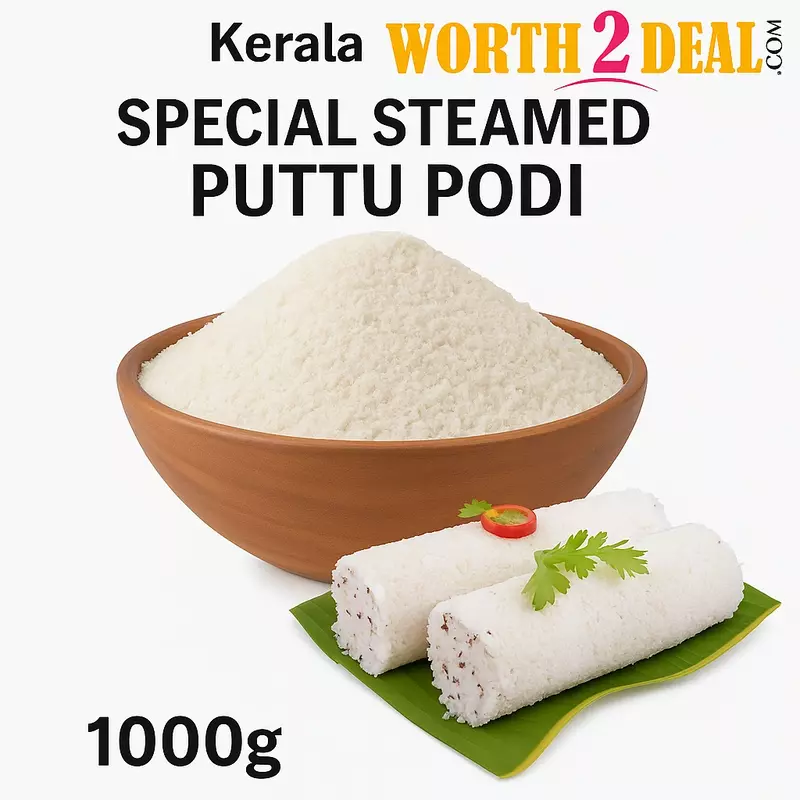


Buy Worth2Deal Kerala Puttu Podi Online — Authentic Steamed Rice Flour for Soft Fluffy Puttu, 1kg
Available Offer
Share :
Worth2Deal Kerala Puttu Podi is coarse ground steamed rice flour — made from premium Kerala rice, washed, dried, and processed specifically for making Kerala puttu. Known as ari podi or puttu podi in Malayalam and rice puttu flour in English, this is the rice flour that makes Kerala's traditional steamed breakfast cylinder — soft, fluffy, light, and authentically flavoured — the way it has been made in Kerala homes for generations. Available in a 1kg pack, no preservatives, no additives, free delivery anywhere in India.
What Is Kerala Puttu Podi — The Rice Flour Behind Kerala's Most Loved Breakfast
Puttu is one of the most universally loved breakfasts across Kerala — a cylindrical steamed rice cake layered with freshly grated coconut, eaten at morning tables from Kasaragod to Thiruvananthapuram, in every community, every district, every generation. It is Kerala's breakfast in the way that idli is Tamil Nadu's and poha is Maharashtra's — deeply embedded in daily life, deeply familiar, and deeply satisfying.
Puttu podi — the rice flour used to make puttu — is not the same as ordinary rice flour. Standard rice flour is milled fine for idli, dosa, and appam. Puttu podi has a specific coarseness — a medium-coarse grind that allows steam to pass through the flour column freely during cooking, creating the characteristic soft, light, non-sticky texture that makes puttu what it is.
The rice matters too. Traditional Kerala puttu podi is made from specific Kerala rice varieties — white raw rice or parboiled rice — that are washed, sun-dried, and then ground or processed to the precise coarseness needed. The type of rice and the degree of roasting determine whether the puttu will be soft and white or slightly golden and more aromatic.
Worth2Deal Kerala Puttu Podi is made from premium Kerala rice, processed at the correct coarseness for consistently soft, light puttu — suitable for traditional brass puttu kudams and all modern puttu makers. No guesswork, no adjustment of texture needed.
Puttu podi is also known as ari podi (ari = rice in Malayalam), puttu powder, rice puttu flour, and steamed rice flour. In Hindi it is sometimes called chawal ka atta for puttu, though this is a simplified description — puttu podi has a specific coarseness not found in standard chawal atta.
What Makes Worth2Deal Puttu Podi Different From Commercial Brands
The Kerala puttu podi market is dominated by large commercial brands — Ponkathir, KK, Ajmi, Brahmins — all of which produce puttu podi at industrial scale. Worth2Deal's puttu podi is positioned differently in three specific ways.
First — freshness and small-batch packing. Large commercial brands produce at massive scale with extended supply chains — the puttu podi sitting on a supermarket shelf or in an Amazon warehouse may be months old. Worth2Deal packs in Malappuram and dispatches directly — the puttu podi reaching your door is fresher, which means better aroma, better moisture content, and better texture in the final puttu.
Second — no preservatives, no additives, no artificial colour. Worth2Deal Puttu Podi contains only rice — no chemical preservatives, no anti-caking agents, no artificial colour to enhance whiteness, no moisture absorbers. What you receive is the flour as it comes from the rice.
Third — Malabar origin and authentic preparation standards. Worth2Deal is based in Malabar — North Kerala's rice-culture heartland — where puttu is not an occasional breakfast but a daily staple. The preparation standards reflect this cultural familiarity with what good puttu podi should feel, look, and cook like.
How to Make Puttu with Worth2Deal Puttu Podi — Step by Step
Ingredients You Need
For 2 servings: Worth2Deal Kerala Puttu Podi — 1 cup (approximately 150g), freshly grated coconut — 4 tablespoons, water — approximately 5–6 tablespoons, salt — a pinch. A puttu kudam (puttu maker) is required — traditional brass or modern plastic both work equally well.
Step by Step Method
Take one cup of Worth2Deal Puttu Podi in a wide bowl. Add a pinch of salt. Add water gradually — one tablespoon at a time — and mix using your fingertips, rubbing the flour to distribute the moisture evenly. The flour should reach a crumbly, damp sand-like consistency — it should hold its shape when pressed together but break apart easily when you release it.
Do not add all the water at once and do not make a dough. Test the consistency after each tablespoon of water. When the flour holds shape when pressed but crumbles when broken — it is ready. If it still feels dry and powdery, add one more tablespoon and test again.
Fill the puttu maker: add a tablespoon of grated coconut at the base, then a layer of the moistened flour (fill to one-third), then another tablespoon of coconut, then more flour, ending with a layer of coconut on top. Fill gently — do not press the layers tightly. Steam for 5–7 minutes. When steam comes out continuously from the top, the puttu is ready. Push out carefully onto a banana leaf or plate using the pushing rod. Serve immediately.
Tips for Perfect Puttu Every Time
The most common mistake is adding too much water — this makes the puttu dense and sticky. Add water slowly and test after each tablespoon. Fresh grated coconut is important — the coconut layer provides both flavour and the structural separation between puttu layers. Desiccated or frozen coconut works but gives a drier, less aromatic result. Do not steam for too long — over-steaming makes the puttu hard. When continuous steam flows freely from the top, it is done. Serve immediately — puttu hardens as it cools.
What to Serve with Kerala Puttu — All Traditional Pairings
Kadala Curry — The Classic
Black chickpeas (kadala) slow-cooked in a thick roasted coconut and spice gravy — this is Kerala's most iconic puttu pairing. The rich, earthy kadala curry soaks into the soft puttu layers, creating a complete and filling breakfast. This combination is the definitive Kerala morning meal — found at every Kerala hotel breakfast counter, every home table, and every fond memory of growing up in Kerala.
Ripe Nendran Banana
The simplest pairing — a ripe nendran banana alongside puttu. The banana's natural sweetness and soft texture contrast with the light, neutral puttu. Children universally love this combination. In many Kerala homes, the banana is broken apart and mashed directly into the puttu as it is eaten.
Coconut Milk and Jaggery
Thin coconut milk poured over the puttu with a spoon of jaggery dissolved in — a sweet breakfast pairing that is particularly popular in South Kerala and for serving to children. Worth2Deal Marayoor Jaggery — GI-tagged Kerala sugarcane jaggery — dissolved in warm coconut milk makes an exceptional puttu accompaniment.
Fish Curry
Kerala fish curry — particularly the red, coconut-free nadan meen curry of South Kerala — paired with puttu is one of the most satisfying savory combinations in the Kerala breakfast repertoire. The fish curry gravy absorbs into the puttu creating a meal rather than a breakfast.
Egg Roast
Spiced egg roast with the puttu — particularly popular in Malabar Muslim households and increasingly common across all Kerala communities. The egg roast gravy soaks into the puttu layers, creating a protein-rich, deeply savoury breakfast.
Kerala Puttu Podi vs Other Rice Flours — What Is the Difference
Buyers new to Kerala cooking often ask why they cannot simply use regular rice flour (atta) for puttu. The answer is texture and grind.
| Puttu Podi | Regular Rice Flour | Idli/Dosa Rice Flour | |
|---|---|---|---|
| Grind | Medium-coarse | Fine | Fine to medium |
| Steam behaviour | Steam passes through freely | Blocks steam, becomes dense | Clumps and sticks |
| Result in puttu | Soft, fluffy, light | Dense, sticky, clumped | Wet, unworkable |
| Result in idli/dosa | Too coarse — grainy result | Works well | Works well |
| Traditional use | Puttu, some porridges | Kozhukatta, murukku | Idli, dosa, appam |
Puttu podi must be used for puttu — there is no substitute that gives the same result. The coarseness is what enables steam to move through the flour column without compacting, producing the signature soft, cylindrical, layered texture of authentic Kerala puttu.
For the full range of Kerala flours, explore Flours and Powders for Daily Cooking. Also see Worth2Deal Kerala Wheat Puttu Podi for the wheat flour version of this same breakfast.
Product Details
Net Weight: 1kg Flour type: Coarse ground Kerala rice flour (puttu podi / ari podi) Rice: Premium Kerala rice Processing: Washed, dried, coarse ground — steamed preparation method Preservatives: None Artificial colour or flavour: None Additives: None Packaging: Food-grade sealed pack Storage: Store in an airtight container in a cool dry place after opening Shelf life: Refer to best-before date on pack Suitable for: Traditional brass puttu kudam and all modern puttu makers FSSAI Licence No.: 21317233000044 Manufactured and packed by: Worth2Deal, 7/330 A, Shanthi Nagar, Kokkur, Malappuram, Kerala — 679591 Customer support: worth2deal@gmail.com | +91 98462 94242
FAQs
What is puttu podi — what is it made from?
Puttu podi is a coarse-ground rice flour made specifically for making Kerala puttu — the traditional steamed breakfast cake. It is made from premium Kerala rice — washed, dried, and ground to a medium-coarse texture that allows steam to pass through the flour column during cooking, producing a soft, light, non-sticky steamed rice cake. It is also called ari podi in Malayalam, rice puttu flour in English, and steamed rice flour in some packaging. Worth2Deal Kerala Puttu Podi is made from premium Kerala rice with no preservatives, no artificial colour, and no additives.
Can I use regular rice flour or atta instead of puttu podi?
No — regular rice flour or wheat atta cannot be substituted for puttu podi. Regular rice flour is ground fine — when you try to steam it in a puttu maker, the fine flour blocks the steam passage, causing the flour column to compact into a dense, sticky, clumped mass rather than the soft, fluffy cylindrical puttu. Puttu podi must be coarse-ground to allow steam to pass through freely. Worth2Deal Kerala Puttu Podi is ground at the specific coarseness needed for authentic Kerala puttu results.
How do I know if I have added the right amount of water to puttu podi?
The correct test: take a small amount of moistened puttu podi and press it between your palms. It should hold its shape when pressed together. When you release the pressure and tap it gently, it should break apart easily into a crumbly texture. If it stays stuck together like dough — too much water added. If it crumbles immediately without holding shape when pressed — too dry, add one more tablespoon of water. The ideal consistency is described as "damp sand" — moist enough to hold shape momentarily when pressed, dry enough to crumble freely.
How long does it take to steam puttu?
Puttu takes 5–7 minutes to steam from the time you place the filled puttu maker over the steam source. The indicator that the puttu is ready is continuous steam flowing freely from the top of the puttu maker. Do not open or push out the puttu before continuous steam is flowing — the centre will not be cooked. Do not over-steam — steaming for more than 8–10 minutes after the steam flows freely will make the puttu hard and dry. Serve immediately after pushing out — puttu hardens as it cools.
Is puttu podi gluten-free?
Yes — Worth2Deal Kerala Puttu Podi is made from 100% rice and is naturally gluten-free. Rice contains no gluten. Puttu made from rice puttu podi is therefore suitable for people following a gluten-free diet. Note: this is general nutritional information and not a medical or dietary claim. If you have a medically diagnosed gluten intolerance or coeliac disease, please consult your doctor or dietitian before incorporating any food product into your diet.
Can I order puttu podi online with free delivery across India?
Yes — Worth2Deal delivers free to all major cities and towns across India including Mumbai, Delhi, Bengaluru, Chennai, Hyderabad, Kolkata, Pune, Ahmedabad, Jaipur, Lucknow, Surat, Visakhapatnam, Coimbatore, Kochi, Thiruvananthapuram, Kozhikode, Thrissur, Palakkad, Malappuram, Nagpur, Indore, Bhopal, Patna, Vadodara, Ludhiana, Agra, Nashik, Faridabad, and all other serviceable pin codes. FSSAI Lic. No.: 21317233000044.
How should I store puttu podi after opening?
Transfer to an airtight container immediately after opening the pack. Store in a cool dry place away from moisture, direct sunlight, and heat. Do not store near the stove or in a humid environment — moisture causes the flour to clump, develop off-aromas, and eventually spoil. Always use a completely dry spoon or cup when measuring — even a slightly wet spoon introduces moisture into the container. Properly stored, puttu podi stays fresh for several months. Refer to the best-before date on the pack for the specific shelf life.
What is the difference between puttu podi and pathiri podi?
Puttu podi and pathiri podi are both Kerala rice flours but with different properties. Puttu podi is coarse-ground specifically for steaming — the coarse texture enables steam to pass through the flour during puttu making, producing a fluffy result. Pathiri podi is ground very fine — used for making pathiri (Kerala-style rice flatbread), the fine grind produces a smooth, pliable dough that rolls thin and cooks evenly on a tava. Using puttu podi for pathiri gives a grainy, coarse pathiri. Using pathiri podi for puttu gives a dense, clumped, steam-blocked puttu. They are not interchangeable — each flour is optimised for its specific preparation.
Is puttu a healthy breakfast?
Kerala puttu is a steamed preparation with no oil added during cooking — making it one of the lower-fat traditional breakfast options in Indian cuisine. It is made from rice (naturally gluten-free), layered with grated coconut (which adds natural fat and fibre), and typically paired with kadala curry (black chickpeas — a good protein source) or banana (natural sugars and potassium). As a combination, puttu with kadala curry provides carbohydrates, protein, and fibre in one meal. Note: this is general nutritional information and not a medical or dietary claim. Individual nutritional needs vary.
Can I make puttu in a pressure cooker without a puttu maker?
Yes — puttu can be made in a pressure cooker without a dedicated puttu maker. Remove the pressure cooker whistle. Place a perforated container or bowl (a steel tiffin with holes punched in the base) filled with the layered flour and coconut on top of the pressure cooker's steam output. The steam from the cooker passes upward through the perforations into the flour. Steam for 6–8 minutes. The result is puttu without the cylindrical shape — it will be a disc or ball shape depending on your container, but the texture will be the same if the flour moisture is correct. A dedicated puttu maker gives the most consistent shape and steam distribution.
How is Worth2Deal puttu podi different from branded commercial puttu podi like Ponkathir or KK?
The primary differences are freshness and scale. Ponkathir, KK, and Ajmi are large-scale industrial producers — their puttu podi goes through extended storage and distribution before reaching the buyer. Worth2Deal is a small-batch producer based in Malabar — packing fresh and dispatching directly to buyers, which means fresher flour, better aroma, and more consistent texture. The ingredient is the same (rice) — the difference is in the time from production to your kitchen and the absence of any preservatives or additives to compensate for extended shelf time.
Will puttu remain a mainstream Kerala breakfast as food habits change?
Puttu has shown remarkable staying power despite the arrival of instant breakfast options. Unlike processed cereals or instant oats, puttu requires a puttu maker and 10–15 minutes of active cooking — yet demand for puttu podi online has grown consistently year over year, driven by the Kerala diaspora across India and internationally who want authentic Kerala breakfast at home. Worth2Deal has been supplying Kerala puttu podi from Malappuram since 2017 — and orders from buyers in Mumbai, Delhi, Bengaluru, Dubai, and abroad have grown every year, confirming that for Kerala families living outside Kerala, puttu is not a convenience food but a comfort food worth making properly.
NAP Block
Worth2Deal 7/330 A, Shanthi Nagar, Kokkur, Malappuram, Kerala — 679591 Phone: +91 98462 94242 Email: worth2deal@gmail.com Website: www.worth2deal.com FSSAI Licence No.: 21317233000044