

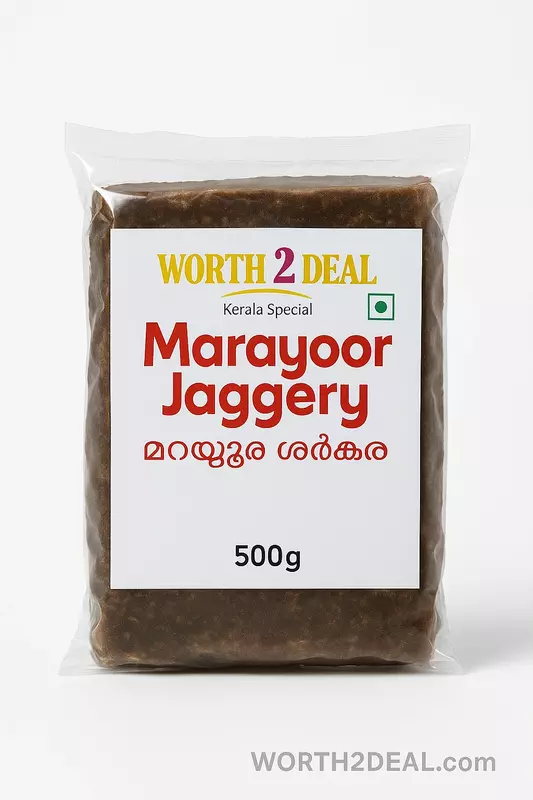


Buy Marayoor Jaggery Online — Worth2Deal GI-Tagged Kerala Sarkara
Available Offer
Share :
Marayoor jaggery is a Geographical Indication (GI) certified natural sweetener made exclusively from CO 86032 sugarcane grown in the rain-shadow hills of Marayoor and Kanthalloor in Idukki, Kerala — slow-boiled in open iron cauldrons without chemicals, bleach, or slaked lime, and hand-rolled into dark brown blocks known locally as unda sharkara.
Why Marayoor Jaggery Is Different from Every Other Jaggery You Have Tried
Most jaggery sold in Indian markets — including what you find in supermarkets labelled "natural" or "organic" — is commercially processed. It is bleached with slaked lime (chunnambu) to lighten its colour, treated with sodium hydrosulphite to extend shelf life, and often adulterated with cheaper cane varieties to reduce cost. The result is a pale yellow block that looks clean but carries chemical residues through the entire production process.
Marayoor jaggery is none of that.
It is made by the Muthuvan tribal community in the high-altitude sheds (known locally as Sharkara making centres) of Marayoor and Kanthalloor in Idukki district — using the same methods passed down through generations. Fresh sugarcane juice is boiled in massive iron cauldrons using bagasse (dried cane waste) as the only fuel. No chemicals. No bleach. No additives. The hot molten jaggery is poured into moulds and hand-rolled into the signature dark brown blocks while still warm — which is why original Marayoor unda sharkara often carries the artisan's fingerprints on the surface.
Worth2Deal sources Marayoor jaggery directly from registered GI producers in Idukki — packed in Malappuram and delivered free to your door anywhere in India.
The GI Tag — What It Means and Why It Matters
Marayoor jaggery received its Geographical Indication (GI) certification from the Government of India's GI Registry — legally certifying that only jaggery produced in the Marayoor and Kanthalloor regions of Idukki, Kerala, using the traditional Muthuvan production method, can be called authentic Marayoor jaggery.
This matters because it means the quality, mineral profile, and flavour of the jaggery are entirely dependent on three things that cannot be replicated anywhere else — the specific altitude and climate of the Idukki hills, the loamy mountain soil in which the CO 86032 sugarcane variety grows, and the traditional open-vat processing method of the Muthuvan community.
A GI tag is not a marketing claim. It is a legal certification. When you buy Marayoor jaggery from Worth2Deal you are buying the real thing — not a cheaper substitute from another region sold under the same name.
Nutrition — What Makes Marayoor Unda Sharkara a Mineral Powerhouse
The dark colour of Marayoor jaggery is not a sign of lower quality — it is the opposite. The deep brown comes from the full retention of natural molasses during processing. Commercial jaggery removes this molasses layer to produce the pale yellow colour consumers associate with "purity." In doing so it removes most of the mineral content.
Marayoor unda sharkara retains everything:
- Iron — naturally high iron content supports haemoglobin production, reduces fatigue, and is particularly beneficial for women, children, and anyone with anaemia. A small piece of Marayoor jaggery after meals is a traditional Kerala practice specifically for iron supplementation.
- Calcium — supports bone density, dental health, and muscle function.
- Magnesium — supports heart health, nerve function, and blood pressure regulation.
- Potassium — supports fluid balance and healthy kidney function.
- Antioxidants — natural phenolic compounds in the molasses layer combat oxidative stress and inflammation.
- No refined sugar — unlike white sugar which is pure sucrose with zero nutritional value, Marayoor jaggery releases energy gradually due to its complex carbohydrate structure and mineral content.
Important note: Marayoor jaggery has a lower glycaemic index than white sugar and releases energy more slowly. However it is still a sweetener and a source of calories. People with diabetes should consume it in moderation and consult a healthcare provider before using it as a sugar substitute. FSSAI Lic. No.: 21317233000044.
Marayoor Jaggery vs Regular Jaggery — The Real Difference
This is the most common question buyers ask before purchasing, and it deserves a direct answer.
Regular jaggery sold in markets across India is typically made from sugarcane varieties grown in plains — Uttar Pradesh, Maharashtra, Tamil Nadu — using fast industrial processing. The juice is boiled quickly in large batches, treated with bleaching agents to achieve uniform colour, and sometimes adulterated with cheaper sweeteners. The result is a pale, uniform block with low mineral content and a generic sweet flavour.
Marayoor jaggery is made from one specific sugarcane variety — CO 86032 — grown only in the high-altitude loamy soil of Idukki at elevations between 900 and 1400 metres. The mountain water used for irrigation, the cool climate, and the mineral-rich soil give this sugarcane a uniquely high sugar density and mineral profile. The slow open-vat boiling process without any chemicals retains all of that mineral complexity in the final block.
The flavour difference is immediate and unmistakable. Regular jaggery is uniformly sweet with a mild caramel note. Marayoor unda sharkara has a deep, complex sweetness — earthy, slightly smoky from the bagasse fuel, with a rich molasses depth that makes any dish it touches taste distinctly different.
How to Use Marayoor Jaggery — Kerala Kitchen and Beyond
- Chukku Kaapi (Dry Ginger Coffee) — the most traditional use. Dissolve a small piece of Marayoor jaggery in hot water with dry ginger powder and pepper for Kerala's classic digestive and respiratory wellness drink.
- Payasam — Marayoor jaggery payasam in coconut milk is a festival staple across Kerala. The dark jaggery gives the payasam its characteristic deep colour and complex sweetness that no other jaggery can replicate.
- Unniyappam and Ada Pradhaman — traditional Kerala sweets where the quality of jaggery determines the final flavour entirely.
- Sharkara Varatti — the iconic Kerala banana chips tossed in jaggery syrup, made properly only with Marayoor unda sharkara.
- Tea and Coffee — replace white sugar with a small piece of Marayoor jaggery in your morning tea or coffee. The flavour is richer and the energy release is slower and more sustained.
- Baby food — since Marayoor jaggery is chemical-free and contains no slaked lime, it is traditionally mixed with ragi porridge and banana powder as a natural iron supplement for infants and toddlers.
- Post-meal digestive — a small piece of Marayoor jaggery after meals is a traditional Kerala Ayurvedic practice for digestive support, bowel regulation, and iron absorption.
- Baking — substitute white sugar with grated Marayoor jaggery in cookies, cakes, and energy bars for a deeper flavour profile and better nutritional value.
Marayoor Jaggery Price — What You Are Actually Paying For
When people search for Marayoor sarkara price online they often compare it with regular jaggery and wonder why authentic Marayoor jaggery costs more. The answer is in the production.
Regular commercial jaggery is made in bulk industrial facilities using fast processing and chemical treatment — it is cheap to produce. Marayoor unda sharkara is made by hand in small-batch tribal sheds at high altitude using no machinery, no chemicals, and traditional knowledge that takes years to master. The Muthuvan community's livelihoods depend on this production — and the GI tag ensures that only their authentic product can carry the Marayoor name.
Worth2Deal offers Marayoor jaggery at farm-direct pricing — no distributor margins, no middlemen. What you pay goes directly to supporting the GI-certified producers of Idukki.
Storage Instructions
Store Marayoor jaggery in a cool, dry, airtight container away from moisture and direct sunlight. Jaggery is hygroscopic — it absorbs moisture from the air and softens if left uncovered. If the block softens slightly in transit during summer months the quality is completely unaffected — this is natural behaviour of pure jaggery without preservatives. Best consumed within 6 months of purchase. Do not refrigerate — the condensation accelerates moisture absorption.
Also from Worth2Deal Natural Sweeteners
For another traditional Kerala sweetener, explore our Kerala Cheruthen (Stingless Bee Honey) — raw, unprocessed honey from the native stingless bee, used in Ayurvedic medicine across Malabar. For the perfect breakfast pairing, see our Organic Parboiled Brown Rice 90% Bran — high-fibre rice that pairs beautifully with jaggery-sweetened porridge. And for our full range, explore Natural Sweeteners & Honey.
Product Details
Net Weight: 500g | 1kg Variety: Marayoor Unda Sharkara — GI Certified Sugarcane Variety: CO 86032 Origin: Marayoor and Kanthalloor, Idukki District, Kerala Produced by: Muthuvan tribal community, traditional open-vat method Colour: Deep dark brown — natural molasses retained Artificial Colour: None Preservatives: None Bleaching Agents: None — no slaked lime used Shelf Life: 6 months from date of packing (stored correctly, airtight) Storage: Cool, dry, airtight container — do not refrigerate Packed by: Worth2Deal, 7/330 Shanti Nagar, Valayamkulam, Kokkur Post, Malappuram District, Kerala 679591 FSSAI Licence No.: 21317233000044 Contact: worth2deal.com@gmail.com | +91 9846294242
FAQ — Marayoor Jaggery (Marayur Sarkara)
Q1. What is Marayoor jaggery and what makes it different from regular jaggery?
Marayoor jaggery — locally called Marayur Sarkara or Unda Sharkara — is a GI-certified natural sweetener made from CO 86032 sugarcane grown exclusively in the Marayoor and Kanthalloor regions of Idukki, Kerala. Unlike commercial jaggery which is bleached with slaked lime and processed industrially, Marayoor unda sharkara is slow-boiled in open iron cauldrons by the Muthuvan tribal community without any chemicals, artificial colour, or preservatives. The result is a dark brown block with deep complex sweetness and high iron, calcium, and magnesium content. FSSAI Lic. No.: 21317233000044.
Q2. What is the price of Marayoor jaggery — why is it more expensive than regular jaggery?
Marayoor jaggery costs more than commercial jaggery because it is hand-produced in small batches by the Muthuvan tribal community in traditional sheds at high altitude in Idukki — with no machinery, no chemicals, and no bulk processing. Worth2Deal offers farm-direct pricing with no distributor margins. The current price for 500g and 1kg packs is shown on this page. Pricing varies slightly by harvest season. FSSAI Lic. No.: 21317233000044.
Q3. Is Marayoor jaggery really GI tagged — what does that mean?
Yes. Marayoor jaggery holds an official Geographical Indication (GI) certificate from the Government of India's GI Registry. This means only jaggery produced in the Marayoor and Kanthalloor regions of Idukki using the traditional Muthuvan production method can legally be called Marayoor jaggery. The GI tag is a government-backed legal certification — not a marketing claim. Worth2Deal sources exclusively from registered GI producers.
Q4. Is Marayoor jaggery safe for diabetics?
Marayoor jaggery has a lower glycaemic index than white sugar and releases energy more slowly due to its complex carbohydrate structure and mineral content. However it is still a sweetener and a source of carbohydrates. People with diabetes should consume it in moderation and consult a healthcare provider before using it as a sugar substitute. It is not a medicine and should not replace any prescribed diabetes management plan.
Q5. What is unda sharkara — is it the same as Marayoor jaggery?
Yes. Unda Sharkara is the Malayalam name for the round or block-shaped jaggery produced in Marayoor — "unda" means round or ball-shaped in Malayalam. Marayoor Jaggery, Marayur Sarkara, and Unda Sharkara all refer to the same GI-certified product from Idukki, Kerala. The block shape comes from the traditional hand-rolling method used by the Muthuvan community.
Q6. Why is Marayoor jaggery dark brown — is that a sign of lower quality?
The opposite. The dark colour of Marayoor unda sharkara comes from the full retention of natural molasses during slow open-vat processing without bleaching agents. Commercial jaggery is pale yellow because the molasses is removed or bleached out — along with most of the iron, calcium, and mineral content. The darker the Marayoor jaggery the more molasses retained and the higher the mineral density. Dark colour is the mark of authenticity, not poor quality.
Q7. How do I use Marayoor jaggery in Chukku Kaapi?
Dissolve one small piece (approximately 10g) of Worth2Deal Marayoor jaggery in 150ml hot water. Add half a teaspoon of dry ginger powder (chukku) and a pinch of black pepper. Stir until fully dissolved and drink warm. This is Kerala's traditional respiratory and digestive wellness drink — particularly popular across Malabar and Wayanad households during monsoon season.
Q8. Can I give Marayoor jaggery to babies and toddlers?
Yes — Marayoor jaggery is chemical-free with no slaked lime, artificial colour, or preservatives, making it a safe natural sweetener for infants above 6 months as per traditional Kerala practice. It is commonly mixed with ragi porridge and banana powder as a natural iron source for toddlers. However consult your paediatrician before introducing any new food to your infant's diet.
Q9. How do I know if the Marayoor jaggery I am buying is authentic and not a fake?
Authentic Marayoor unda sharkara has three distinctive characteristics — a deep dark brown colour (never pale yellow), a complex earthy-smoky-sweet flavour (never just uniformly sweet), and visible artisan fingerprints on the block surface from hand-rolling. Pale yellow jaggery labelled as Marayoor jaggery is almost certainly a substitute from plains-grown cane. Worth2Deal sources exclusively from GI-registered producers in Idukki — the producer registration details are available on request. FSSAI Lic. No.: 21317233000044.
Q10. How should I store Marayoor jaggery to prevent it from melting or hardening?
Store in a cool, dry, airtight container away from moisture and direct sunlight. Do not refrigerate — condensation inside the container will make the jaggery sticky and accelerate dissolution. If the block softens during summer transit it is completely natural — pure jaggery without preservatives responds to heat and humidity. Hardened jaggery can be grated or broken with a knife. Best consumed within 6 months of packing.
Q11. Does Worth2Deal deliver Marayoor jaggery across India — can I get it in Bangalore, Mumbai, or Delhi?
Yes — Worth2Deal delivers authentic GI-tagged Marayoor jaggery pan-India with free shipping. We regularly fulfil orders to Bangalore, Mumbai, Delhi, Hyderabad, Chennai, Pune, Kolkata, and all major metro and Tier 2 cities. Delivery takes 4 to 7 working days. Cash on Delivery is available at checkout for eligible pin codes. You no longer need to travel to Idukki to get genuine Marayoor sarkara.
Q12. Will Marayoor jaggery become as mainstream as organic honey and coconut sugar in Indian health food markets?
It already is. Marayoor jaggery has seen a sharp rise in online searches and e-commerce orders over the last three years driven by the clean-label food movement and growing awareness of GI-tagged Indian heritage foods. What organic honey did for the natural sweetener category a decade ago, GI-certified Marayoor unda sharkara is doing now — and with a stronger origin story, tribal producer connection, and government-certified authenticity than almost any other traditional Indian sweetener. Worth2Deal has been part of this shift since 2017.
Worth2Deal Marayoor Jaggery is sourced directly from GI-registered Muthuvan producers in Idukki — chemical-free, bleach-free, no slaked lime, no artificial colour. The purest unda sharkara from Kerala's most famous jaggery hills, packed in Malappuram and delivered free anywhere in India. Order now — 500g or 1kg.
Order Worth2Deal Marayoor Jaggery Now — Free Pan-India Delivery →