

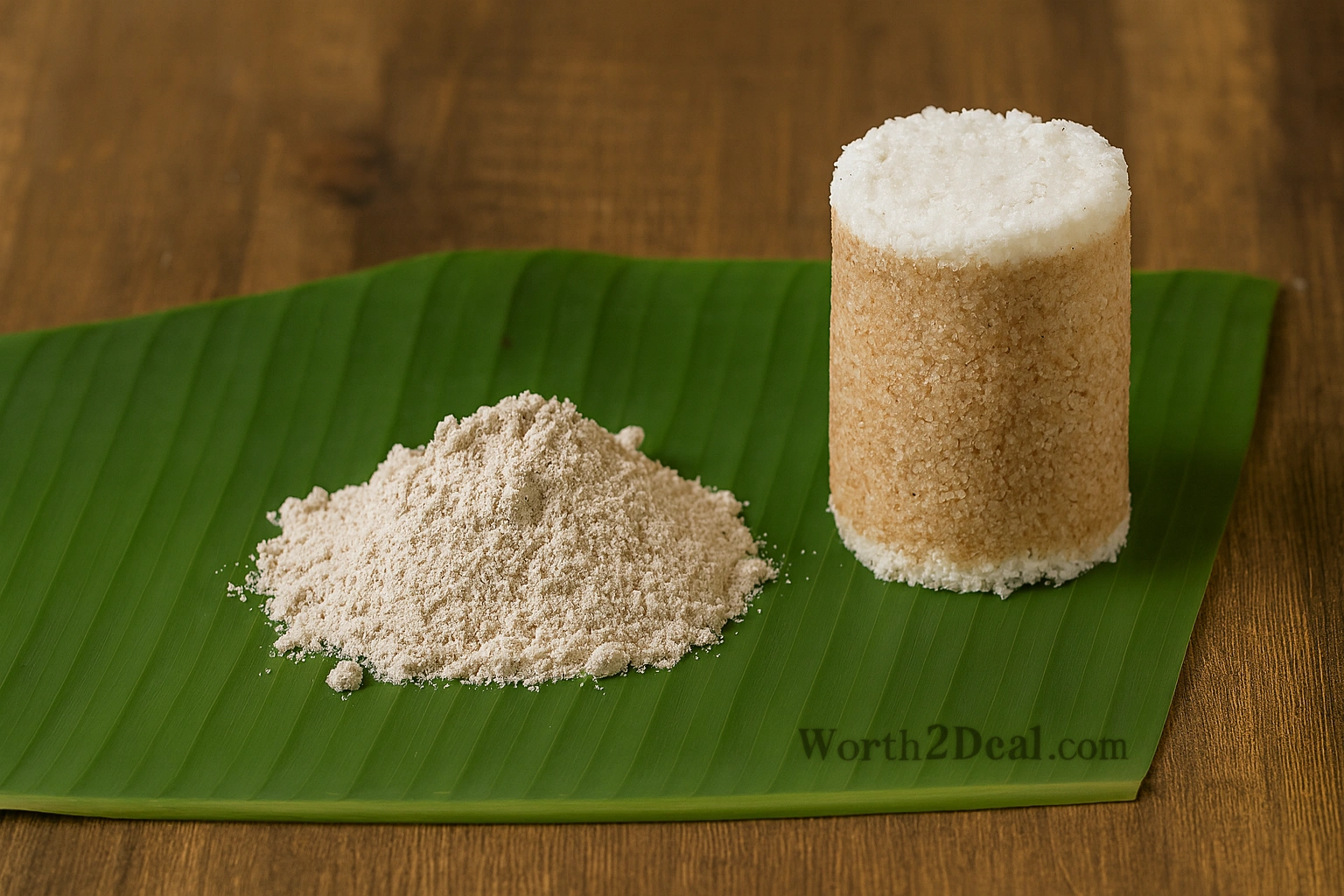


Buy Worth2Deal Kerala Wheat Puttu Podi Online — Authentic Gothambu Puttu Flour, Coarse Ground, 1kg
Available Offer
Share :
Worth2Deal Kerala Wheat Puttu Podi is coarse ground gothambu flour — specially prepared for making soft, fluffy, perfectly layered steamed wheat puttu. Known as gothambu puttu podi in Malayalam and atta puttu podi in everyday usage, this is the flour that makes Kerala's wheat puttu breakfast the way it should be made — coarse enough for steam to pass through freely, fine enough for a soft, non-sticky result. No preservatives, no artificial colour, no additives. Available in a 1kg pack with free delivery anywhere in India.
What Is Wheat Puttu Podi — Kerala's Gothambu Puttu Explained
Puttu is one of Kerala's most beloved breakfast dishes — a cylindrical steamed cake made from rice or wheat flour layered with freshly grated coconut, cooked in a traditional puttu kudam or puttu maker. It has been eaten in Kerala households for generations, across all communities and all districts, from the coastal fishing villages of Thiruvananthapuram to the Malabar households of Malappuram and Kozhikode.
Wheat puttu — gothambu puttu in Malayalam — is the wheat flour version of this classic dish. Where traditional rice puttu uses raw or roasted rice flour (puttu podi), wheat puttu uses coarse ground wheat flour that absorbs steam in the same way, producing a soft, lightly textured steamed cake that is slightly nuttier and more substantial than rice puttu.
The key to good wheat puttu is the grind of the flour. The wheat must be ground coarse — not as fine as standard atta used for chapati, and not as coarse as broken wheat. The ideal coarseness allows steam to pass through the flour column freely while holding the cylindrical shape and creating the characteristic soft, layered texture. Too fine and the puttu becomes dense and sticky. Too coarse and it crumbles.
Worth2Deal Kerala Wheat Puttu Podi is ground specifically for puttu — the coarseness is calibrated for consistent results in both traditional brass puttu kudams and modern plastic puttu makers. No guesswork, no adjustments needed.
Wheat Puttu vs Rice Puttu — Which Should You Choose
The most common question buyers ask is how wheat puttu compares to the traditional rice puttu they already know. Both are Kerala breakfast staples — both steamed, both layered with coconut — but they have distinct textures, flavours, and nutritional profiles.
| Wheat Puttu | Rice Puttu | |
|---|---|---|
| Flour base | Coarse ground wheat | Raw or roasted rice flour |
| Texture | Slightly denser, more substantial | Lighter, more delicate |
| Flavour | Mild nutty wheat flavour | Neutral, clean rice taste |
| Fibre content | Higher — whole wheat retains bran | Lower — rice flour is lighter |
| Satiety | More filling — keeps hunger away longer | Lighter on the stomach |
| Best pairing | Kadala curry, egg roast, banana | Kadala curry, fish curry, banana |
| Traditional association | Malabar Muslim households, North Kerala | Universal Kerala |
| Cooking time | Slightly longer steam — 7–8 minutes | 5–6 minutes |
Neither is superior — they serve different preferences. Rice puttu is lighter and more neutral, ideal for those who want a delicate breakfast. Wheat puttu is more substantial and nutty, preferred by those who want a breakfast that holds through a long morning. Many Kerala families keep both flours at home and alternate depending on the day and the mood.
Worth2Deal carries both: the wheat puttu podi on this page and Worth2Deal Kerala Steamed Rice Puttu Podi — explore the full Flours and Powders for Daily Cooking range for all Kerala cooking flours.
How to Make Wheat Puttu with Worth2Deal Puttu Podi
Ingredients Needed
For 2 servings of wheat puttu: Worth2Deal Kerala Wheat Puttu Podi — 1 cup (approximately 150g), freshly grated coconut — 4–5 tablespoons, water — approximately 4–5 tablespoons, salt — a small pinch (optional). A puttu kudam or puttu maker is required for steaming.
Step by Step Instructions
Take one cup of Worth2Deal wheat puttu podi in a wide bowl. Add a small pinch of salt and mix through. Add water gradually — one tablespoon at a time — and mix by rubbing between your palms until the flour reaches a crumbly, sand-like texture that holds its shape when pressed but breaks apart easily. Do not make it into a dough — it should remain crumbly. Test by pressing a small handful together — if it holds shape without being sticky, it is ready.
Fill the puttu maker with alternating layers: start with a tablespoon of grated coconut at the base, then a layer of the moistened flour, then coconut, then flour, ending with coconut on top. Press gently — not compactly. Steam for 7–8 minutes until the puttu is cooked through — when steam emerges freely from the top, it is done. Push out carefully onto a banana leaf or plate and serve immediately with your choice of accompaniment.
Tips for Perfect Wheat Puttu Every Time
The water ratio is the most important variable. Add water very gradually — wheat flour absorbs differently than rice flour and slightly more water than expected will make the puttu dense. The flour should feel like damp sand, not wet dough. If you add too much water, spread the flour on a tray for a few minutes to dry slightly before loading the puttu maker. Fresh grated coconut gives the best result — desiccated coconut produces a drier, less aromatic puttu. Do not press the layers tightly — the steam needs to move through the flour column freely.
What to Serve with Wheat Puttu — Traditional Kerala Pairings
Kadala Curry
The most classic Kerala puttu pairing — black chickpeas slow-cooked in a thick coconut and spice gravy. The richness of kadala curry with the mild nuttiness of wheat puttu is one of Kerala's most complete breakfast combinations. This pairing is particularly traditional in Malabar Muslim households where wheat puttu has a deep cultural identity.
Ripe Banana
The simplest and most universal pairing — a ripe nendran banana or any sweet variety alongside wheat puttu. The banana's sweetness contrasts with the mild wheat flavour. Children particularly love this combination. In many Kerala homes, the banana is mashed into the puttu as it is eaten.
Coconut Milk and Sugar
A sweet pairing — thin coconut milk poured over the puttu with a spoon of sugar or palm jaggery dissolved in. Worth2Deal Marayoor Jaggery dissolved in warm coconut milk is a traditional accompaniment that adds a natural caramel depth to the wheat puttu.
Egg Roast
A popular Malabar pairing — spiced egg roast with the wheat puttu. The egg roast gravy soaks into the puttu layers, creating a deeply savoury, protein-rich breakfast combination that is particularly common in Malappuram and Kozhikode households.
Product Details
Net Weight: 1kg Flour type: Coarse ground wheat flour (gothambu puttu podi) Grind: Coarse — specifically calibrated for puttu making Preservatives: None Artificial colour or flavour: None Additives: None Packaging: Food-grade sealed pack Storage: Store in an airtight container in a cool dry place after opening Shelf life: Refer to best-before date on pack Suitable for: Traditional puttu kudam and modern puttu makers FSSAI Licence No.: 21317233000044 Manufactured and packed by: Worth2Deal, 7/330 A, Shanthi Nagar, Kokkur, Malappuram, Kerala — 679591 Customer support: worth2deal@gmail.com | +91 98462 94242
FAQs
What is wheat puttu podi — is it the same as regular atta?
No — wheat puttu podi is different from standard atta (chapati flour). Atta is ground fine for smooth, pliable dough. Wheat puttu podi is ground coarser — between fine atta and broken wheat — specifically so that steam can pass through the flour column freely during cooking, producing a soft, textured puttu rather than a dense, sticky mass. Worth2Deal Kerala Wheat Puttu Podi is calibrated at the exact coarseness needed for consistent puttu results. Using regular atta for puttu will give a sticky, clumped result — not the soft, layered texture of authentic Kerala wheat puttu.
What is the Malayalam name for wheat puttu podi?
Wheat puttu podi is called gothambu puttu podi in Malayalam — gothambu meaning wheat and podi meaning powder or flour. The dish made from it is gothambu puttu or wheat puttu. It is also sometimes called atta puttu podi in everyday usage across Kerala, particularly in Malabar districts. Worth2Deal's product is specifically gothambu puttu podi — coarse ground wheat flour for steamed puttu.
How much water do I add to wheat puttu podi?
The general ratio is approximately 3–4 tablespoons of water per cup (150g) of wheat puttu podi — but the exact amount varies by the flour's dryness and the ambient humidity. Always add water gradually, one tablespoon at a time, and test by pressing a small amount between your palms. The moistened flour should hold its shape when pressed but break apart easily — like damp sand. It should not feel wet, sticky, or doughy. Err on the side of less water — slightly dry flour steams better than slightly wet flour.
Can wheat puttu podi be used in a modern puttu maker?
Yes — Worth2Deal Kerala Wheat Puttu Podi works in both traditional brass puttu kudams and all modern plastic puttu makers. The coarseness of the flour is calibrated to allow steam to pass through regardless of the puttu maker type. Follow the same layering and steaming process — fill in alternating layers of flour and grated coconut, steam for 7–8 minutes, and push out carefully.
Is wheat puttu healthier than rice puttu?
Wheat puttu is made from whole wheat flour which retains the bran layer, providing more dietary fibre than rice puttu flour. Higher fibre content contributes to a more filling breakfast that may help maintain energy levels through the morning. However, both wheat and rice puttu are nutritious traditional Kerala breakfasts when made without additives. Note: this is general nutritional information and not a medical or dietary claim. Individual nutritional needs vary — consult a dietitian for personalised advice.
Can I order wheat puttu podi online with free delivery across India?
Yes — Worth2Deal delivers free to all major cities and towns across India including Mumbai, Delhi, Bengaluru, Chennai, Hyderabad, Kolkata, Pune, Ahmedabad, Jaipur, Lucknow, Surat, Visakhapatnam, Coimbatore, Kochi, Thiruvananthapuram, Kozhikode, Thrissur, Palakkad, Malappuram, Nagpur, Indore, Bhopal, Patna, Vadodara, Ludhiana, and all other serviceable pin codes. FSSAI Lic. No.: 21317233000044.
How should I store wheat puttu podi after opening?
Transfer to an airtight container immediately after opening the pack. Store in a cool dry place away from moisture and direct sunlight. Do not store near the stove or in a humid environment — moisture causes the flour to clump and develop an off-taste. Properly stored in an airtight container, wheat puttu podi stays fresh for several months. Always use a dry spoon when measuring — wet utensils introduce moisture into the flour.
Can I make puttu without a puttu kudam?
Yes — Worth2Deal Wheat Puttu Podi can be used in any steaming vessel with a perforated base. A pressure cooker with the whistle removed and a perforated bowl placed inside works well. A steel tiffin box with holes punched in the bottom and placed in a steamer also works. The key requirement is that steam must pass upward through the flour column — any vessel that enables this will produce puttu. For frequent puttu making, a dedicated puttu maker gives the most consistent results.
What is the difference between wheat puttu and gothambu ada?
Wheat puttu and gothambu ada are two different preparations using wheat flour. Wheat puttu is steamed in a cylindrical puttu maker with layered grated coconut — a dry, crumbly, soft breakfast cake. Gothambu ada is a flat steamed preparation — wheat dough filled with sweetened coconut and jaggery, wrapped in banana leaf or folded flat, and steamed. Ada is denser and sweeter. Puttu is lighter and typically savoury. Worth2Deal Wheat Puttu Podi is specifically for puttu — it is not suitable for ada which requires a dough consistency rather than a crumbly flour consistency.
How many puttu can I make from 1kg of wheat puttu podi?
From 1kg of Worth2Deal Wheat Puttu Podi you can make approximately 12–14 standard portions of wheat puttu, assuming one cup (150g) of flour per 2-serving preparation. This makes the 1kg pack suitable for a family of 4 for approximately 6–7 puttu breakfasts. Actual yield depends on portion size and the size of your puttu maker.
Will wheat puttu replace rice puttu as Kerala's preferred puttu variety?
Wheat puttu has always been equally prominent in Malabar Muslim households — particularly in Malappuram, Kozhikode, and Kannur — where gothambu puttu has been a breakfast staple alongside biryani and Malabar bread culture for generations. Outside Malabar, rice puttu has historically been more common. However, as awareness of whole wheat and fibre-rich diets grows across India, wheat puttu is gaining broader adoption among health-conscious buyers who appreciate its nutritional profile alongside its authentic Kerala identity. Worth2Deal has supplied Kerala Wheat Puttu Podi from Malappuram since 2017 — and demand from buyers across India has grown every year.
Can I use wheat puttu podi for other recipes besides puttu?
Yes — coarse wheat flour has several traditional Kerala applications beyond puttu. It can be used for making gothambu kanji (wheat porridge — a traditional Malabar breakfast), for gothambu upma (coarse wheat stir-fry similar to semolina upma), and for thickening certain traditional gravies. For puttu specifically, the coarse grind is ideal. For chapati or paratha, standard fine atta is better. Worth2Deal Wheat Puttu Podi is optimised for puttu and kanji — its coarse texture gives the best result in steamed applications.
NAP Block
Worth2Deal 7/330 A, Shanthi Nagar, Kokkur, Malappuram, Kerala — 679591 Phone: +91 98462 94242 Email: worth2deal@gmail.com Website: www.worth2deal.com FSSAI Licence No.: 21317233000044