

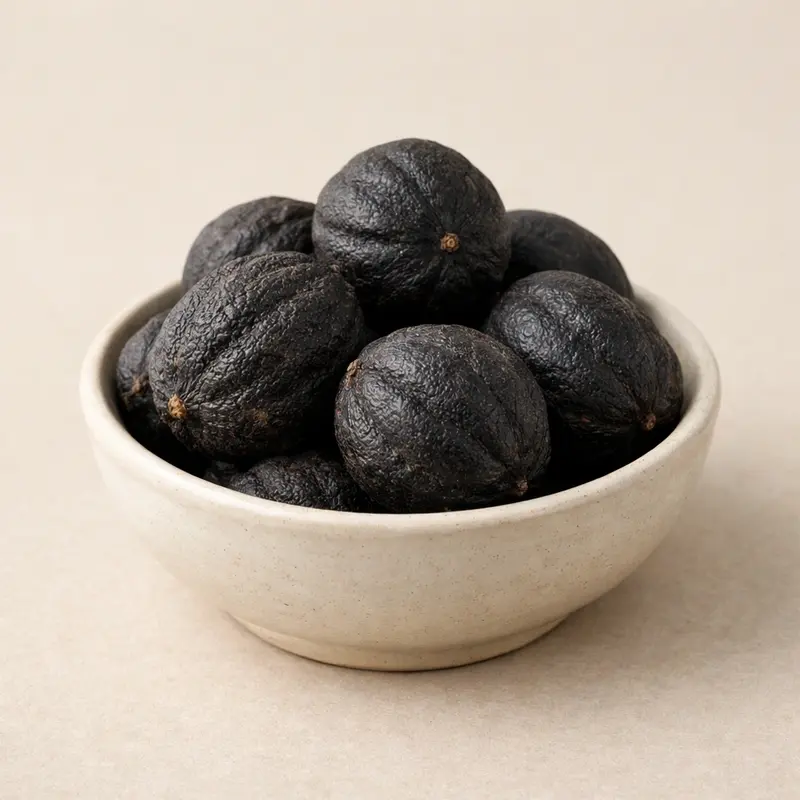


Buy Worth2Deal Black Dried Lemon Online — Unakka Naranga, Authentic Loomi for Mandhi, Kabsa and Machboos, 100g
Worth2Deal Black Dried Lemon is authentic Unakka Naranga — whole limes naturally sun-dried and smoked to produce the deep citrus tang essential for Mandhi, Kabsa, Machboos, Persian stews, and Arabian rice dishes. No additives, no artificial flavour, no preservatives. Available in 100g with free pan-India delivery. FSSAI Lic. No.: 21317233000044.
Available Offer
Share :
Worth2Deal Black Dried Lemon is authentic Unakka Naranga — whole limes naturally sun-dried and smoked into the concentrated citrus spice used across Middle Eastern, Persian, and Gulf cuisine. Known internationally as Loomi, Limoo Omani, Noomi Basra, or dried lime, this is the essential souring spice for Mandhi, Kabsa, Machboos, and Persian stews. No additives, no artificial colour, no preservatives. Available in 100g with free pan-India delivery.
What Is Black Dried Lemon — The Spice That Defines Gulf and Persian Cooking
Black dried lemon is not a spice blend or a flavouring compound. It is a whole lime that has been boiled in brine and then slowly sun-dried until all moisture evaporates and the interior turns dark and brittle. The result is a concentrated form of citrus that delivers a layered combination of sourness, smokiness, and a subtle fermented depth that fresh lime juice cannot replicate.
Wikipedia's entry on dried lime — the most reliably cited reference on the subject — documents that dried lime originated in the Persian Gulf and is known as Loomi in Oman, Limoo Amani or Limu Omani in Iran, and Noomi Basra in Iraq. The name Noomi Basra — meaning lemon from Basra — reflects the historical trade route through which these limes spread across the Middle East and South Asia. In India, particularly among Malabar Muslim communities in Kerala, it is called Unakka Naranga — dried lemon.
A ScienceDirect study published in the Journal of Functional Foods (December 2024) specifically examined black lemon's antioxidative and anti-inflammatory properties. The study found that after the aging-drying process, black lemon contains significantly higher concentrations of polyphenols and flavonoids compared to fresh lemon — including gallic acid, protocatechuic acid, vanillic acid, p-coumaric acid, ferulic acid, luteolin, naringenin, hesperetin, and diosmetin. The researchers confirmed the anti-inflammatory activity through NF-κB pathway inhibition studies.
Worth2Deal does not make clinical health claims for this product. The above is a factual summary of published food science research. This product is a culinary spice.
The Maillard Reaction — Why Black Dried Lemon Tastes Different From Dried Lemon
The dark colour and smoky, slightly fermented character of black dried lemon is not from artificial smoking or colouring. It is produced by the Maillard reaction — the same chemical process that browns bread crust, roasted coffee, and caramelised onions. As documented in the Wisdomlib culinary reference on black lemon (November 2025): the Maillard reaction occurs between the amino acids and reducing sugars in the lime during the drying process, producing the dark colour and complex aromatic compounds.
This is why the darker the lime, the more intense the flavour — a principle documented consistently across culinary sources including Linsfood.com and the Oman Magazine feature on Loomi. Both brown and black dried limes are the same product at different stages of the drying process. Black limes are dried longer — their interior is darker and their flavour is more concentrated and complex.
Worth2Deal Black Dried Lemon is the fully dried, deeply coloured black variety — maximum flavour concentration, not the milder brown stage.
The Flavour Profile — What Black Dried Lemon Actually Tastes Like
Black dried lemon delivers a flavour that has no single equivalent in Western cooking. The VitaLibrary culinary analysis (November 2025) describes it accurately: "salty, sour, a little musky and with just a hint of bitter." The citric acid provides sourness, but it is more mellow and complex than fresh lime because concentration during drying changes the acid balance. The Maillard-produced compounds add a smoky, earthy undertone. The slight fermentation during the drying process adds a muted savoury depth.
When simmered whole in a dish, black dried lemon releases its flavour gradually — the slow-release citrus deepens as cooking progresses. This is precisely why it is irreplaceable in long-cooked rice dishes like Mandhi and Kabsa, where a fresh lime squeezed in at the end cannot build the same structural sourness.
Why This Spice Matters for Mandhi, Kabsa, and Machboos — The Three Big Dishes
Mandhi is a traditional Yemeni and Gulf slow-cooked rice dish — meat simmered over low heat for hours with spices and the distinctive sourness of whole dried lemon as the defining flavour note. No authentic Mandhi recipe omits it. Black dried lemon is what separates Mandhi from ordinary spiced rice.
Kabsa is the national dish of Saudi Arabia — fragrant rice cooked with meat, tomatoes, and a spice blend that always includes dried lime as a souring agent. The Fas Kitchen comprehensive guide on dried lime documents that in Gulf cuisine, black dried lemon is "commonly added to soups, stews, rice dishes, and marinades" and that the powder "is used as a spice by Middle Eastern and Persian people."
Machboos is Bahrain and Qatar's version of a similar dish — heavily spiced rice with the same essential dried lime base note. The VitaLibrary analysis confirms that in Gulf cooking, black lime "is used whole, sliced, or ground as a spice."
For the large Malabar Muslim and Gulf-return community across Kerala, Karnataka, and Hyderabad, authentic Mandhi, Kabsa, and Machboos cooked at home requires genuine black dried lemon — not a substitute.
How to Use Worth2Deal Black Dried Lemon
Whole in slow cooking: Pierce the lime lightly with a knife or fork to allow flavour to escape. Drop into the pot during slow cooking — Mandhi, Kabsa, Machboos, dals, lentil soups, Persian stews. Remove before serving. The lime itself is not eaten directly.
Crushed for more flavour: Pound the dried lemon gently with the back of a knife to break it into 3 to 4 pieces. This releases more flavour during shorter cooking times. Suitable for biryanis, rice cookers, and chicken curries.
Ground into powder: Use a spice grinder or mortar and pestle to grind the dried lemon into powder. The resulting powder can be stirred into marinades, rubs, and spice blends for meats, vegetables, and roasted dishes. Linsfood.com documents this as standard practice in Persian and Gulf cuisine.
Dried lemon tea: Boil one whole dried lemon in 400ml of water for 8 to 10 minutes. Strain and drink. This is a traditional Gulf remedy documented in the Gosumitup.com culinary guide on Loomi as a warming, digestion-supporting tea.
In spice blends: Ground black dried lemon is a component of Gulf-style baharat — the Middle Eastern equivalent of garam masala. Use 1 teaspoon of ground dried lemon per tablespoon of baharat mixture.
Also From Worth2Deal — Ayurvedic and Herbal Products
For another traditional herbal product, explore Worth2Deal Nannari Sharbat — Authentic Naruneendi Syrup 1 Litre — the classic South Indian Ayurvedic cooling drink. Browse our complete range at the Ayurvedic and Herbal Products collection.
Storage Instructions
Store in a tightly sealed airtight container in a cool dry place away from moisture and direct sunlight. Black dried lemon can absorb ambient moisture which softens the shell and reduces intensity. Under correct storage conditions — dry, airtight, away from light — dried lemon retains full flavour for 12 to 18 months. Do not refrigerate — condensation reduces shelf life.
Shelf life: 12 months from date of manufacture in airtight storage.
Product Details
Net Weight: 100g Product Type: Whole black dried lemon, naturally sun-dried and smoked Main Ingredient: Citrus aurantifolia / Citrus latifolia (dried lime) Additives: None Artificial Colour: None Artificial Flavour: None Preservatives: None Salt: May contain trace salt from traditional brine preparation Dietary: Vegan, vegetarian, gluten-free Also known as: Loomi, Limoo Omani, Limu Omani, Noomi Basra, Unakka Naranga (Malayalam), Kala Nimbu, Dried Lime, Black Lime, Lemon Omani Shelf Life: 12 months from manufacture in airtight storage Storage: Cool dry place, airtight container, do not refrigerate Manufactured and Packed by: Worth2Deal, 7/330 Shanti Nagar, Valayamkulam, Kokkur Post, Malappuram District, Kerala 679591 FSSAI Licence No.: 21317233000044 Contact: worth2deal.com@gmail.com | +91 9846294242
FAQs-Worth2Deal Black Dried Lemon
Q1: What is black dried lemon and what is it used for?
Black dried lemon is a whole lime that has been boiled in brine and then slowly sun-dried until all moisture is gone and the interior turns dark and brittle. It is known internationally as Loomi (Oman), Limoo Omani (Iran), Noomi Basra (Iraq), and Unakka Naranga in Kerala. Wikipedia documents that dried lime originated in the Persian Gulf and is used across Middle Eastern cuisine as the primary souring spice in rice dishes, stews, soups, and spice blends. Worth2Deal Black Dried Lemon is used in Mandhi, Kabsa, Machboos, Persian stews, biryanis, and lentil dishes. No additives, no artificial flavour, no preservatives. FSSAI Lic. No.: 21317233000044.
Q2: Why is black dried lemon used in Mandhi and Kabsa?
Mandhi and Kabsa are Gulf slow-cooked rice dishes where the defining flavour is the structural sourness of dried lime simmered whole for hours in the cooking liquid. Fresh lime juice cannot replicate this because it delivers a sharp immediate sourness that evaporates with heat. Black dried lemon releases its citrus slowly — building a mellow, fermented, deep citrus character over long cooking that becomes the backbone of the dish. No authentic Mandhi, Kabsa, or Machboos recipe substitutes this ingredient. The Fas Kitchen comprehensive guide on dried lime confirms it is "commonly added to soups, stews, rice dishes, and marinades" across Gulf and Persian cuisine.
Q3: What is the difference between black dried lemon and regular dried lemon?
Both black and brown dried lemons are the same product — whole limes boiled in brine then sun-dried. The difference is drying duration. Brown dried limes are dried for a shorter period — milder flavour, lighter colour. Black dried limes are dried longer — the extended drying triggers greater Maillard reaction, producing a darker colour and more concentrated, complex flavour. Linsfood.com documents this clearly: "the black limes are just dried a little longer — the darker the lime, the more intense and pungent the flavour." Worth2Deal supplies the fully dried black variety — maximum flavour concentration.
Q4: What does black dried lemon taste like?
The flavour is a layered combination of sourness, smokiness, mild bitterness, and a subtle fermented depth. The VitaLibrary culinary analysis (November 2025) describes dried lime as "salty, sour, a little musky and with just a hint of bitter." It is unlike fresh lime — the citric acid is mellower and more complex because the drying process changes the acid balance. The Maillard reaction during drying adds smoky, earthy aromatic compounds with no equivalent in fresh citrus. When used whole in slow cooking, it releases flavour gradually — the slow-release sourness is precisely what makes it irreplaceable in long-cooked rice dishes.
Q5: How do I use black dried lemon in cooking?
For slow-cooked dishes — Mandhi, Kabsa, biryanis, lentil dals, Persian stews — pierce the lime lightly and drop it whole into the pot. Remove before serving. For shorter cooking times, pound the dried lemon into 3 to 4 pieces to release more flavour faster. For spice blends, rubs, and marinades, grind into powder using a spice grinder or mortar and pestle. For dried lemon tea, boil one whole dried lemon in 400ml water for 8 to 10 minutes, strain, and drink. Ground dried lemon powder is also used as a component in Gulf-style baharat spice blends.
Q6: Is black dried lemon the same as Unakka Naranga?
Yes. Unakka Naranga is the Malayalam name — Unakka means dried, Naranga means citrus. It is the same product known in Arabic cuisine as Loomi, in Iranian cuisine as Limoo Omani or Limu Omani, and in Iraqi cuisine as Noomi Basra. Among Malabar Muslim communities in Kerala who have family ties to Gulf countries, this ingredient is a regular kitchen staple used in Mandhi and Kabsa prepared at home. Worth2Deal sources and packs Unakka Naranga in Malappuram and delivers across India.
Q7: Does black dried lemon have any nutritional value?
A ScienceDirect study published in the Journal of Functional Foods (December 2024) examined black lemon's composition after the aging-drying process and found significantly higher concentrations of polyphenols and flavonoids compared to fresh lemon — including protocatechuic acid, p-coumaric acid, ferulic acid, luteolin, naringenin, and hesperetin. The VitaLibrary nutritional analysis confirms black lime contains vitamin C, potassium, calcium, and antioxidant plant compounds in concentrated form. Worth2Deal does not make health claims for this product. This is a culinary spice. Consult your doctor for medical advice.
Q8: Can I order Worth2Deal Black Dried Lemon from Delhi, Mumbai, Bangalore, or Hyderabad?
Yes. Worth2Deal ships pan-India from Malappuram, Kerala with free delivery on all orders. We deliver to Mumbai, Delhi, Bangalore, Hyderabad, Chennai, Pune, Kolkata, Ahmedabad, Kochi, Thiruvananthapuram, Kozhikode, Thrissur, Malappuram, Coimbatore, Mysore, Surat, Jaipur, Lucknow, Nagpur, and all major cities. Delivery takes 4 to 7 working days. With a 12-month shelf life, the dried lemon arrives in perfect condition regardless of destination.
Q9: How long does black dried lemon last and how should I store it?
In a tightly sealed airtight container in a cool dry place, black dried lemon retains full flavour for 12 to 18 months. Moisture is the primary enemy — avoid refrigeration as condensation softens the dried shell and reduces aroma intensity. Keep in a dark location — light accelerates the breakdown of aromatic compounds. If the lemon has absorbed some moisture and feels soft rather than brittle, spread on a tray and leave in a warm dry place for a few hours to restore dryness. Shelf life from manufacture: 12 months.
Q10: Can I make dried lemon powder from whole black dried lemon?
Yes — grinding whole black dried lemon into powder is a standard practice in Middle Eastern cooking. Use a spice grinder for fine powder or a mortar and pestle for coarser texture. The resulting powder is used in spice rubs for grilled meat, stirred into rice before cooking, mixed into baharat and ras el hanout spice blends, and used as a finishing seasoning on grilled vegetables and roasted chicken. Ground dried lemon has a more intense citrus hit per volume than whole lemon — use sparingly in initial batches until you calibrate to your taste preference.
Q11: Which cities does Worth2Deal deliver Black Dried Lemon to?
Worth2Deal ships across India with free delivery — including Mumbai, Delhi, Bangalore, Hyderabad, Chennai, Pune, Kolkata, Ahmedabad, Kochi, Thiruvananthapuram, Kozhikode, Thrissur, Malappuram, Palakkad, Kannur, Coimbatore, Mysore, Jaipur, Surat, Lucknow, Nagpur, Bhopal, Patna, Guwahati, Chandigarh, Bhubaneswar, Vizag, and all major cities and towns. Dispatched from Malappuram, Kerala within 1 to 2 business days, delivered in 4 to 7 working days.
Q12: Is demand for Middle Eastern spices like black dried lemon growing in India?
Yes — significantly. The rise of Mandhi restaurants across tier-1 and tier-2 Indian cities between 2020 and 2025 has brought Gulf cuisine into mainstream Indian food culture. Mandhi rice has become a popular dish in Bangalore, Hyderabad, Chennai, Mumbai, and Delhi restaurants. Home cooks who have eaten Mandhi in restaurants now search for authentic ingredients to replicate the dish at home — black dried lemon being the most distinctive and least substitutable of those ingredients. Worth2Deal's Amazon listing for Black Dried Lemon confirms 8+ years of family trust on the platform. Worth2Deal packs and delivers authentic Unakka Naranga from Malappuram pan-India.