

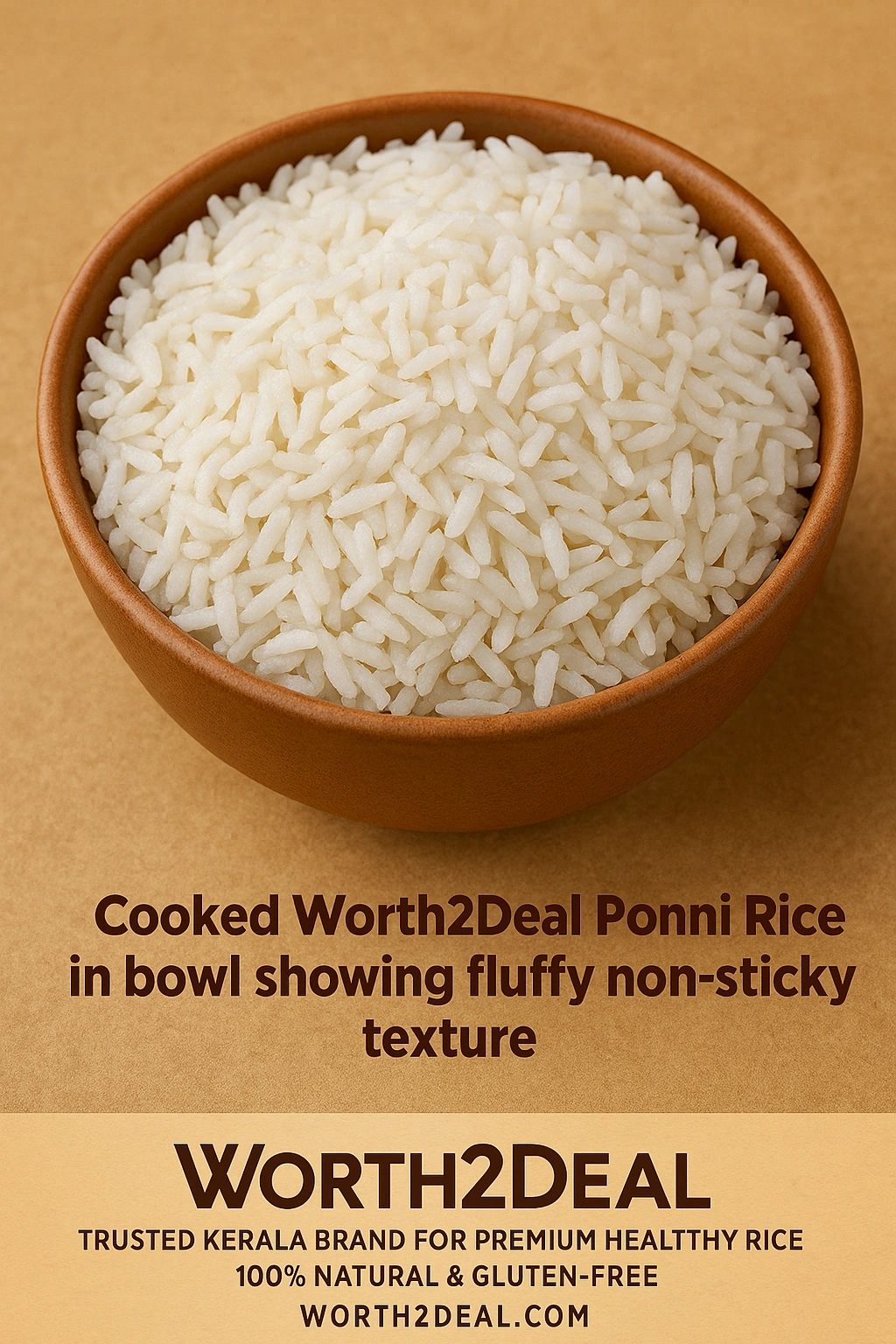


Worth2Deal Ponni Rice | Parboiled South Indian Rice | Low GI | Gluten Free | Diabetic Friendly | Sourced from Palakkad | 1kg, 2kg & 5kg
Available Offer
Share :
The Rice That Keeps South Indian Kitchens Running
There is a rice that does not demand attention. It does not need to be the centrepiece of a conversation about nutrition trends or ancient heritage. It simply does what a great everyday rice should do — it cooks quickly, absorbs the curry placed beside it without overpowering it, stays soft and separate for hours, and makes every meal feel complete without effort.
That rice is Ponni.
Worth2Deal Ponni Rice is a traditional South Indian parboiled rice variety sourced directly from Palakkad, Kerala — the region known as Kerala's rice bowl for its fertile soil and ideal rice-growing conditions. Soft, fluffy, naturally low GI, and gluten free — Ponni is the rice that millions of South Indian families reach for every single day. Not for festivals. Not for special occasions. For Tuesday lunch. For the quick sambar rice that needs to be ready in 20 minutes. For the curd rice at the end of a meal that makes everything settle.
Worth2Deal sources this Ponni Rice directly from Palakkad farms — cleaned, sorted, and packed hygienically in Malappuram, Kerala. No middlemen. No adulteration. Just dependable, genuine South Indian Ponni rice.
What Is Ponni Rice — The Full Story
Ponni Rice is a medium-grain parboiled rice variety developed by the Tamil Nadu Agricultural University (TNAU) in the 1960s — released in 1986 — and named after the Cauvery River (Ponni being the Tamil name for the Cauvery). It was developed specifically to combine three qualities that South Indian families needed most from their daily rice: easy digestibility, consistent cooking quality, and nutritional retention through parboiling.
Within a decade of its release, Ponni became the most widely consumed rice variety across Tamil Nadu — and rapidly spread to Kerala, Karnataka, and Andhra Pradesh as the go-to everyday rice for South Indian households. Today it remains the default daily rice for millions of South Indian families and the standard rice used in South Indian restaurants across India for sambar rice, rasam rice, and curd rice service.
Worth2Deal sources Ponni Rice from Palakkad — a key growing region for this variety where the black cotton soil and consistent water supply from the Western Ghats produce grains of exceptional consistency and flavour.
Why Parboiling Makes Ponni Better
Parboiling is not just a processing step — it is the reason Ponni Rice is nutritionally superior to raw polished white rice. Before the paddy is milled, it is soaked, steamed, and dried while still in the husk. This steaming process drives the vitamins and minerals from the outer husk layer deep into the grain before the husk is removed.
The result: a parboiled Ponni grain retains significantly more B vitamins — thiamine (B1), riboflavin (B2), and niacin (B3) — than raw milled rice of the same variety. These B vitamins are essential for energy metabolism, nervous system health, and cell function — and are completely lost in raw milling.
Parboiling also gelatinises the starch in the grain — which is why parboiled Ponni cooks into separate, non-sticky grains rather than clumping together. This gelatinisation lowers the rice's glycaemic index compared to raw rice — slowing glucose release and making it a more suitable daily rice for people managing blood sugar.
The Nutritional Profile of Parboiled Ponni Rice
Parboiled Ponni Rice is not a superfood. But it is a genuinely better daily rice than polished white rice — and that matters when you eat rice twice a day.
Glycaemic Index
Parboiled Ponni Rice has a lower glycaemic index than raw polished white rice — typically in the 50–60 range depending on cooking method and cooling time. This means blood glucose rises more slowly and steadily after eating Ponni compared to regular polished rice. Suitable for diabetics as an everyday rice option — particularly when paired with high-fibre vegetables and protein-rich curries.
B Vitamins
Thiamine, riboflavin, and niacin driven into the grain during parboiling — supporting energy metabolism and nervous system health.
Iron
Present in parboiled Ponni — contributing to daily iron intake for managing anaemia risk.
Magnesium
Supports heart function, blood pressure regulation, and bone health.
Gluten Free
Ponni Rice is naturally gluten free — suitable for people with gluten intolerance, wheat sensitivity, or coeliac disease.
Easy Digestibility
The gelatinised starch in parboiled Ponni is easier to digest than raw rice — particularly beneficial for people with sensitive stomachs, children, and the elderly.
Important note: Ponni Rice is a carbohydrate food. While parboiled Ponni has a lower GI than raw polished rice, people with diabetes should manage portion sizes and consult a healthcare provider before making it a daily dietary staple.
How to Use Worth2Deal Ponni Rice
Daily South Indian Meals
Ponni with sambar, rasam, dal, fish curry, chicken curry, avial, thoran, and moru curry. The soft, separate grain texture absorbs each curry gently without competing — making it the most versatile base for South Indian cooking.
Sambar Rice
Mix freshly cooked Ponni with hot sambar directly on the plate — the soft grain absorbs sambar deeply, creating the satisfying mixed rice that is the backbone of every South Indian lunch.
Rasam Rice
The soft texture of Ponni makes it particularly well-suited for rasam — the thin, peppery South Indian soup that soaks into rice better when the grain is soft and yielding.
Curd Rice
Cooked Ponni mixed with thick fresh curd, tempered with mustard seeds, curry leaves, and green chilli — the traditional cooling end to every South Indian meal. Ponni's non-sticky texture ensures the curd rice stays light and fresh rather than heavy.
Lemon Rice and Tamarind Rice
The firm but soft grain holds the tempering and spice coating evenly in mixed rice preparations.
Pongal
Ponni cooked with moong dal, ghee, pepper, and cumin makes the traditional South Indian Pongal — one of the most beloved comfort foods in Tamil Nadu and Kerala.
Idli and Dosa Batter
Ponni can be used in idli and dosa batter in place of or alongside idli rice for a slightly firmer batter texture. For dedicated idli and dosa batter preparation — explore our Worth2Deal Idli Ponni Parboiled Rice — specifically selected for soft idlis and crispy dosas.
Rice Porridge and Kanji
Ponni cooked with generous water makes a smooth, comforting rice porridge — lighter and more delicate than Matta rice kanji, ideal for illness recovery and gentle digestive support.
How to Cook Worth2Deal Ponni Rice
Rinse the rice 2–3 times until water runs clear. Soak for 15–20 minutes before cooking — parboiled Ponni soaks faster than raw rice due to the gelatinised starch structure.
Pressure Cooker (Recommended):
Use 1 cup rice to 2.5 cups water. Cook on medium flame for 3–4 whistles. Allow pressure to release naturally. Open and fluff gently with a fork. Ponni cooks faster than Matta rice — 3–4 whistles produces perfectly soft, separate, non-sticky grains. Do not overcook or grains will become mushy.
Open Vessel (Traditional Method):
Use 1 cup rice to 5–6 cups water in a large pot. Bring to full boil. Add soaked rice. Cook on medium flame for 15–18 minutes stirring occasionally. Press a grain between fingers — it should mash smoothly and completely. Drain through colander. The excess starchy water can be consumed warm as a nourishing kanji drink.
Electric Rice Cooker:
Use 1 cup rice to 2 cups water. Cook on standard white rice setting. Allow to rest for 5 minutes after the cooker switches to warm mode before opening. Fluff with fork before serving.
Rice Porridge (Kanji):
Use 1 cup rice to 8–10 cups water. Cook on low flame for 20–25 minutes without draining. Stir occasionally. Add salt to taste. Serve warm with small onions, green chillies, and pickle for a light comforting meal.
Storage Instructions
Store in a cool, dry, airtight container away from direct sunlight and moisture. Add 2–3 dried cloves or a bay leaf inside the container to naturally prevent infestation during long storage. Best consumed within 8–10 months of purchase for optimal freshness and flavour. Do not store near strong-smelling items — rice absorbs odours easily.
FAQ
What is Ponni Rice?
Ponni Rice is a traditional South Indian medium-grain parboiled rice variety developed by Tamil Nadu Agricultural University — named after the Cauvery River (Ponni in Tamil). Released in 1986, it became the most widely consumed everyday rice across Tamil Nadu, Kerala, and South India within a decade of release. Worth2Deal Ponni Rice is sourced from Palakkad, Kerala — parboiled with nutrients retained, soft non-sticky texture, naturally low GI and gluten free. FSSAI Lic. No.: 21317233000044.
Is Ponni Rice good for diabetics?
Yes. Parboiled Ponni Rice has a lower glycaemic index than raw polished white rice — typically in the 50–60 range. The parboiling process gelatinises the starch in the grain, slowing glucose release and reducing blood sugar spikes compared to regular white rice. Pairing Ponni with high-fibre vegetables and protein-rich curries further slows glucose absorption. People with diabetes should manage portion sizes and consult a healthcare provider for personalised dietary advice.
What is the difference between Ponni Rice and regular white rice?
Regular polished white rice has its husk, bran, and germ removed entirely — leaving only starch with minimal nutrition and a high glycaemic index. Ponni Rice is parboiled before milling — a process that drives B vitamins and minerals from the outer husk deep into the grain before the husk is removed. The result is a rice with better nutritional retention, lower GI, and non-sticky cooked texture compared to raw polished white rice. Worth2Deal Ponni is sourced from Palakkad and packed in Malappuram — no artificial additives.
Is Ponni Rice gluten free?
Yes. Worth2Deal Ponni Rice is naturally gluten free — suitable for people with gluten intolerance, wheat sensitivity, or coeliac disease. Rice is inherently gluten-free as it does not contain the gluten proteins found in wheat, barley, and rye. Worth2Deal Ponni is processed in a facility that handles only rice — no cross-contamination risk from wheat products.
Why does parboiled Ponni Rice cook non-sticky?
The parboiling process gelatinises the starch inside the Ponni grain while it is still in the husk. This gelatinisation changes the starch structure — the cooked grains stay separate and firm rather than sticking together as raw rice does. This is why parboiled Ponni is preferred for sambar rice, curd rice, and lunch meals where separate, non-sticky grains are essential for proper texture and eating experience.
What dishes can I make with Ponni Rice?
Worth2Deal Ponni Rice is ideal for sambar rice, rasam rice, curd rice, lemon rice, tamarind rice, Pongal, biryani, rice porridge, and all daily South Indian meals. It pairs perfectly with sambar, rasam, fish curry, chicken curry, dal, avial, thoran, and moru curry. It can also be used in idli and dosa batter — though for dedicated batter use, see our Worth2Deal Idli Ponni Parboiled Rice which is specifically selected for soft idlis and crispy dosas.
How do I cook Worth2Deal Ponni Rice in a pressure cooker?
Rinse the rice 2–3 times until water runs clear. Soak for 15–20 minutes. Use 1 cup rice to 2.5 cups water in a pressure cooker. Cook on medium flame for 3–4 whistles. Allow pressure to release naturally. Open and fluff with a fork. Ponni cooks faster than Matta rice due to its medium grain structure — 3–4 whistles produces soft, separate, perfectly cooked grains.
Is Ponni Rice sourced from Palakkad?
Yes. Worth2Deal Ponni Rice is sourced directly from Palakkad, Kerala — a key growing region for this variety where fertile soil and consistent water supply from the Western Ghats produce grains of exceptional consistency and flavour. Cleaned, sorted, and hygienically packed by Worth2Deal in Malappuram, Kerala. FSSAI Lic. No.: 21317233000044.
How should I store Ponni Rice for maximum freshness?
Store in a cool, dry, airtight container away from direct sunlight and moisture. Add 2–3 dried cloves or a bay leaf to naturally prevent infestation — the traditional South Indian household method. Best consumed within 8–10 months of purchase for optimal freshness. Do not store near strong-smelling items — rice absorbs odours easily.
What is the difference between Ponni Rice and Idli Ponni Rice?
Ponni Rice is the everyday table rice — used for daily meals, sambar rice, rasam rice, curd rice, and general South Indian cooking. Idli Ponni is a specific short-grain variety of Ponni rice selected specifically for its soaking, grinding, and fermentation properties — producing the smooth batter needed for soft idlis and crispy dosas. Worth2Deal supplies both — see our Idli Ponni Parboiled Rice for dedicated batter preparation.
Worth2Deal Ponni Rice is sourced directly from Palakkad farms — standard parboiled, naturally low GI, gluten free, and packed in Malappuram with no artificial additives and no middlemen. This is the everyday South Indian rice that millions of families trust for every meal — soft, non-sticky, consistently dependable. Order now — 1kg, 2kg, or 5kg — delivered free anywhere in India.
[Order Worth2Deal Ponni Rice Now — Free Pan-India Delivery →]