

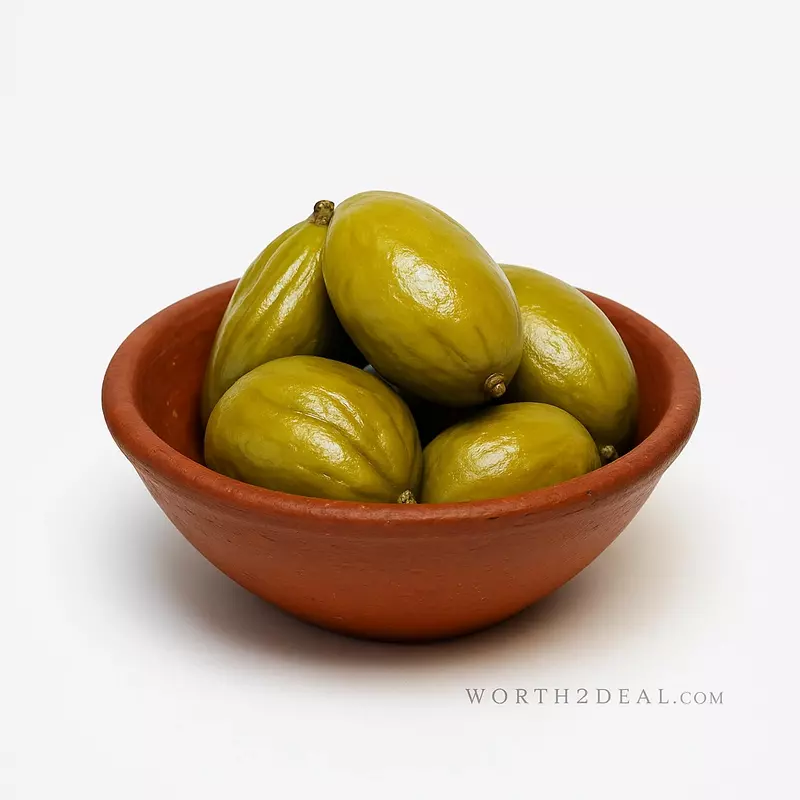


Buy Worth2Deal Kerala Manga Uppilittathu Online — Kilichundan Mango in Brine
Worth2Deal Kerala Manga Uppilittathu is kilichundan raw mango slow-fermented for 6 months in pure rock salt brine using the traditional Palakkad Namboodiri bharani method — no vinegar, no oil, no preservatives, no spices. Available in 400g with free pan-India delivery. FSSAI Lic. No.: 21317233000044.
Available Offer
Share :
Kerala Manga Uppilittathu is whole raw Kilichundan mango preserved in pure rock salt brine for a minimum of six months using the traditional Palakkad bharani method — without vinegar, oil, spices, or preservatives — producing Kerala's most authentic uppu manga with deep natural sourness and firm texture.
The Bharani That Takes Six Months
Every April and May, when the Kilichundan mango trees in Palakkad are heavy with hard, firm green fruit — that brief window before the summer rains — a Namboodiri family begins the same ritual their ancestors followed for centuries.
The mangoes are handpicked at peak firmness, with a small piece of stalk retained to keep the skin sealed and the juices locked inside. They are washed, dried completely — not a drop of water can remain — and packed whole into large ceramic bharanis. Pure rock salt goes in between each layer. The lid is sealed. The bharani goes into a cool dark corner of the house.
Nobody touches it for six months.
What comes out of that bharani in October or November is Manga Uppilittathu — the real kind. Tangy, firm, intensely flavoured brine-preserved mango that has slowly absorbed salt through every cell wall over half a year. Worth2Deal sources this directly from that Palakkad Namboodiri family. What reaches your table is their recipe — unchanged — in a 400g pack, delivered free anywhere in India.
What Is Manga Uppilittathu — For Those Searching in English
Manga Uppilittathu (Malayalam: മാങ്ങ ഉപ്പിലിട്ടത്) literally means mango preserved in salt. In English it is most accurately described as Kerala-style mango in brine or salted raw mango. It is also called Uppu Manga, Uppu Mango, and Salt Mango across different parts of Kerala. It is not a pickle in the conventional sense — there is no oil, no spice paste, no chilli. It is purely whole mango, rock salt, water, and time. This is Kerala's oldest preservation technique, used across all communities to carry the taste of mango season through the full year.
Why Kilichundan — Why Not Any Other Mango
Kilichundan — named for the beak-like tip (kili = bird, chundan = beak in Malayalam) — is a native Kerala mango variety cultivated primarily in Palakkad district. It is the only variety Namboodiri households in Palakkad have traditionally used for Manga Uppilittathu — not because it is the cheapest, but because nothing else produces the same result.
Its firm, fibre-free flesh holds structure through six months of fermentation without turning soft or mushy. Its thick skin locks in the mango's natural sourness throughout the brine period. Its naturally high malic acid content produces a deep, rounded sourness after six months — not the sharp, flat sourness of quick-brined cheaper varieties.
Kilichundan mango is available only during a short April-May window in Palakkad each year. Worth2Deal sources the entire year's stock during this single seasonal harvest — which is why we produce only one batch per year and stock is genuinely limited.
Why Six Months — The Full Process, Not a Shortcut
Six months is when the salt fully penetrates a whole Kilichundan mango to the seed. At six months the sourness mellows from sharp and raw to deep and rounded. The texture becomes firm but yielding — not crunchy like a quick-brined product, not mushy like an overbrined one. The brine flavour embeds throughout the flesh — not just on the surface.
This process cannot be replicated in six days or six weeks. Quick-brined products taste unfinished. Worth2Deal Manga Uppilittathu is released only after the full six-month cycle is complete — this is not a marketing claim, it is when the product is actually ready to eat.
No Vinegar — Why This Matters
Vinegar is added to commercial brine pickles to accelerate sourness quickly and extend shelf life cheaply. It also covers the mango's natural flavour under a sharp acidic edge that has nothing to do with mango. Worth2Deal Manga Uppilittathu contains zero vinegar. The sourness comes entirely from the raw Kilichundan mango's own malic acid, developed slowly through natural fermentation over six months. This is the taste that pairs correctly with kanji and curd rice. Vinegar brine does not.
Manga Uppilittathu vs Mango Pickle — Understanding the Difference
This is the most common question buyers ask — and it deserves a clear answer.
Manga Uppilittathu is a pure salt brine product — no oil, no spices, no chilli. It is a side dish, served alongside rice and kanji. The flavour is tangy, salty, and clean — nothing else. Mango Pickle (Manga Achar) is an oil-based spiced condiment made with sesame oil, chilli powder, mustard, fenugreek, and asafoetida. It is bold, spicy, and meant to be eaten in small quantities as a flavour punch alongside a full meal.
Both belong in a Kerala kitchen. They serve different purposes. If you want the bold, spicy version, Worth2Deal also makes Kerala Tender Mango Pickle — Kannimanga Achar — same Namboodiri family, same Palakkad tradition, different preparation. If you want the pure brine side dish that goes with kanji every morning — that is this product.
Manga Uppilittathu vs Maavadu — The Difference
Maavadu is a Tamil Nadu product using marble-sized baby tender mangoes in heavy brine — very common in Tamil Nadu, Andhra Pradesh, and Karnataka. Worth2Deal Manga Uppilittathu uses Kilichundan — a fully grown, mature raw mango variety native to Palakkad, Kerala. Different mango, different size, different flavour depth. The Kilichundan's thick skin and fibre-free flesh develop a fuller, more complex sourness over six months that baby mangoes cannot produce. If you grew up in a Kerala home, the taste of Manga Uppilittathu is distinct from Maavadu — and unmistakable.
How to Eat Manga Uppilittathu — The Kerala Way
- With Kanji— the classic pairing. One piece alongside hot Kerala red rice kanji. The tangy brine cuts through the starch and lifts the entire bowl. This is breakfast in thousands of Kerala homes every morning across Malappuram, Thrissur, Palakkad, and Kozhikode.
- With Plain Rice and Dal— place one or two pieces on the side of the lunch plate. The salt and natural sourness act as a natural digestive pairing with lentils.
- With Curd Rice — fermented mango alongside fermented curd — both naturally tangy, both cooling. A combination documented in Kerala kitchen practice for centuries.
- With Kerala Sadya— Manga Uppilittathu has a traditional place in Kerala sadya as a palate cleanser.
- With Dosa or Idli— break a small piece and eat alongside plain dosa. Works particularly well with thin, crisp dosa without chutney.
- As an Off-Season Mango Substitute — use the brined mango pieces in manga curry, manga pachadi, or manga chammanthi when raw mangoes are out of season.
- Mid-Morning with Water — one piece of Uppu Manga with water — the traditional Kerala mid-morning pick-me-up before electrolyte drinks existed.
Storage Instructions
Refrigerate immediately after opening. Always use a clean, completely dry spoon — never introduce moisture into the jar. Keep mango pieces fully submerged in brine at all times. If brine level drops, add a small amount of boiled and cooled salt water to cover. Best consumed within 3 to 4 months of opening. Unopened — store in a cool, dark place away from direct sunlight.
Also from Worth2Deal Kerala Pickles
For the bold, spiced version of Kerala mango preserve, see our Kerala Tender Mango Pickle — Kannimanga Achar — sesame oil, chilli, mustard, fenugreek, same Namboodiri family. For our full range of traditional Kerala pickles and kondattam, explore the Kerala Pickles & Kondattam collection.
Product Details
Contents: Kilichundan raw mango, natural rock salt, water Net Weight: 400g Mango Variety: Kilichundan — native Palakkad, Kerala Made By: Namboodiri family — traditional recipe, Palakkad, Kerala Brine Duration: Minimum 6 months — bharani method Mango Season Sourced: April-May peak harvest only Preservatives: None Vinegar: None Oil: None Spices: None — pure brine only Allergens: None Shelf Life: 12 months unopened — 3 to 4 months after opening (refrigerated) Packed by: Worth2Deal, 7/330 Shanti Nagar, Valayamkulam, Kokkur Post, Malappuram District, Kerala 679591 FSSAI Licence No.: 21317233000044 Contact: worth2deal.com@gmail.com | 91 9846294242
FAQ — Kerala Manga Uppilittathu
Q1. What is manga uppilittathu — what does it mean in English?
Manga Uppilittathu (Malayalam: മാങ്ങ ഉപ്പിലിട്ടത്) means mango preserved in salt. In English it is most accurately described as Kerala mango in brine or Kerala salted raw mango. It is also called Uppu Manga, Uppu Mango, and Salt Mango. Worth2Deal uses Kilichundan mango from Palakkad, fermented for 6 full months in the traditional bharani method by a Namboodiri family — no vinegar, no oil, no preservatives. FSSAI Lic. No.: 21317233000044.
Q2. Where can I buy authentic manga uppilittathu online with free delivery?
Worth2Deal sources Manga Uppilittathu directly from a Namboodiri family in Palakkad — Kilichundan variety, 6 months in brine, no vinegar, no oil, no preservatives. Available in 400g with free pan-India delivery from worth2deal.com. We regularly deliver to Bangalore, Mumbai, Delhi, Hyderabad, Chennai, Pune, and all major cities. Cash on Delivery available at checkout for eligible pin codes. FSSAI Lic. No.: 21317233000044.
Q3. What is the difference between manga uppilittathu and mango pickle?
Manga Uppilittathu is a pure salt brine product — no oil, no spices, no chilli. It is a mild, tangy side dish for kanji and plain rice. Mango Pickle (Manga Achar) is an oil-based spiced condiment made with sesame oil, chilli, mustard, and fenugreek — bold and spicy, eaten in small quantities. Think of Uppilittathu as a daily side dish and Achar as a flavour-packed condiment. Worth2Deal makes both — see our Kerala Tender Mango Pickle for the spiced version.
Q4. What is the difference between manga uppilittathu and maavadu?
Maavadu uses marble-sized baby tender mangoes in heavy brine — common in Tamil Nadu. Worth2Deal Manga Uppilittathu uses Kilichundan — a fully grown mature raw mango native to Palakkad, Kerala. Different mango, different size, different flavour depth. Kilichundan's thick skin and fibre-free flesh develop a fuller, more complex sourness over 6 months that baby mangoes cannot produce. If you grew up in a Kerala home the difference in taste is immediately recognisable.
Q5. What is the difference between uppu manga and manga uppilittathu?
They are the same product. Uppu Manga, Manga Uppilittathu, and Uppu Mango are all Malayalam names for raw mango preserved in salt brine. Uppu means salt, Manga means mango, Uppilittathu means preserved in salt. Worth2Deal's version uses Kilichundan mango specifically from Palakkad, fermented for the full 6-month traditional bharani cycle.
Q6. Why does worth2deal manga uppilittathu take 6 months to make?
Six months is when the salt fully penetrates a whole Kilichundan mango to the seed. At six months the sourness mellows from sharp to deep and rounded, the texture becomes firm but yielding, and the brine flavour embeds throughout — not just on the surface. Quick-brined products taste unfinished. Worth2Deal releases Manga Uppilittathu only after the full six-month cycle — this is not a marketing claim, it is when the product is actually ready.
Q7. Why does worth2deal use only kilichundan mango — what is special about it?
Kilichundan is a native Kerala mango variety from Palakkad with firm, fibre-free flesh that holds structure through six months of fermentation without turning mushy. Its thick skin locks in natural sourness throughout the brine period. Its high malic acid content produces deep, rounded sourness after six months. No other variety produces the same result in the bharani method — which is why Namboodiri households in Palakkad have always used Kilichundan specifically for Manga Uppilittathu.
Q8. Why is there no vinegar in worth2deal manga uppilittathu?
Vinegar is added to commercial brine products to accelerate sourness artificially and extend shelf life cheaply. It also masks the mango's natural flavour with a sharp acidic edge. Worth2Deal Manga Uppilittathu contains zero vinegar. All sourness comes from the Kilichundan mango's own malic acid developed naturally over six months. This is the authentic taste that pairs correctly with kanji, plain rice, and curd rice.
Q9. Is manga uppilittathu healthy?
Worth2Deal Manga Uppilittathu contains only Kilichundan mango, natural rock salt, and water — zero artificial additives, preservatives, or colours. Natural slow fermentation produces beneficial organic acids. Raw mango contributes Vitamin C and antioxidants. It is high in sodium due to brine preservation — consume 1 to 2 pieces per meal as a side dish, not in large quantities. People managing blood pressure or sodium intake should use it sparingly and consult their doctor.
Q10. How long does manga uppilittathu last after opening?
Refrigerate immediately after opening. Always use a clean, completely dry spoon — never introduce moisture into the jar. Keep mango pieces fully submerged in brine. Under these conditions Worth2Deal Manga Uppilittathu stays good for 3 to 4 months after opening. Unopened it keeps for 12 months stored in a cool dark place.
Q11. I want a spicy mango product — is manga uppilittathu the right choice?
No — Manga Uppilittathu is not spicy. It is purely tangy and salty with no chilli, no spices, and no oil. If you want a bold, spicy Kerala mango product, Worth2Deal's Kerala Tender Mango Pickle — Kannimanga Achar is made with sesame oil, chilli powder, mustard, fenugreek, and asafoetida — same Namboodiri family, same Palakkad tradition, completely different preparation.
Q12. Will kerala mango in brine like manga uppilittathu become popular across India the way canned pickles are?
It already is. Searches for manga uppilittathu online, uppu manga buy, and kilichundan mango brine have grown consistently on e-commerce platforms over the last three years — driven by the Kerala diaspora across Bangalore, Mumbai, Delhi, and Dubai who grew up eating it at home and can now order it directly. What coconut oil did for Kerala food culture nationally, traditional preserved foods like Manga Uppilittathu are doing now — and with an authenticity story that mass-produced brands cannot compete with. Worth2Deal has been part of this shift since 2017, delivering Palakkad's traditional recipes to Kerala kitchens across India.
Worth2Deal Kerala Manga Uppilittathu is sourced directly from a Namboodiri family in Palakkad — Kilichundan mango, six months in brine, no vinegar, no oil, no preservatives, no shortcuts. The real Uppu Manga that Kerala grew up on, packed in Malappuram and delivered free anywhere in India. Order now — 400g.
Order Worth2Deal Kerala Manga Uppilittathu Now — Free Pan-India Delivery →