

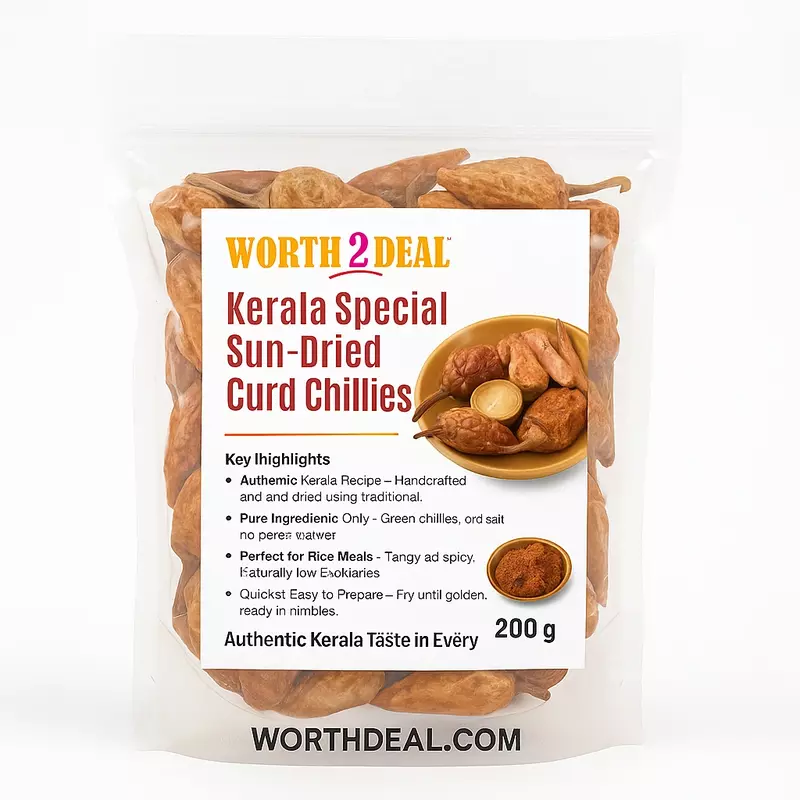


Buy Worth2Deal Mor Milagai Online — Authentic South Indian Sun-Dried Curd Chillies, Ready to Fry, No Preservatives, 200g
Available Offer
Share :
What Is Mor Milagai — The Condiment Every South Indian Home Has Stored for Generations
Mor Milagai literally translates as "buttermilk chilli" in Tamil. The name describes the process exactly: fresh green chillies are soaked in sour buttermilk or thick curd with salt, allowed to ferment slightly, then sun-dried until completely crisp and moisture-free. Once dried they are stored and fried as needed — one of the oldest and most practical preservation methods in South Indian cooking.
The condiment appears across South India under different names depending on the region. In Tamil Nadu it is Mor Milagai or Thayir Molagai. In Andhra Pradesh, Challa Mirapakayalu or Dahi Mirchi. In Karnataka, Sandige Menasu or Uppina Menasinkai. In Kerala it is called Molagu Kondattam or Thayir Milagai. The same product, the same process, the same centuries-old tradition — different names by state.
Multiple traditional recipe sources confirm its cultural footprint. Raks Kitchen describes it as "best accompaniment for curd rice or pazhaya sadam." MasterChefMom's documented recipe notes the process has been passed down through generations as a summer-season preservation ritual. Sharmis Passions describes it as "one of the oldest methods of preserving green chillies" through natural fermentation.
Worth2Deal produces Mor Milagai in Malappuram, Kerala — staying true to the traditional three-ingredient recipe: green chillies, curd, natural salt. Nothing else.
The Traditional Making Process — Why Sun-Drying Takes 4 to 5 Days and Cannot Be Rushed
Every authentic Mor Milagai recipe source confirms the same process. The chillies are slit slightly and soaked in thick sour curd mixed with salt overnight. The next day they are drained and spread in direct sunlight. In the evening, the partially dried chillies go back into the remaining curd mixture. This back-and-forth — soaking and drying — repeats for 4 to 5 days until the curd is fully absorbed and the chillies are completely moisture-free.
This process cannot be shortened without compromising quality. The repeated soaking-and-drying cycle is what drives the curd flavour deep into the chilli, not just coating the surface. Sharmis Passions specifically notes that "the recipe involves sun drying and marinating back and forth for 4 to 5 days until they are completely dried." A chilli that is only surface-soaked will taste salty and sharp when fried — not the layered tangy, mildly sour depth that defines properly made Mor Milagai.
Worth2Deal follows this full multi-day cycle. The chillies in each batch are checked for complete dryness before packing — a chilli that still bends rather than snapping when broken has not finished drying and will not fry correctly.
The Natural Fermentation Benefit — Why Curd Changes the Chilli
Soaking green chillies in sour curd does several things simultaneously. The lactic acid in sour curd partially breaks down the chilli's cell wall, reducing raw sharpness and creating a softer, more complex heat when fried. The buttermilk proteins coat the chilli's surface, which is why fried Mor Milagai has a characteristic slightly milky-white coating before it turns golden.
Jeyashri's Kitchen notes that "sour curd balances the spiciness of the chillis" — this is the functional reason for the soaking, not merely tradition. The fermentation process also introduces naturally occurring lactobacillus bacteria, which have documented digestive benefits — consistent with the traditional South Indian practice of eating Mor Milagai alongside curd rice at the end of a meal when the digestive system is already supported by the probiotic yoghurt.
Worth2Deal does not make clinical health claims for this product. The above is a summary of documented traditional food science from multiple culinary sources.
What Makes Worth2Deal Mor Milagai Different From Commercial Brands
Amazon India lists multiple commercial Mor Milagai products. The Ikkiyam and Seema brands have Amazon reviews with consistent negative feedback including "no hint of chillies being dipped in curd" and "below average product" — suggesting shortened soaking times and surface-only curd coating. The fundamental shortcut most commercial producers take is reducing the 4 to 5 day multi-soak cycle to a single overnight dip, which produces a product that lacks depth.
Worth2Deal Mor Milagai is made in small batches following the full traditional process — multiple soak-and-dry cycles, complete dryness before packing, three ingredients only. No citric acid, no artificial souring agents, no added colouring to simulate the curd's natural pale coating.
How to Fry Worth2Deal Mor Milagai — Getting It Right
Heat enough oil in a small pan or wok. The oil should be at medium-low heat — hot enough that the chilli sizzles immediately when dropped in, but not so hot that the outside burns before the inside crisp. Multiple traditional recipe sources including Raks Kitchen, Sharmis Passions, and Jeyashri's Kitchen all specify low to medium-low heat.
Add 3 to 4 chillies at a time. Fry until they turn dark golden-brown to almost black — this is correct and intended, not burnt. Masterchefmom's authentic recipe specifically states: "fry until they turn dark brown and when you break the fried mor milagai, it should crumble beautifully — that is the sign of a perfectly made mor milagai."
Drain on absorbent paper and serve immediately. They lose crispness within 10 to 15 minutes of frying, so fry only as many as needed per meal.
For tempering: Mor Milagai can also be used whole in the tempering (tadka) for mor kuzhambu, mor kali, puli upma, and poriyal — as documented by Jeyashri's Kitchen and Tomato Blues — used in place of dry red chillies, but with a distinctly tangy, mildly sour character that dried red chillies cannot replicate.
What to Eat With Mor Milagai — Meal-by-Meal Guide
With curd rice (Thayir Sadam): This is the classic, definitive pairing. Every single traditional recipe source — Raks Kitchen, Sharmis Passions, Jeyashri's Kitchen, MasterChefMom, Chitra's Food Book, Sizzling Tastebuds — names curd rice as the primary pairing. The bland, cooling curd rice and the crisp, salty-tangy chilli create one of the most satisfying flavour contrasts in South Indian food.
With pazhaya sadam (leftover rice): Old rice soaked overnight becomes soft, slightly fermented, and deeply satisfying the next morning. A single piece of Mor Milagai alongside pazhaya sadam and a small shallot is one of the most loved traditional South Indian breakfast combinations — documented by Raks Kitchen and Chitra's Food Book as a deeply nostalgic pairing.
With kanji (rice porridge): As noted in the Essenceoflife food blog, "you can eat a bowl full of neeragaram or pazhangkanji with just a single piece of Mor Milagai." The warmth of kanji and the sharp, salty crunch of the fried chilli are a natural match.
With sambar rice and rasam rice: Mor Milagai replaces pickle alongside sambar and rasam meals — providing a dry, crunchy contrast to the liquid gravies.
With dal rice: A simpler North-South fusion pairing where Mor Milagai adds the regional South Indian character to plain dal and rice.
As a tempering ingredient: Use one or two pieces of Mor Milagai in the tempering for mor kuzhambu, mor kali, puli pongal, and poriyal. The curd-fermented flavour adds complexity unavailable from regular dried red chillies.
Also From Worth2Deal — Kerala Kondattam and Pickle Collection
For another authentic South Indian condiment, explore Worth2Deal Kerala Tender Mango Pickle (Kannimanga Achar) — traditional Namboodiri recipe, sesame oil, no preservatives. Or browse our Kerala Pickles and Kondattam collection for the complete range.
Storage Instructions
Keep in a tightly sealed airtight container in a cool, dry place away from moisture. Moisture is the enemy of sun-dried products — even a single contact with a wet spoon or humid environment can cause the chillies to lose their crispness and develop mould within days.
If the chillies have absorbed moisture during storage, spread them on a plate and sun-dry for a few hours before frying — this restores their crispness completely. Sharmis Passions notes: "in about 3 to 4 months it is best to sun the vathal again so it remains crisp and moisture free."
Shelf life: 3 to 6 months in a dry, airtight container in a cool place. Do not refrigerate — condensation from the refrigerator introduces moisture that softens the chillies.
Product Details
Net Weight: 200g Main Ingredients: Fresh green chillies, thick curd (yoghurt), natural salt Process: Traditional multi-day sun-drying — soak, dry, repeat over 4 to 5 days Artificial Preservatives (Class II): None Artificial Colour: None Artificial Flavour: None MSG: None Product Type: Ready to fry Preparation time after purchase: Shallow fry on low-medium heat for 2 to 3 minutes Also known as: Thayir Molagai, Dahi Mirchi, Uppu Milagai, Sandige Menasu, Molagu Kondattam, Challa Mirapakayalu, Curd Chilli Vathal, Buttermilk Chilli Shelf Life: 3 to 6 months from manufacture in airtight container Storage: Cool dry place, airtight container, no refrigeration Manufactured and Packed by: Worth2Deal, 7/330 Shanti Nagar, Valayamkulam, Kokkur Post, Malappuram District, Kerala 679591 FSSAI Licence No.: 21317233000044 Contact: worth2deal.com@gmail.com | +91 9846294242
FAQs-Worth2Deal Mor Milagai
What is Mor Milagai?
Mor Milagai is a traditional South Indian sun-dried curd chilli — fresh green chillies soaked in thick sour curd and natural salt, then sun-dried through repeated soak-and-dry cycles over 4 to 5 days until completely moisture-free. The name means "buttermilk chilli" in Tamil. Once dried and stored, they are shallow or deep fried in oil until crisp and dark golden-brown, then served as a side dish alongside rice meals. The product is known by different regional names across South India — Thayir Molagai in Tamil Nadu, Dahi Mirchi in Hindi-speaking households, Sandige Menasu in Karnataka, Molagu Kondattam in Kerala, and Challa Mirapakayalu in Andhra Pradesh. Worth2Deal Mor Milagai is made using green chillies, curd, and natural salt with no artificial preservatives. FSSAI Lic. No.: 21317233000044.
Q2: What is the difference between Mor Milagai and regular dried chillies?
Regular dried red chillies are simply sun-dried fresh red chillies — no curd soaking, no fermentation. Mor Milagai goes through a multi-day curd fermentation process that fundamentally changes the chilli's flavour profile. The lactic acid in sour curd reduces the raw sharpness of the green chilli and replaces it with a tangy, mildly sour depth that dried red chillies cannot produce. When fried, Mor Milagai has a distinctly milky-tangy character and a lighter, more delicate crispness compared to the direct, sharp heat of fried dried red chillies. The two products are not interchangeable in flavour.
Q3: How do you fry Mor Milagai correctly?
Heat oil in a small pan or wok to medium-low heat — hot enough that the chilli sizzles immediately when dropped in. Add 3 to 4 chillies at a time. Fry on low-medium heat until they turn dark golden-brown. Multiple traditional sources including MasterChefMom document that they should "crumble beautifully when broken" — this indicates they are perfectly fried. Do not use high heat as the outside burns before the inside crisps. Fry only as many as you need for the meal — they lose crispness within 10 to 15 minutes of frying and are best eaten immediately.
Q4: Is Mor Milagai healthy?
Mor Milagai is a naturally low-calorie condiment — three ingredients only, no oil until frying, no sugar, no artificial additives. The fermentation process using curd introduces naturally occurring lactic acid bacteria. The capsaicin in green chillies has documented metabolic and digestive benefits, reviewed in published research on dietary chilli consumption. Worth2Deal does not make clinical health claims for this product. Consume as part of a balanced diet. Those with sensitive digestive systems or chilli intolerance should consume in small quantities. Consult your doctor if you have medical conditions that restrict chilli or salt intake.
Q5: What chillies are used for Mor Milagai and does it matter?
The type of chilli significantly affects the final product. Traditional recipe sources including Raks Kitchen recommend chillies that are "small, tender and thin." Jeyashri's Kitchen specifies Thanjavur milagai as ideal for Tamil Nadu-style preparation. The Essenceoflife food blog notes that "gundu milagai (Kooda milagai) also tastes great." Short, plump, moderately spicy green chillies are preferred — they have enough wall thickness to absorb the curd through the multi-day soaking process but thin enough to fry evenly. Very thick chillies may not dry completely and can develop mould internally.
Q6: How long does Mor Milagai last after purchase?
Worth2Deal Mor Milagai has a shelf life of 3 to 6 months from manufacture when stored in a tightly sealed airtight container in a cool dry place. Do not refrigerate — condensation from the refrigerator introduces moisture that softens the chillies. If the chillies absorb ambient moisture during storage, spread them on a plate in direct sunlight for a few hours to restore crispness before frying. Sharmis Passions notes that "in about 3 to 4 months it is best to sun the vathal again so it remains crisp and moisture free." Moisture is the only real threat to properly dried Mor Milagai — kept dry, they can last close to a year.
Q7: Can Mor Milagai be used for cooking, not just as a side dish?
Yes — Mor Milagai is frequently used as a tempering ingredient in traditional South Indian cooking. Jeyashri's Kitchen and Tomato Blues both document its use in the tempering (tadka) for mor kuzhambu, mor kali, puli pongal, poriyal, and puli upma. Used in place of dried red chillies in the tempering, Mor Milagai adds a distinctly tangy, curd-fermented character that dried red chillies cannot replicate. It is also used in tempering for sambar by traditional cooks who prefer its milder, more complex heat over regular dried red chilli.
Q8: What meals pair best with fried Mor Milagai?
Fried Mor Milagai pairs best with: curd rice (Thayir Sadam) — the definitive pairing documented by every traditional recipe source; pazhaya sadam (overnight leftover rice) — a nostalgic South Indian breakfast combination with small shallots; kanji (rice porridge) — one piece of Mor Milagai alongside a bowl of kanji is a traditional comfort meal; sambar rice and rasam rice; and simple dal rice. It is also used as a tempering ingredient in mor kuzhambu, mor kali, and poriyal. Fried in desi ghee rather than oil, as some buyers mention in Amazon reviews, Mor Milagai takes on additional richness.
Q9: Can I order Worth2Deal Mor Milagai from outside Tamil Nadu or Kerala?
Yes. Worth2Deal ships Mor Milagai pan-India from Malappuram, Kerala with free delivery on all orders. We regularly deliver to Mumbai, Delhi, Bangalore, Hyderabad, Chennai, Pune, Kolkata, Ahmedabad, Kochi, Thiruvananthapuram, Kozhikode, Thrissur, Malappuram, Coimbatore, Mysore, Surat, Jaipur, Lucknow, Nagpur, Chandigarh, and all major cities. Delivery takes 4 to 7 working days. With a 3 to 6 month shelf life, the product arrives well within its quality window.
Q10: What is the difference between Mor Milagai and Mor Milagai Vathal?
Vathal is the Tamil word for sun-dried vegetable or chilli — so Mor Milagai Vathal simply means sun-dried Mor Milagai, specifically the dried-but-unfried form that is stored and fried as needed. The two terms are used interchangeably in product listings and recipe discussions. Worth2Deal sells the vathal form — the fully sun-dried chilli ready to be fried at home, not pre-fried. Pre-fried versions lose crispness during transit and packaging and do not deliver the fresh-fried texture that defines the product.
Q11: Which cities does Worth2Deal deliver Mor Milagai to?
Worth2Deal ships sun-dried curd chillies across India with free delivery — including Mumbai, Delhi, Bangalore, Hyderabad, Chennai, Pune, Kolkata, Ahmedabad, Kochi, Thiruvananthapuram, Kozhikode, Thrissur, Malappuram, Palakkad, Kannur, Coimbatore, Mysore, Jaipur, Surat, Lucknow, Nagpur, Bhopal, Patna, Guwahati, Chandigarh, Vizag, Bhubaneswar, and all major cities and towns. Dispatched from Malappuram, Kerala within 1 to 2 business days and delivered in 4 to 7 working days.
Q12: Is there growing demand online for traditional South Indian condiments like Mor Milagai?
Yes — and the category data is clear. Online food product sales in India are growing significantly, with traditional and regional condiments identified as the fastest-growing segment by The India Watch (2025). India's pickle and condiment market reached USD 592.66 million in 2024 (IMARC Group, 2024). The specific driver is urban South Indian buyers — particularly diaspora in Mumbai, Delhi, Bangalore, and abroad — seeking authentic homemade-style products unavailable in local supermarkets. Amazon India listings for Mor Milagai have increased significantly year-on-year, with verified buyers specifically praising products that deliver the authentic curd-soaked taste rather than commercial shortcuts. Worth2Deal delivers the traditional three-ingredient product from Malappuram with no shortcuts.