

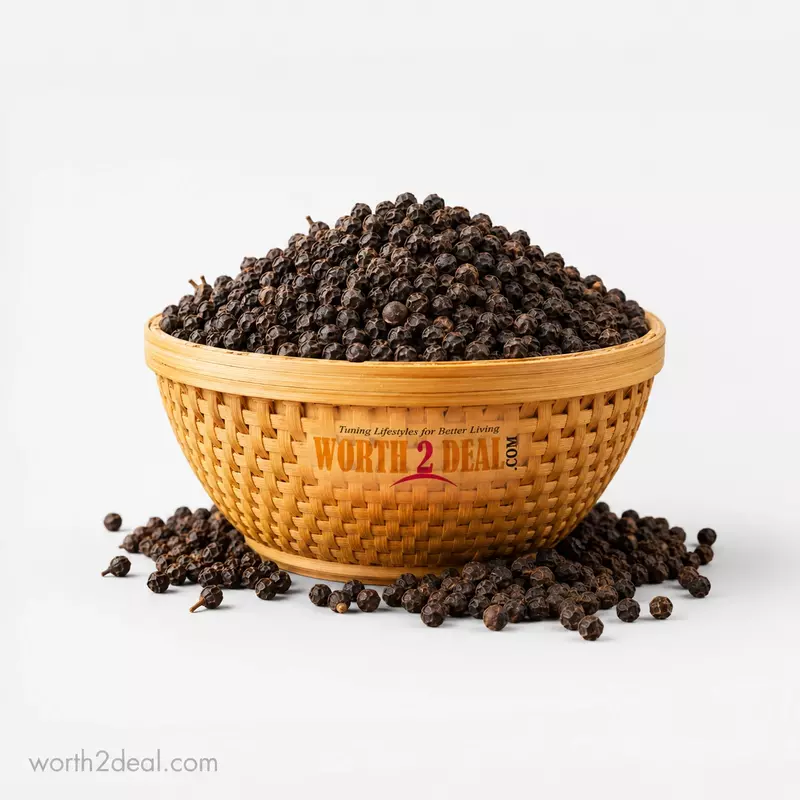


Worth2Deal Malabar Black Pepper (Kurumulaku) — 100% Whole Peppercorns from Tellicherry, Wayanad & Idukki
Available Offer
Share :
What Is This Product?
Worth2Deal Malabar Black Pepper is 100% whole peppercorns (Kurumulaku) — naturally grown across Tellicherry, Wayanad, and Idukki in Kerala's Western Ghats, the same GI-tagged Malabar Pepper region officially recognized since 2008. Sun-dried using traditional methods, sold whole (never pre-ground), with no additives, and delivered fresh anywhere in India by Worth2Deal, a Kerala grocery business operating since 2017.
Quick Facts
- Form: Whole peppercorns (not ground)
- Origin: Tellicherry, Wayanad & Idukki, Kerala (Malabar Pepper — GI tagged, 2008)
- Cultivation: Naturally grown, chemical-free, traditional methods (not certified organic)
- Processing: Sun-dried, hand-cleaned, no additives
- Shelf Life: 12–24 months from packing, stored airtight
- Sold by: Worth2Deal, Kerala grocery e-commerce, since 2017
Three Questions Buyers Ask First
Is this whole pepper or ground?
Whole peppercorns only. Ground pepper loses most of its aroma within weeks; whole peppercorns stay potent for years.
Where exactly does it come from?
Tellicherry, Wayanad, and Idukki — three distinct growing belts within Kerala's officially GI-tagged Malabar Pepper region, each with its own flavour character.
Is it certified organic?
No — it's naturally grown using traditional, chemical-free cultivation methods, but not certified organic. We'd rather say that plainly than overclaim.
The Story Behind This Pepper
Long before it was a shelf spice, this berry was currency. Arab and later European traders sailed months across open ocean chasing this one climbing vine — and they were chasing it because of hills exactly like Tellicherry, Wayanad, and Idukki, where Worth2Deal sources every batch of this pepper today.
Why Whole Peppercorns, Not Powder?
Black pepper's heat and aroma come from volatile oils that begin evaporating the moment the berry is cracked. Pre-ground pepper loses most of that aroma within weeks — often before it even reaches a shelf. Whole peppercorns hold their oils for years. Worth2Deal sells only whole peppercorns for exactly this reason: what you crack fresh at your table is the closest you can get to standing in a Wayanad pepper garden.
Sourcing — Tellicherry, Wayanad & Idukki
These three names aren't interchangeable marketing terms — they're specific growing belts within the Malabar pepper region, each known for particular grade and boldness. Worth2Deal peppercorns are naturally grown using traditional, chemical-free cultivation methods passed down through generations of Kerala farmers, hand-harvested and sun-dried without shortcuts.
Traditional and Culinary Use
In Malabar kitchens, this pepper isn't a background note — it's often the main spice, from Kurumulaku Vatticha Meen Curry (black pepper fish curry) to the pepper-and-curry-leaf base of countless Kerala fry dishes. It's also central to Kerala's home remedy tradition: a pinch of crushed pepper stirred into warm honey for a sore throat, or simmered into a pepper rasam during monsoon season — not far in spirit from the dry ginger, pepper, and tulsi blend many households now keep ready-made, or a spoon of Cheruthen stingless bee honey mixed straight with crushed pepper.
Pepper isn't the only essential agent in a Malabar fish curry, either — if you want the full picture of what gives Kerala fish curry its signature tang, our guide to Kudampuli, Malabar's essential souring agent on Paithrka.com covers the other half of that story.
Storage
Store in an airtight container away from direct sunlight and moisture. Whole peppercorns stay potent for up to 2–3 years when stored this way — grind only what you need, when you need it.
Delivery Across India
Worth2Deal delivers this pepper fresh across India — to home kitchens in Mumbai, Delhi, Bengaluru, Chennai, Hyderabad, Pune, Kolkata, Ahmedabad, Surat, Jaipur, Lucknow, Nagpur, Chandigarh, Gurgaon, Noida, Coimbatore, Kochi, Kozhikode, Thiruvananthapuram, Thrissur, Kannur, Bhopal, and Indore — with free pan-India shipping.
NAP BLOCK
Worth2Deal, 7/330 A, Shanthi Nagar, Kokkur, Malappuram, Kerala — 679591. Phone: +91 9846294242. WhatsApp: +91 79071 68550. Email: worth2deal@gmail.com. FSSAI Lic. No. 21317233000044.
FAQs
1. What is Kurumulaku and why is it called the "King of Spices"?
Kurumulaku is the Malayalam name for black pepper (Piper nigrum), a flowering vine native to Kerala's Malabar Coast. It earned the title "King of Spices" for once being traded as valuable as gold and for remaining the world's most traded spice today.
2. What is Kurumulaku called in English?
Kurumulaku is simply black pepper in English — the same dried peppercorn used worldwide, but grown specifically in Kerala's Malabar region.
3. What's the difference between Malabar and Tellicherry pepper?
Tellicherry isn't a separate variety — it's a premium grade of Malabar pepper, made up of the largest, most mature berries left longer on the vine before harvest, giving a bolder, more complex flavour.
4. Does Malabar Pepper actually have a GI tag?
Yes. Malabar Pepper received official Geographical Indication status in 2008, held by the Spices Board, Kochi — legally recognising that pepper from this specific Kerala region has a distinct character tied to its soil and climate.
5. Why is Malabar pepper called "Black Gold"?
Because for over a thousand years, this pepper was valuable enough to be used as currency and taxed like treasure — driving Arab, Roman, and later European traders to risk long sea voyages just to reach Kerala's pepper coast.
6. How can I tell if black pepper is pure and not adulterated?
Drop peppercorns in water — pure, dense peppercorns sink; lighter, adulterated, or hollow ones float. Genuine peppercorns are also uniformly dark and wrinkled, never dusty grey.
7. Should I buy whole peppercorns or ground pepper?
Whole, if flavour matters to you. Ground pepper loses most of its aroma within weeks of grinding, while whole peppercorns stay potent for years — grind fresh each time for the real flavour.
8. Is pre-ground pepper as good as fresh cracked?
No. Fresh-cracked pepper releases volatile aromatic oils at the moment of grinding — oils that evaporate quickly once exposed to air, which is exactly what's already happened to any pre-ground pepper sitting on a shelf.
9. Why is black pepper always paired with turmeric?
Piperine in black pepper significantly boosts the body's absorption of curcumin, turmeric's active compound — which is otherwise poorly absorbed on its own. This is why Kerala kitchens instinctively use both together.
10. What are the health benefits of black pepper?
Traditionally used in Ayurveda to support digestion, ease coughs and colds, and act as a natural warming agent. Piperine, its active compound, is also studied for anti-inflammatory and antioxidant properties.
11. Do I need to toast peppercorns before grinding?
It's optional but recommended — briefly dry-roasting peppercorns before grinding deepens their aroma and brings out a rounder, less sharp heat, a trick many Kerala cooks swear by.
12. How long does black pepper stay fresh, and how should I store it?
Whole peppercorns stay potent for 2–3 years if stored in an airtight container away from sunlight and moisture. Avoid clear glass jars kept near the stove — heat and light are what age pepper fastest.
13. Which is better — Tellicherry, Wayanad, or Idukki pepper?
Each has its own character: Tellicherry berries are typically larger and bolder, Wayanad's high-altitude vines produce a sharper heat, and Idukki's shaded plantations give a more rounded aroma. Worth2Deal sources from all three to capture this range.
14. How is kurumulaku used for cold and cough relief?
A traditional Kerala remedy — crushed pepper with honey, or pepper simmered into hot water with ginger — is a household first response to a sore throat or the first signs of a cold. (Pairs naturally with our [Cheruthen Stingless Bee Honey] and [Dry Ginger Coffee] for the full remedy.)
15. Is climate change affecting Kerala's pepper belt?
Yes — erratic monsoon patterns and rising temperatures in the Western Ghats are increasingly cited by Kerala's spice farmers and researchers as pressures on traditional pepper cultivation, making authentically-sourced, small-farm pepper increasingly valuable.
16. Where can I buy authentic Malabar pepper online?
Directly from Worth2Deal — sourced from Tellicherry, Wayanad, and Idukki, sun-dried and packed with no additives, delivered free across India with FSSAI Lic. No. 21317233000044.