

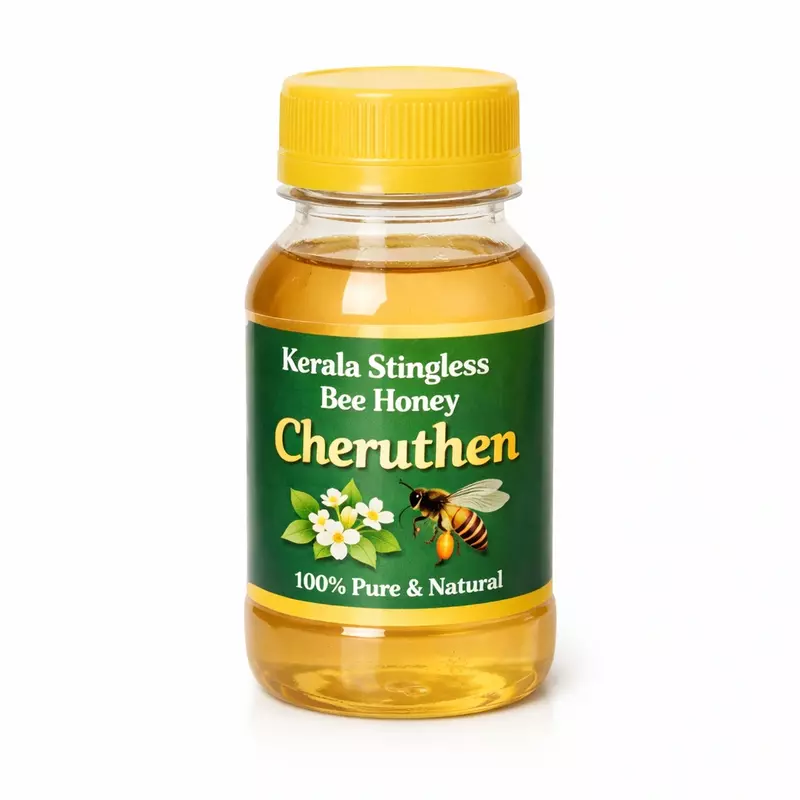


Buy Worth2Deal Cheruthen Online — Kerala Pure Stingless Bee Honey
Available Offer
Share :
Cheruthen is raw honey produced by Kerala's native stingless bee — Tetragonula iridipennis — a small, stingless species that builds colonies in tree hollows and rock crevices across Kerala's forest regions, producing honey that is naturally more acidic, thinner, and medicinally richer than regular honeybee honey.
What Is Cheruthen — Kerala's Rarest Honey
Cheruthen (Malayalam: ചെറുതേൻ) literally means "small honey" — cheru meaning small, then meaning honey — named after the tiny stingless bee that produces it. In English it is called stingless bee honey or meliponine honey. It is completely different from regular forest honey or commercial honey in species, flavour, texture, nutritional profile, and traditional use.
The stingless bee — Tetragonula iridipennis — is a native Kerala species significantly smaller than the common honeybee. Unlike honeybees, stingless bees build their colonies inside hollow trees, bamboo stems, and rock crevices rather than open combs. They produce far less honey than honeybees — a single colony produces only 300 to 500ml of honey per year compared to several kilograms from a honeybee colony. This scarcity is why cheruthen is rare, why it costs significantly more than regular honey, and why most of what is sold as cheruthen online is adulterated or substituted.
Worth2Deal sources cheruthen directly from tribal communities in Kerala's forest regions who maintain traditional stingless bee colonies — no middlemen, no adulteration, no blending with regular honey. Every 300g bottle contains only genuine Tetragonula iridipennis honey.
Why Cheruthen Tastes Different from Regular Honey
The first thing buyers notice about real cheruthen is that it does not taste like honey. It is thin — almost watery in consistency compared to the thick viscosity of forest honey or commercial honey. It is naturally tangy and slightly sour — more acidic than any honeybee honey. The sweetness is present but secondary to the tartness. This is not a defect. This is exactly what authentic cheruthen tastes like.
The natural acidity of cheruthen comes from its higher organic acid content — particularly gluconic acid — which develops through the stingless bee's unique honey processing method. Stingless bees store honey in small resin-sealed pots rather than open combs, which creates a different fermentation environment compared to honeybee honey. The result is a naturally tangy, lower-sugar honey with a distinctive flavour profile that regular honey cannot replicate.
If the cheruthen you buy tastes sweet and thick like regular honey — it is not genuine cheruthen. Genuine cheruthen is thin, tangy, and distinctly sour.
Cheruthen in Kerala Ayurveda — Traditional Uses
Cheruthen has been documented in Kerala's Ayurvedic texts as a therapeutic honey distinct from regular bee honey — classified separately due to its different properties, taste profile, and medicinal applications. Traditional Ayurvedic practitioners across Malabar and Travancore have used cheruthen specifically for:
- Eye health— cheruthen applied as eye drops is a traditional Kerala Ayurvedic practice documented in classical texts. The honey's natural antibacterial and anti-inflammatory compounds make it a traditional remedy for eye irritation and minor infections. This is a traditional practice — consult an Ayurvedic practitioner before any ocular application.
- Respiratory health — cheruthen mixed with dry ginger and pepper is a traditional remedy for cough, throat irritation, and respiratory congestion used across Kerala households.
- Wound healing— the natural hydrogen peroxide and antibacterial compounds in raw cheruthen support traditional wound care practices.
- Digestive support— a teaspoon of cheruthen on an empty stomach in warm water is a traditional Kerala morning practice for digestive health and metabolism.
- Skin health — applied topically, raw cheruthen is used traditionally for skin brightening and minor skin irritations.
- Children's health — cheruthen is traditionally given to children above 1 year for immunity support and as a natural supplement — its lower sugar content compared to regular honey makes it a preferred traditional choice for young children.
Important note: The above reflects traditional Ayurvedic use of cheruthen documented in Kerala's classical texts. These are not medical claims. Worth2Deal does not claim that cheruthen treats, cures, or prevents any disease or medical condition. Consult a qualified Ayurvedic practitioner or healthcare provider before using cheruthen for any therapeutic purpose. FSSAI Lic. No.: 21317233000044.
Cheruthen vs Forest Honey vs Regular Honey — The Complete Comparison
This is the most important section for buyers who are deciding between the three.
Regular commercial honey is produced by Apis mellifera (European honeybee), pasteurised, filtered, and often blended from multiple global sources. It is nutritionally reduced by heating and has a mild, uniform sweet flavour. It is the most widely available and cheapest honey option.
Forest honey — like Worth2Deal's Pure Unheated Forest Honey — is also produced by Apis species (honeybees) but collected from wild colonies in Kerala's forests by tribal harvesters, never heated, and fully raw. It is nutritionally superior to commercial honey with a stronger, earthier flavour and active enzymes. It is used for daily wellness and as a natural sweetener.
Cheruthen is produced by an entirely different bee species — Tetragonula iridipennis (stingless bee). It is thinner, more acidic, naturally tangy, lower in sugar, and richer in certain bioactive compounds including flavonoids and phenolic acids compared to honeybee honey. It is produced in far smaller quantities which makes it significantly rarer and more expensive. It is used primarily for specific therapeutic purposes in Ayurvedic practice rather than as a general sweetener.
| Feature | Regular Honey | Forest Honey | Cheruthen |
|---|---|---|---|
| Bee species | Apis mellifera | Apis (wild) | Tetragonula iridipennis |
| Texture | Thick | Thick | Thin — watery |
| Taste | Sweet | Sweet earthy | Tangy sour |
| Processing | Heated filtered | Raw unheated | Raw unheated |
| Availability | Common | Moderate | Very rare |
| Primary use | Sweetener | Daily wellness | Ayurvedic therapeutic |
| Price | Low | Medium | High |
How to Use Cheruthen
- Daily wellness— one teaspoon on an empty stomach in warm water every morning
- With ginger and pepper — traditional Kerala remedy for throat comfort and respiratory health
- Eye application — one drop in each eye — traditional Ayurvedic practice — consult a practitioner before use
- As a supplement for children — half a teaspoon mixed in warm water or milk for children above 1 year — do not give to infants under 12 months
- Applied to minor skin irritations — a thin layer applied topically as a traditional skin remedy
- As a natural sweetener— drizzle over fruits, yogurt, or herbal teas — note the tangy flavour will alter the taste of sweet dishes
How to Identify Authentic Cheruthen
The cheruthen market is unfortunately full of adulterated products — regular honey thinned with water and sold as cheruthen, or forest honey mixed with acidic additives to mimic the tangy taste. Here is how to identify the real product:
Genuine cheruthen is naturally thin and flows easily — almost like water. It is naturally tangy and sour — noticeably more acidic than any honeybee honey. The colour ranges from pale golden to amber. It ferments naturally over time — a slightly fermented smell is normal and a sign of raw purity. It does not crystallise the same way honeybee honey does due to its different sugar composition.
Worth2Deal sources cheruthen exclusively from verified tribal collectors in Kerala who maintain genuine Tetragonula iridipennis colonies. We do not blend, dilute, or substitute. If you have received a product that tastes sweet and thick like regular honey — that is not genuine cheruthen.
Storage Instructions
Store in a cool, dry place away from direct sunlight. Do not refrigerate — cold temperatures slow the natural fermentation process and alter the flavour. Keep the lid tightly closed after every use. A slight fermented note that develops over time is natural and a sign of raw purity — not spoilage. Shelf life is 18 months from date of packing when stored correctly. Do not heat — heat destroys the bioactive compounds that make cheruthen therapeutically valuable.
Also from Worth2Deal Natural Sweeteners
For daily wellness and general use, see our Pure Unheated Kerala Forest Honey — tribal-collected wild honey, never heated. For Kerala's GI-tagged natural sweetener, see our Marayoor Jaggery — GI Tagged Unda Sharkara. For our full range, explore Natural Sweeteners & Honey.
Product Details
Net Weight: 300g Type: Raw Stingless Bee Honey — Cheruthen Bee Species: Tetragonula iridipennis — Kerala native stingless bee Collected by: Tribal honey gatherers — Kerala forest regions Processing: Raw — never heated, never pasteurised Texture: Thin — naturally low viscosity Taste: Naturally tangy and mildly sweet — more acidic than honeybee honey Colour: Pale golden to amber — natural variation batch to batch Artificial Colour: None Preservatives: None Added Sugar: None Shelf Life: 18 months from date of packing (stored correctly) Storage: Cool dry place, tightly sealed — do not refrigerate, do not heat Packed by: Worth2Deal, 7/330 Shanti Nagar, Valayamkulam, Kokkur Post, Malappuram District, Kerala 679591 FSSAI Licence No.: 21317233000044 Contact: worth2deal.com@gmail.com | +91 9846294242
FAQ — Cheruthen Kerala Stingless Bee Honey
Q1. What is cheruthen — what does it mean in Malayalam?
Cheruthen (Malayalam: ചെറുതേൻ) means small honey — named after the tiny stingless bee Tetragonula iridipennis that produces it. It is Kerala's native stingless bee honey — completely different from regular honeybee honey in species, taste, texture, and therapeutic use. Cheruthen is naturally thin, tangy, and more acidic than regular honey. It has been used in Kerala Ayurvedic medicine for centuries. Worth2Deal sources genuine cheruthen from tribal collectors in Kerala's forest regions. FSSAI Lic. No.: 21317233000044.
Q2. Where can I buy authentic cheruthen online with free delivery?
Worth2Deal sources cheruthen directly from tribal honey gatherers maintaining genuine Tetragonula iridipennis colonies in Kerala's forest regions — raw, unheated, never adulterated. Available in 300g with free pan-India delivery. We deliver to Bangalore, Mumbai, Delhi, Hyderabad, Chennai, Pune, and all major cities. Cash on Delivery available at checkout for eligible pin codes. FSSAI Lic. No.: 21317233000044.
Q3. What are the benefits of cheruthen — why is it used in Ayurveda?
Cheruthen is documented in Kerala's classical Ayurvedic texts as therapeutically distinct from regular bee honey. Traditional uses include eye health support, respiratory health, wound healing, digestive support, and immunity for children. Its higher organic acid content, flavonoids, and phenolic compounds give it a different bioactive profile compared to honeybee honey. These are traditional Ayurvedic applications — consult a qualified practitioner before using cheruthen for any therapeutic purpose.
Q4. What does cheruthen taste like — why is it sour and thin?
Genuine cheruthen is naturally thin — almost watery — and distinctly tangy and sour. This is not a defect. The natural acidity comes from higher gluconic acid content produced through the stingless bee's unique honey processing method. The sourness is the primary flavour identifier of authentic cheruthen. If a product sold as cheruthen tastes sweet and thick like regular honey — it is not genuine. Real cheruthen is thin, tangy, and noticeably sour.
Q5. What is the difference between cheruthen and regular honey?
Cheruthen is produced by Tetragonula iridipennis — a native Kerala stingless bee species. Regular honey is produced by Apis species (honeybees). Cheruthen is naturally thinner, more acidic, lower in sugar, and richer in certain bioactive compounds. A single stingless bee colony produces only 300 to 500ml of honey per year versus several kilograms from a honeybee colony — which is why cheruthen is significantly rarer and more expensive. It is used primarily for Ayurvedic therapeutic purposes rather than as a general daily sweetener.
Q6. How do I know if the cheruthen I am buying is genuine and not adulterated?
Genuine cheruthen has three unmistakable characteristics — it is thin and flows like water, it is naturally tangy and sour, and it may develop a slight fermented note over time. Adulterated cheruthen is typically regular honey thinned with water or forest honey mixed with acidic additives. Worth2Deal sources exclusively from verified tribal collectors maintaining genuine Tetragonula iridipennis colonies in Kerala — no blending, no dilution, no substitution. FSSAI Lic. No.: 21317233000044.
Q7. Can cheruthen be used as eye drops — is this safe?
Applying cheruthen as eye drops is a traditional Kerala Ayurvedic practice documented in classical texts — used for eye comfort and minor irritations. This is a traditional practice, not a medically approved treatment. Worth2Deal does not recommend or endorse any ocular application without guidance from a qualified Ayurvedic practitioner or ophthalmologist. Please consult a healthcare professional before any eye application.
Q8. Is cheruthen safe for babies and children?
Cheruthen is traditionally given to children above 1 year of age in Kerala households as an immunity supplement and natural sweetener. Honey of any kind — including cheruthen — should never be given to infants under 12 months due to the risk of infant botulism. For children above 1 year, cheruthen is considered a safe traditional supplement. Consult your paediatrician before introducing cheruthen into your child's diet.
Q9. Why does cheruthen cost more than regular honey or forest honey?
A single stingless bee colony produces only 300 to 500ml of cheruthen per year compared to several kilograms from a honeybee colony. Cheruthen cannot be produced at industrial scale — each colony must be individually maintained by tribal collectors using traditional methods. The rarity of genuine Tetragonula iridipennis colonies and the extremely low yield per colony makes authentic cheruthen one of the most expensive honeys in India. Worth2Deal prices reflect direct farm sourcing with no distributor margins.
Q10. How should I store cheruthen at home?
Store in a cool dry place away from direct sunlight. Do not refrigerate — cold temperatures slow natural fermentation and alter the flavour profile. Keep the lid tightly closed. A slight fermented note developing over time is completely natural and a sign of raw authenticity. Do not heat — heat destroys the bioactive compounds that make cheruthen therapeutically valuable. Shelf life is 18 months from date of packing when stored correctly.
Q11. Does Worth2Deal deliver cheruthen across India — can I get it in Bangalore, Mumbai, or Delhi?
Yes — Worth2Deal delivers authentic Kerala cheruthen pan-India with free shipping. We regularly fulfil orders to Bangalore, Mumbai, Delhi, Hyderabad, Chennai, Pune, Kolkata, and all major metro and Tier 2 cities. Delivery takes 4 to 7 working days. Cash on Delivery is available at checkout for eligible pin codes. Kerala's native stingless bee honey delivered directly to your door from Malappuram.
Q12. Will cheruthen become widely available across India as awareness of its Ayurvedic value grows?
It already is growing — but genuine cheruthen will always remain rare and expensive due to the biological constraints of stingless bee production. What will happen — and is already happening — is that demand will outpace supply, making adulteration a growing problem. The best protection for buyers is sourcing from verified, FSSAI-certified sellers who can trace their product to specific tribal collectors. Worth2Deal has been part of Kerala's traditional food ecosystem since 2017 — our cheruthen is genuine, our source is traceable, and our FSSAI certification (Lic. No.: 21317233000044) is verifiable.
Worth2Deal Cheruthen is Kerala's rare stingless bee honey — collected from genuine Tetragonula iridipennis colonies by tribal harvesters in Kerala's forest regions, raw and unheated, never adulterated. The real cheruthen that Kerala's Ayurvedic tradition built its reputation on, packed in Malappuram and delivered free anywhere in India. Order now — 300g.
Order Worth2Deal Cheruthen Now — Free Pan-India Delivery →