

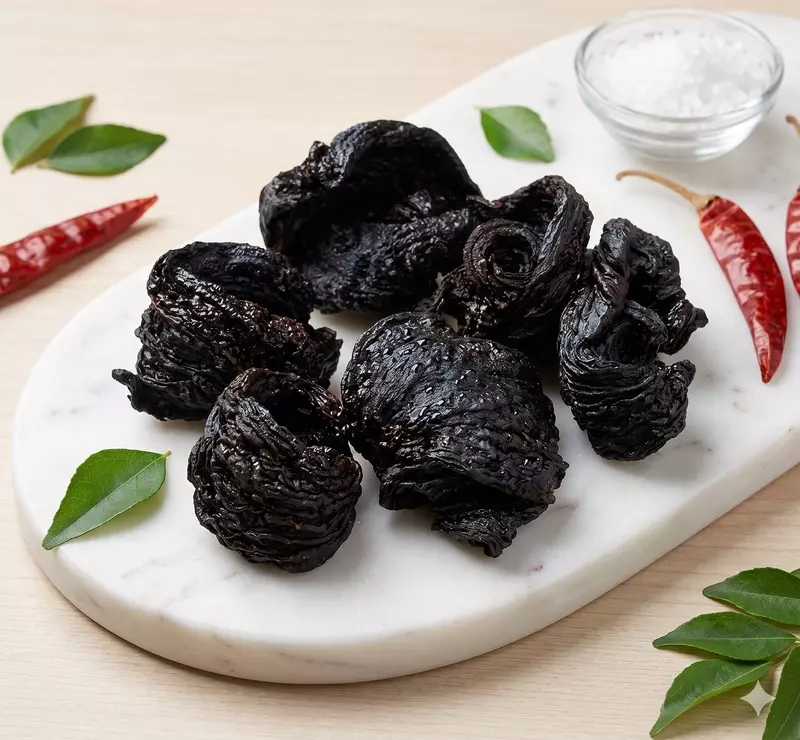


Buy Kudampuli Online — Sun-Dried Malabar Tamarind (Garcinia Cambogia) for Kerala Fish Curry | Worth2Deal
Available Offer
Share :
Why Kudampuli Is Irreplaceable in Kerala Cooking
Tamarind adds sourness. Kokum adds sourness. But neither adds what Kudampuli adds — a deep, smoky, rounded tang that matures inside the curry as it rests. This is why every traditional Kerala fish curry recipe specifies Kudampuli and not regular tamarind. The sourness of Kudampuli bonds with coconut milk and coconut oil differently from any other souring agent, mellowing as the curry rests and intensifying the longer it sits. A Kerala fish curry made with regular tamarind tastes sharp and thin. The same curry made with Kudampuli tastes deep, rounded, and complete. There is no substitute.
The fruit itself — small, pumpkin-shaped, pale green to yellow when raw — is harvested along the Western Ghats and coastal Malabar. After harvest, it is dried and darkens to a wrinkled black-brown piece. Worth2Deal sources it during the fresh harvest window from Malabar farms, washes each piece, removes the seeds, and slices it before sun-drying. Most commercial Kudampuli is sold whole and undried — customers must soak and discard the first soaking water to remove excess smokiness. Worth2Deal's de-seeded, sliced preparation means the souring compounds are released faster and more evenly into the curry, with no seed bitterness and no off-flavours.
Kudampuli and Garcinia Cambogia — The Same Fruit, Two Uses
Kudampuli is the culinary name used in Kerala kitchens. Garcinia cambogia — more accurately Garcinia gummi-gutta — is the same fruit, known internationally for its Hydroxycitric Acid (HCA) content. HCA is the active compound in the rind of the Kudampuli fruit that has been studied for its role in appetite regulation and fat metabolism. It works by inhibiting Citrate Lyase, the enzyme the body uses to convert excess carbohydrates into stored fat.
This is not a recent discovery. Kudampuli has been prescribed in Ayurvedic medicine under the Sanskrit name Vrikshamla for centuries — listed in classical Ayurvedic texts for its digestive, anti-obesity, and anti-inflammatory properties long before Western research validated the HCA connection. The difference between pharmaceutical Garcinia cambogia supplements sold in capsule form and Worth2Deal Kudampuli is that you are getting the whole, unadulterated dried fruit — not an extract, not a concentrate — exactly as Ayurveda intended it to be consumed, as part of a daily meal.
Worth2Deal Kudampuli is a culinary ingredient, not a medicine. It is not sold as a weight-loss supplement and no specific weight-loss outcomes are guaranteed. As with all Ayurvedic dietary ingredients, consult your physician before using Kudampuli specifically for therapeutic purposes. What it will do, without question, is make your Kerala fish curry taste exactly as it should.
How to Use Kudampuli in Kerala Fish Curry
Take 3 to 4 pieces of Worth2Deal Kudampuli per curry for a family of four. Rinse under running water briefly. Soak in ¼ cup of warm water for 10 to 15 minutes — this rehydrates the dried slices and releases the souring compounds into the soaking water. Add both the pieces and the soaking water directly into the curry at the stage when you add water or thin coconut milk. Do not discard the soaking water — it carries the flavour. Leave the pieces in the curry while cooking. Remove before serving if preferred, or leave in — the sourness continues to deepen as the curry rests. For best results, allow the curry to rest for at least 2 to 3 hours before eating. A Kerala fish curry always tastes better the next day.
Worth2Deal Kudampuli works with any fish — sardines, mackerel, king fish, pomfret, seer fish, or any coastal catch. It also works in prawn curry, mussel curry, and kappa puzhukku (mashed tapioca with fish).
What Makes Worth2Deal Kudampuli Different From Commercial Brands
Sun-Dried, Not Smoke-Cured to Mask Quality
Traditional Kudampuli is sun-dried. The smoky flavour associated with commercial Kudampuli often comes from smoke-curing, which is used to accelerate drying and mask lower-grade fruit. Excessive smokiness — a complaint seen in multiple Flipkart and Amazon reviews of commercial brands — does not occur with properly sun-dried Kudampuli. Worth2Deal Kudampuli is sun-dried only, which preserves the natural tangy flavour of the Garcinia fruit without artificial smokiness.
Washed, De-Seeded, and Sliced — Not Sold Whole
Most Kudampuli sold online is whole, undried, and unsorted. Seeds contribute bitterness. Unsorted pieces include damaged fruit that affects batch consistency. Worth2Deal's preparation — washed, de-seeded, sliced — means every piece in the pack is clean, consistent, and ready to use without extra preparation.
No Additives, No Artificial Colour, No Preservatives
The natural acidity of Kudampuli and its low moisture content after sun-drying make it self-preserving for years. No salt, no oil, no sodium benzoate, no artificial colour is needed or used. What is in the pack is dried Malabar tamarind — nothing else.
How to Store Worth2Deal Kudampuli
Store in an airtight container in a cool, dry place away from moisture and direct sunlight. Kudampuli is naturally self-preserving due to its high acidity and low moisture content — properly stored, it remains usable for 18 to 24 months. Never store in the refrigerator as condensation introduces moisture. If any white surface deposit appears, it is natural dried fruit residue — rinse before use.
Product Details
Contents: Sun-dried Malabar tamarind (Garcinia gummi-gutta / Kudampuli) — washed, de-seeded, sliced Available Weights: 100g | 200g Artificial Colours: None | Additives: None | Preservatives: None Storage: Airtight container, cool dry place Shelf Life: 18 months from date of packing SKU: W2D-SPX-KDP FSSAI Lic. No.: 21317233000044 Manufacturer: Worth2Deal, 7/330 A, Shanthi Nagar, Kokkur, Malappuram, Kerala — 679591
Explore More From Worth2Deal's Kerala Kitchen Collection
Worth2Deal Kerala Manga Uppilittathu — Kilichundan Mango in Brine: https://www.worth2deal.com/products/kerala-manga-uppilittathu-kilichundan-mango-brine-palakkad-namboodiri/3289552000000078171
Worth2Deal Kannimanga Achar — Kerala Tender Mango Pickle in Sesame Oil: https://www.worth2deal.com/products/kerala-tender-mango-pickle-kannimanga-achar-namboodiri/3289552000000129023
Explore the full Kerala Spices and Kitchen Essentials collection at Worth2Deal: https://www.worth2deal.com
FAQS
Q1. What is Kudampuli?
Kudampuli — also called Malabar tamarind, fish tamarind, pot tamarind, or Kodampuli — is the dried fruit of Garcinia gummi-gutta, a tropical tree native to the Western Ghats and coastal Kerala. The small pumpkin-shaped fruit is harvested, washed, de-seeded, sliced, and sun-dried into the wrinkled black-brown pieces used in Kerala fish curry. It is the primary souring agent in traditional Kerala seafood cooking and is also known internationally as Garcinia cambogia for its natural Hydroxycitric Acid (HCA) content. Worth2Deal Kudampuli is sourced from Malabar farms. FSSAI Lic. No.: 21317233000044.
Q2. Is Kudampuli the same as Garcinia cambogia?
Yes. Kudampuli (Malayalam), Kodampuli, Gamboge, Brindleberry, and Malabar tamarind are all common names for the same fruit — Garcinia gummi-gutta, marketed internationally as Garcinia cambogia. The fruit's rind contains Hydroxycitric Acid (HCA), which has been studied for appetite regulation and fat metabolism. In Kerala, it has been used for centuries both as a culinary souring agent in fish curry and as an Ayurvedic ingredient (Sanskrit: Vrikshamla) for digestive and weight management support. Worth2Deal sells the whole dried fruit — not an extract or capsule supplement.
Q3. What does Kudampuli taste like and how is it different from regular tamarind?
Kudampuli has a deep, smoky, rounded sourness that is distinctly different from the sharp, flat acidity of regular tamarind. When added to Kerala fish curry, it imparts a mellow tang that deepens as the curry rests — the longer the curry sits, the more complex and layered the sourness becomes. Regular tamarind cannot replicate this. Kokum comes closer but lacks the smoky depth. Kudampuli is irreplaceable in authentic Kottayam-style and Malabar-style fish curry — there is genuinely no substitute that produces the same result.
Q4. How do I use Kudampuli in fish curry?
Take 3 to 4 pieces of Kudampuli per curry for a family of four. Rinse under running water. Soak in ¼ cup warm water for 10 to 15 minutes. Add both the pieces and soaking water into the curry when you add water or thin coconut milk. Cook with the pieces in the curry. Allow the curry to rest for 2 to 3 hours before serving — the flavour matures significantly during resting. Works with sardines, mackerel, king fish, pomfret, seer fish, prawns, mussels, and all coastal fish varieties. Also works in kappa puzhukku (tapioca with fish curry).
Q5. Is Worth2Deal Kudampuli sun-dried or smoke-cured?
Sun-dried only. Most commercial Kudampuli sold on Amazon and Flipkart is smoke-cured — a process used to accelerate drying and mask lower-grade fruit. Smoke-curing produces the heavy smoky smell that appears in multiple negative reviews of commercial brands. Worth2Deal Kudampuli is sun-dried the traditional way, which preserves the natural tangy-sour flavour of the Garcinia fruit without artificial smokiness. Additionally, each piece is washed, de-seeded, and sliced before drying — a preparation step most suppliers skip — resulting in cleaner flavour and no seed bitterness.
Q6. I live in Bengaluru — can I order Kudampuli online and get it delivered?
Yes. Worth2Deal delivers pan India with free shipping. Bengaluru, Mumbai, Delhi, Chennai, Hyderabad, Pune, Kolkata, Ahmedabad, Jaipur, Surat, Lucknow, Nagpur, Bhopal, Indore, Chandigarh, Coimbatore, Madurai, Visakhapatnam, Mysuru, and all other pin codes across India — all covered. Orders are packed airtight for safe transit. Kudampuli is a dry ingredient with 18-month shelf life so it travels without any deterioration in quality. Kerala grocery stores in most Tier 1 cities stock Kudampuli inconsistently — ordering from Worth2Deal guarantees fresh, properly prepared stock delivered to your door.
Q7. Can Kudampuli help with weight loss?
Kudampuli contains Hydroxycitric Acid (HCA) in its rind — the same compound marketed in Garcinia cambogia weight-loss supplements. HCA inhibits Citrate Lyase, the enzyme that converts excess carbohydrates into stored fat, and has been studied for appetite regulation. Ayurvedic texts reference Vrikshamla (Kudampuli) for anti-obesity use for centuries. However, clinical studies on HCA show mixed results for short-term weight loss, and no specific outcomes are guaranteed from culinary use. Worth2Deal Kudampuli is a food ingredient — if you are using it specifically for weight management, consult your physician for appropriate guidance.
Q8. How long does Kudampuli last and how should I store it?
Properly stored Kudampuli lasts 18 to 24 months. Store in an airtight container in a cool, dry place — away from moisture, direct sunlight, and humidity. Do not refrigerate as condensation introduces moisture which promotes mould. The natural acidity of Kudampuli makes it self-preserving — no salt, oil, or additives are needed. If a white surface deposit appears on the pieces, it is natural dried fruit residue — rinse under water before use. Worth2Deal Kudampuli has a stated shelf life of 18 months from packing date printed on the pack.
Q9. What is the difference between 200g and 400g — which should I buy?
For first-time buyers or smaller households, the 200g pack is ideal. You use 3 to 4 pieces per curry, so 200g gives you approximately 25 to 30 uses — enough to experience the ingredient across multiple fish curry sessions before committing to a larger quantity. The 400g pack is better value and suited to households that cook Kerala fish curry regularly — once or twice a week — or families ordering for multiple members. Both sizes are packed from the same batch with identical sourcing and preparation.
Q10. Is Kudampuli used in any dishes other than fish curry?
Yes. While Kerala fish curry is the primary use, Kudampuli is also used in prawn curry, crab curry, mussel curry, and kappa puzhukku (mashed tapioca with fish). It appears in some traditional Ayurvedic preparations as Vrikshamla — used in digestive tonics and anti-obesity formulations. In modern kitchen experimentation, the soaking water from Kudampuli is used as a natural souring liquid in marinades and rasam-style broths. Outside Kerala, it is increasingly used by food-curious home cooks in Bengaluru, Mumbai, and Delhi who have discovered authentic Kerala cooking through recipe blogs and food shows.
Q11. Will Worth2Deal introduce Kudampuli powder or extract?
Worth2Deal is evaluating a Kudampuli powder variant — finely ground sun-dried Malabar tamarind — which would allow easier use in marinades, chutneys, and non-curry preparations without soaking. A concentrated paste variant for quick fish curry preparation is also under consideration. Customers interested in either variant can write to worth2deal.com@gmail.com to register interest and be notified on launch.
Q12. Is Kudampuli safe for daily use and are there any side effects?
Kudampuli used in normal culinary quantities — 3 to 4 pieces per curry, consumed as part of a meal — has been part of Kerala's daily diet for centuries with no documented adverse effects at cooking doses. The HCA content in high-dose supplemental form (above 2,800mg/day as an extract) has been associated with liver concerns in isolated case reports, but these involve concentrated pharmaceutical extracts, not the whole dried fruit used in cooking. Pregnant women, breastfeeding mothers, and individuals on diabetes or cholesterol medication should consult their physician before consuming Kudampuli beyond normal culinary use. Worth2Deal Kudampuli is a traditional food ingredient — not a medicine or supplement.