

Worth2Deal Kerala Organic Palm Jaggery is made from organically grown palm trees — collected, slow-boiled, and moulded without chemicals, whiteners, or artificial refining, retaining its natural minerals and deep caramel flavour. FSSAI Lic. No.: 21317233000044. Free delivery across India on all orders.
Natural Sweeteners & Honey Buy Worth2Deal Kerala Organic Palm Jaggery Online — Pure Karupatti, Nattu Panam Vellam, 400g
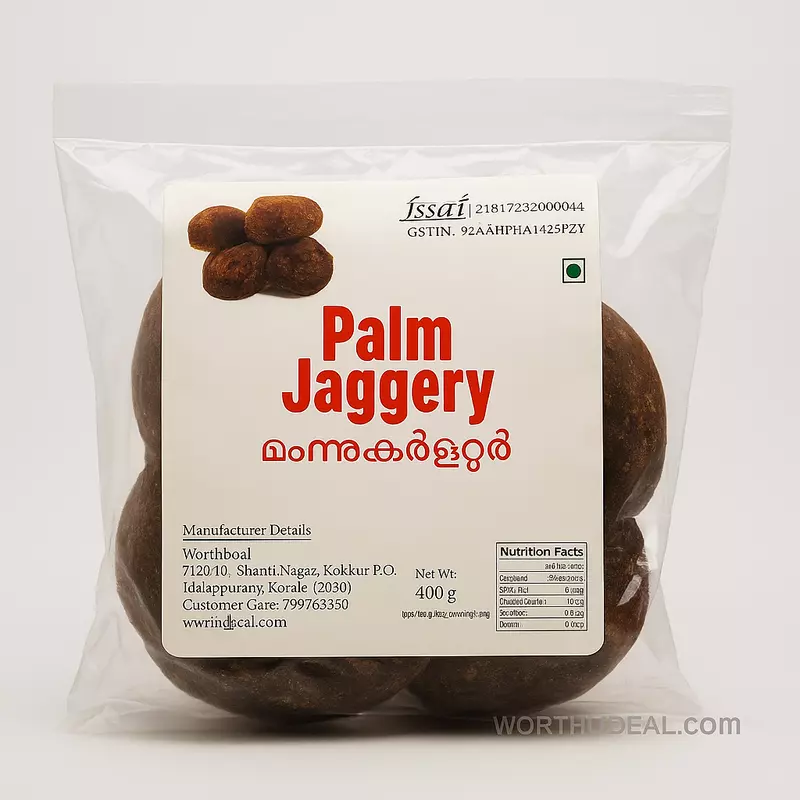


Buy Worth2Deal Kerala Organic Palm Jaggery Online — Pure Karupatti, Nattu Panam Vellam, 400g
Non-returnable
Rs.198.00 Rs.289.00
Available Offer
Share :
Product Details
Worth2Deal Kerala Organic Palm Jaggery is prepared from the sap of organically grown palmyra and date palms in Kerala — collected fresh, slow-boiled in open vessels, and moulded into blocks without any chemical processing, bleaching, or artificial additives. The result is a deep brown, mineral-rich natural sweetener that carries the authentic flavour of traditional Kerala palm jaggery — earthy, slightly smoky, with a natural caramel depth that refined sugar and even sugarcane jaggery cannot replicate. Available in a 400g pack with free delivery anywhere in India.
What Is Palm Jaggery — Kerala's Traditional Karupatti
Palm jaggery — known as karupatti in Tamil, panam vellam or nattu sarkkara in Malayalam, and palm gud in Hindi — is a traditional natural sweetener made from the concentrated sap of palm trees, primarily the palmyra palm (Borassus flabellifer) and the date palm (Phoenix dactylifera). It is one of the oldest sweeteners used in South Indian and Kerala cooking, predating sugarcane jaggery by centuries in many coastal and inland Kerala communities.
The production process is entirely traditional. Palm toddy tappers — kallu vettukar — climb the palm trees at dawn to collect the fresh sap, called toddy or kallu, before it ferments. The fresh sap is then slow-boiled in large iron or clay vessels over wood fire, stirring continuously as the water evaporates and the sap thickens into a dense, viscous mass. This mass is poured into moulds — traditionally hollow coconut shells or stone cups — and allowed to cool and harden into the characteristic dark brown blocks or rounds.
No chemicals are added at any stage. No bleaching agents, no preservatives, no anti-caking agents. The dark colour of palm jaggery is entirely natural — a result of the slow caramelisation of natural sugars during boiling. Any jaggery that appears too light or uniform in colour has likely been adulterated or chemically treated.
Worth2Deal sources this palm jaggery from organic cultivation in Kerala — trees grown without synthetic fertilisers or pesticides — and processes it under hygienic conditions that preserve the natural mineral content and flavour of the sap.
Palm Jaggery vs Sugarcane Jaggery — What Is the Difference
The most common question buyers ask is how palm jaggery differs from the sugarcane jaggery they are more familiar with. They are both jaggery — both unrefined concentrated natural sweeteners — but the source, flavour profile, mineral composition, and culinary use are quite different.
| Palm Jaggery | Sugarcane Jaggery | |
|---|---|---|
| Source | Palmyra or date palm sap | Sugarcane juice |
| Colour | Deep dark brown | Golden yellow to dark brown |
| Flavour | Earthy, smoky, caramel, complex | Sweet, mild, relatively neutral |
| Iron content | Higher | Lower |
| GI (approximate) | Lower (~41) | Moderate (~55–65) |
| Traditional use | Herbal drinks, payasam, medicine | Sweets, chikki, cooking |
| Kerala name | Panam vellam / karupatti | Sarkkara / vellam |
Palm jaggery has a more complex, assertive flavour — it changes the character of whatever it sweetens. This makes it the preferred choice for sukku kaapi, palm jaggery tea, herbal kadhas, and traditional Kerala payasam. Sugarcane jaggery (including the GI-tagged Marayoor Jaggery from Worth2Deal's range) has a milder flavour better suited for sweets, chutneys, and recipes where a neutral sweetness is needed.
Worth2Deal carries both. If you are looking for the milder, golden sugarcane variety, see Buy Marayoor Jaggery Online — Worth2Deal GI-Tagged Kerala Sarkara. For the deeper, mineral-rich, traditional palm variety — you are on the right page.and you can also visit Natural Sweeteners category
How to Use Kerala Palm Jaggery — Traditional and Modern Applications
Palm jaggery is one of the most versatile natural sweeteners in a Kerala kitchen. It dissolves cleanly in hot liquids, melts evenly into batters and gravies, and adds a depth of flavour that granulated sugar simply cannot provide.
The most traditional use in Kerala is sukku kaapi — a warming herbal brew made with dry ginger, coriander seeds, pepper, and palm jaggery simmered together. This drink has been part of Kerala's Ayurvedic kitchen tradition for generations, used as a digestive, a warming remedy for cold and cough, and a post-meal digestive tonic. Palm jaggery is the only sweetener used in authentic sukku kaapi — sugarcane jaggery or sugar changes both the flavour and the traditional character of the drink.
Beyond sukku kaapi, palm jaggery is used in Kerala for ada pradhaman and traditional payasam where a deeper sweetness is preferred, for homemade palm jaggery tea (replace your daily sugar with a small piece of palm jaggery dissolved in black tea), in puttu and idiyappam where a small piece served alongside adds both sweetness and digestion support, in traditional herbal preparations and kadhas where it acts as a vehicle for other ingredients, and as a direct replacement for refined white sugar in any recipe where a more complex, mineral-forward sweetness is desired.
A practical note for storage: palm jaggery absorbs moisture easily and can become sticky or develop surface mould if stored improperly. Always keep it in an airtight container in a cool, dry place. In humid climates like Kerala's coastal belt or during monsoon months, refrigerating in an airtight box is recommended.
Product Details
Net weight: 400g Form: Blocks or rounds (traditional moulded form) Ingredients: Palm sap (100% natural, organically sourced) Preservatives: None Artificial colour or additive: None Processing: Chemical-free, slow-boiled traditional method Storage: Airtight container, cool dry place; refrigerate during monsoon or in humid climates Shelf life: Refer to best-before date on pack FSSAI Licence No.: 21317233000044 Manufactured and packed by: Worth2Deal, 7/330 A, Shanthi Nagar, Kokkur, Malappuram, Kerala — 676591 Customer support: worth2deal@gmail.com | +91 98462 94242
FAQs
What is palm jaggery — how is it different from regular jaggery?
Palm jaggery is made from the sap of palmyra or date palm trees, while regular jaggery (sarkkara or vellam) is made from sugarcane juice. Both are unrefined natural sweeteners, but palm jaggery has a deeper, earthier, smokier flavour, higher iron content, and a lower approximate glycaemic index. In Kerala, palm jaggery is called panam vellam or nattu sarkkara, and in Tamil it is called karupatti — the dark sweetener used in herbal drinks, payasam, and traditional medicines.
Is Worth2Deal's palm jaggery organic and chemical free?
Yes — Worth2Deal's palm jaggery is sourced from organically grown palm trees cultivated without synthetic fertilisers or pesticides. The processing is entirely chemical-free: no bleaching agents, no whiteners, no preservatives, and no artificial additives are used at any stage. The deep dark colour is entirely natural, resulting from slow caramelisation of palm sap sugars during open-vessel boiling.
What does palm jaggery taste like?
Palm jaggery has a complex, deep flavour — earthy, slightly smoky, with a rich caramel undertone that is noticeably different from the milder sweetness of sugarcane jaggery or refined sugar. The flavour is assertive: it changes the character of whatever it sweetens. This is why it is the traditional choice for sukku kaapi, herbal teas, and traditional Kerala payasam where a deep, layered sweetness is preferred over a neutral sweet note.
How do I use palm jaggery in everyday cooking?
Palm jaggery can replace refined sugar in any hot preparation — tea, coffee, herbal drinks, payasam, or kadha. The simplest use is palm jaggery tea: dissolve a small piece in boiling water, add tea leaves or a tea bag, strain, and drink without milk for a clean herbal-sweetened tea. It also works dissolved into warm water as a digestive drink after meals. For traditional sukku kaapi, simmer it with dry ginger and coriander seeds. It melts smoothly and blends well into batters, puddings, and traditional sweets.
Is palm jaggery good for diabetics?
Palm jaggery has a lower approximate glycaemic index than refined sugar and sugarcane jaggery, meaning it causes a slower rise in blood glucose compared to refined sweeteners. However, palm jaggery is still a concentrated source of natural sugars and is not a sugar-free product. People with diabetes or blood sugar conditions should consult their doctor or dietitian before incorporating palm jaggery into their diet. This is general information and not a medical or dietary claim.
Can I order palm jaggery online with free delivery across India?
Yes — Worth2Deal delivers free to all major cities and towns across India including Mumbai, Delhi, Bengaluru, Chennai, Hyderabad, Kolkata, Pune, Ahmedabad, Jaipur, Lucknow, Surat, Visakhapatnam, Coimbatore, Kochi, Thiruvananthapuram, Kozhikode, Thrissur, Palakkad, Malappuram, Nagpur, Indore, and all other serviceable pin codes. FSSAI Lic. No.: 21317233000044.
How should I store palm jaggery to prevent it from melting or going mouldy?
Palm jaggery is hygroscopic — it absorbs moisture from the air, which causes softening, stickiness, and eventually surface mould if stored in open or humid conditions. Store it in an airtight container in a cool, dry place away from direct sunlight. During Kerala's monsoon season or in coastal cities with high humidity, store the airtight container in the refrigerator. If the jaggery develops surface moisture, wipe it dry and re-seal immediately. Properly stored, it keeps well for several months.
What is the difference between palm jaggery and coconut jaggery?
Palm jaggery comes from the sap of palmyra or date palm trees. Coconut jaggery — thenga sarkkara or coconut palm jaggery — comes from the sap of coconut palm flowers (the inflorescence, not the fruit). They are sometimes confused because both are dark, traditional Kerala sweeteners. Coconut jaggery tends to be slightly lighter in colour with a milder, more distinctly coconutty flavour. Palm jaggery from palmyra sap is darker, denser, and has the characteristic smoky depth. Both are natural, unrefined, and chemical-free in traditional preparation.
How is Worth2Deal's palm jaggery different from commercially branded palm jaggery?
The main difference is sourcing and processing integrity. Commercial palm jaggery products often blend palm sap with sugarcane jaggery or add starch and chemical binders to improve texture and reduce cost. Worth2Deal's palm jaggery is single-source — 100% palm sap from organically grown trees, processed traditionally without any blending or additive. The dark colour, irregular texture, and complex flavour of Worth2Deal's product are markers of authentic, unblended palm jaggery.
Can palm jaggery be used in Ayurvedic preparations?
Yes ,palm jaggery has a recognised place in Kerala's Ayurvedic kitchen tradition. It is used as the sweetening vehicle in many traditional herbal preparations, kadhas, and home remedies because it is considered easier to digest than refined sugar and is believed in traditional practice to support digestive fire (agni). It is the base sweetener for sukku kaapi, which is recommended in traditional Kerala households for colds, coughs, and indigestion. Note: these are traditional uses and not medical claims. Consult a qualified Ayurvedic practitioner for therapeutic applications.
Does palm jaggery have a long shelf life ,is it suitable for gifting?
Palm jaggery has a shelf life of several months when stored correctly in an airtight container away from moisture. Worth2Deal's 400g pack is sealed at source, making it suitable for gifting as part of Kerala natural sweetener sets alongside Marayoor Jaggery or honey. It is a popular Onam, Vishu, and housewarming gift for Kerala diaspora buyers across India who want authentic, chemical-free traditional sweeteners from home. For bulk gifting or institutional orders, contact worth2deal@gmail.com or +91 98462 94242. FSSAI Lic. No.: 21317233000044.
Will traditional palm jaggery production survive as palm toddy tapping declines in Kerala?
Palm toddy tapping — the skill of climbing palmyra and date palm trees to collect sap — is a declining traditional craft in Kerala. The number of trained kallu vettukar has fallen sharply over the past three decades as younger generations move to other livelihoods. This directly threatens the supply of authentic palm sap for jaggery production. Worth2Deal sources from small traditional producers who continue this craft — buying authentic Kerala palm jaggery from these producers supports the economic viability of traditional tapping as a livelihood and helps preserve one of Kerala's most important food heritage traditions.
NAP Block
Worth2Deal 7/330 A, Shanthi Nagar, Kokkur, Malappuram, Kerala — 679591 Phone: +91 98462 94242 Email: worth2deal@gmail.com Website: www.worth2deal.com FSSAI Licence No.: 21317233000044
Ratings And Reviews