

By Team Worth2Deal — Sourced directly from the jaggery sheds of Marayoor, Idukki District, Kerala
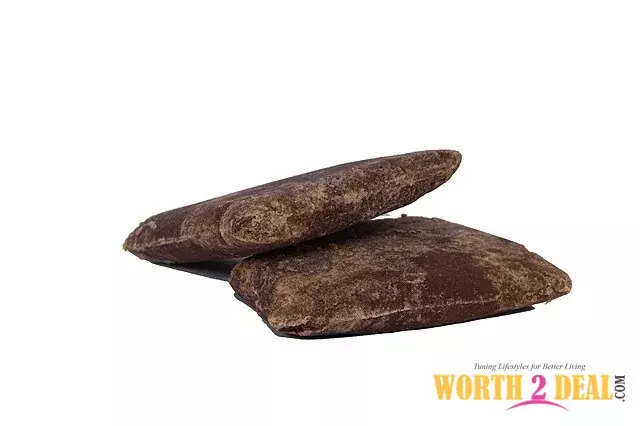
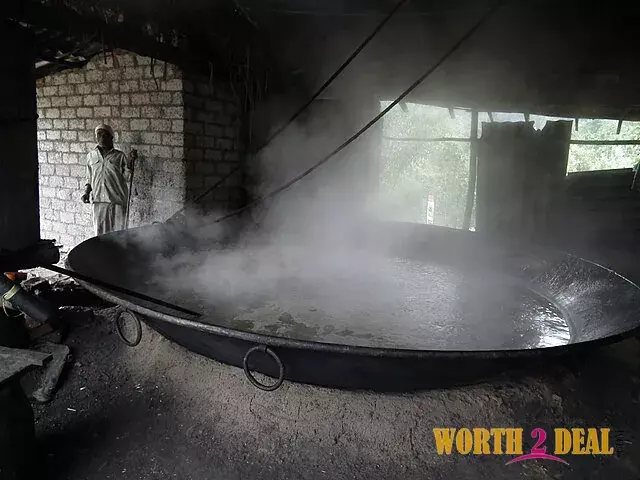
When our team visited the sugarcane fields of Marayoor last season, we met Kandan — a Muthuvan farmer in his late fifties who has been making jaggery since he was twelve years old. His shed smells of caramelised cane and wood smoke. On the wooden bench beside the Nagathagithu — the traditional open pan evaporator — sits a row of freshly pressed square jaggery blocks, still warm, dark as molasses, each one carrying the press marks of the hands that made it.
"My father taught me this," Kandan said, pressing warm syrup into the mango bark mould with both palms. "His father taught him. This is not a factory job. You feel when it is ready."
That sensory knowledge — built across generations of the Muthuvan tribe in the rain-shadow hills of the Western Ghats — is exactly what you hold in your hands when you open a Worth2Deal Marayoor Jaggery block.
Marayoor Jaggery, also spelled Marayur Jaggery and locally called Unda Sharkara or Marayoor Sharkara, holds GI Tag No. 613 awarded by the Geographical Indication Registry, Chennai on March 8, 2019. It is produced exclusively in the Marayoor and Kanthalloor Grama Panchayaths of Devikulam Taluk, Idukki District, Kerala. It is the second jaggery from Kerala and the 31st product from the state to receive GI certification. No other jaggery in India legally carries this name.
Ready to taste the real thing? Shop GI-Certified Marayoor Jaggery Blocks at Worth2Deal →
What Is Marayoor Jaggery? Understanding Unda Sharkara and Its Forms
Marayoor Jaggery is a non-centrifugal cane sugar — the sugarcane juice is boiled down and solidified without separating the molasses. What you get is a whole food sweetener that retains iron, minerals, antioxidants, and deep caramel complexity that refined sugar destroys entirely in processing.
Marayoor Jaggery is traditionally available in four forms: the classic Unda Sharkara (solid ball, hand-rolled), square blocks pressed into mango bark moulds, liquid jaggery (Paani), and jaggery powder. Worth2Deal sources it in firm square blocks — the most practical form for home use, easy to portion with a knife, quick to dissolve in hot liquids, and simple to store flat in an airtight container.
Beyond home kitchens, Marayoor Jaggery has a revered place in Kerala's temples — used in traditional ceremonies, Kerala sadyas, and in jaggery-coated plantain chips called Sharkaraperatti, a staple delicacy at festive tables. This is not a product that found its way into ritual use through marketing. It was always there.
Marayoor Jaggery vs Commercial Jaggery vs White Sugar: Full Comparison
Marayoor Jaggery vs Commercial Jaggery vs White Sugar: Full Comparison
Before the history and science, here is the complete picture across 17 parameters. This is why Marayoor Jaggery blocks are not just a different product — they are a different category entirely.
Feature | Marayoor Jaggery ✓ | Commercial Jaggery | Refined White Sugar |
GI Tag Certified | Yes — No. 613 | No | No |
Iron Content | High (11–26%) | Low–Medium | Zero |
Minerals (Zn, Mg, K, Ca) | Present | Trace | None |
Glycaemic Index | ~84 (lower impact) | ~85 | ~100 |
Processing Chemicals | None (lime only) | Bleach + sulphite | Multiple chemicals |
Colour | Deep dark brown | Yellow–orange | White |
Taste Profile | Pure, non-salty sweet | Slightly salty | Flat sweet |
Molasses Retained | Yes — 100% | Partial | No |
Antioxidants | Present | Minimal | None |
Sodium Content | Naturally low | Higher | Processed |
Ayurvedic Use | Traditional staple | Limited | Not applicable |
Annual Production | ~6,000 tons | Industrial scale | Industrial scale |
Forms Available | Block, ball, liquid, powder | Limited | Granules/powder |
Temple Use | High Court mandated (2002) | No | No |
Export Certified | APEDA — Dubai, UAE (2022) | Varies | Varies |
Made By | Muthuvan tribe, Idukki | Industrial units | Industrial units |
Origin Traceable | Yes — Marayoor, Kerala | Rarely | No |
Table note: GI (Glycaemic Index) values are approximate. Iron content range (11–26%) sourced from Kerala Agricultural University data. Marayoor Jaggery's lower chemical load and fully retained molasses contribute to a better nutritional profile than refined sugar, though it remains a high-sugar food. Consume in moderation.
Every parameter in that table is why Worth2Deal stocks only GI-certified blocks. Order Authentic Marayoor Jaggery Blocks — Delivered Across India →
Why Only Marayoor? The Geography That Creates the Taste
Why Only Marayoor? The Geography That Creates the Taste
Marayoor sits 42 kilometres north of Munnar on the Munnar–Udumalpet road, in the rain shadow of the Western Ghats. The leeward eastern slope receives significantly less rainfall than Kerala's humid west coast. This dry, cool microclimate slows sugarcane growth and concentrates sugar content — a documented total sugar percentage of 77.87% to 96.52%, sucrose between 63% and 80%, and water-insoluble impurities as low as 0.08–0.16%.
Three geographic factors work together:
• Soil: Loamy, phosphorus-rich earth with pH 4.5–7.5 encouraging maximum sucrose development in the cane stalk
• Water: Pure mountain stream irrigation — zero industrial contamination, contributing to exceptionally low sodium levels in the final block
• Climate: Cool temperatures and lower humidity naturally reduce sodium in the cane — the direct reason Marayoor Jaggery has its signature non-salty taste
The name Marayoor derives from 'Maranjirunnayoor' — the place of hiding — linked to the Pandavas taking refuge here during their Mahabharata exile. The region is also home to one of India's few natural sandalwood forests. This is a landscape of rare things. Marayoor Jaggery is one of them.
The Muthuvan Tribe: Kandan and the 832 Families Behind Every Block
The Muthuvan Tribe: Kandan and the 832 Families Behind Every Block
Kandan is one of 832 active sugarcane farmers currently cultivating across Marayoor and Kanthalloor Panchayaths. Most belong to the Muthuvan tribe — an indigenous Western Ghats community whose jaggery-making knowledge travels not through textbooks but through watching, doing, and feeling. A decade ago there were over 2,000 farming families. Cheap counterfeits from Tamil Nadu — relabeled as Marayoor Jaggery — pushed hundreds of families out of the trade by undercutting prices to Rs 35–38 per kg wholesale.
"We do not use a thermometer," Kandan explained, demonstrating the rettai nool padham — the two-thread stage, where the boiling syrup forms two distinct threads between the fingers, signalling it is ready to mould. "When it feels like this" — he pulled the threads apart slowly — "it is time to pour."
These 832 families, working across roughly 150 country sheds, produce approximately 6,000 tons of Marayoor Jaggery per year — entirely by hand, entirely on the farm, entirely in one day from cane to finished block.
How Traditional Marayoor Jaggery Blocks Are Made: Step by Step
How Traditional Marayoor Jaggery Blocks Are Made: Step by Step
Source: Thulasiraman, V. (2025). Scientific Understanding of Traditional Jaggery Making Process at Marayoor, Kerala. Journal of The Institution of Engineers (India): Series A, 106, 1037–1041. DOI: 10.1007/s40030-025-00891-z
1. Harvest: Mature CO 86032 variety cane is harvested and fed through a diesel-run roller. A Brix reading of 12–14° confirms juice quality before processing begins.
2. Filtering: The raw juice is immediately sieved through fine mesh to remove all field impurities.
3. Clarification: A small amount of calcium hydroxide (lime) is added — the only additive in the entire process. No bleaching agents. No artificial colour. No sodium sulphite.
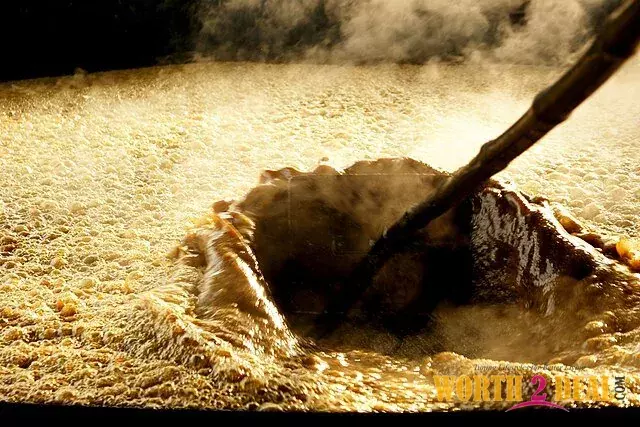
4. Boiling in the Nagathagithu: Clarified juice is slow-boiled in the traditional open pan evaporator fueled by dried bagasse. Cow dung and dry scum insulate the vessel for thermal efficiency. Constant stirring with long wooden spoons prevents charring.
5. Rettai Nool Padham Test: Kandan pulls the syrup between two fingers. When it forms two distinct threads — the rettai nool padham (two-thread stage) — the syrup has reached the exact consistency needed. No thermometer. No timer. Only the hands.
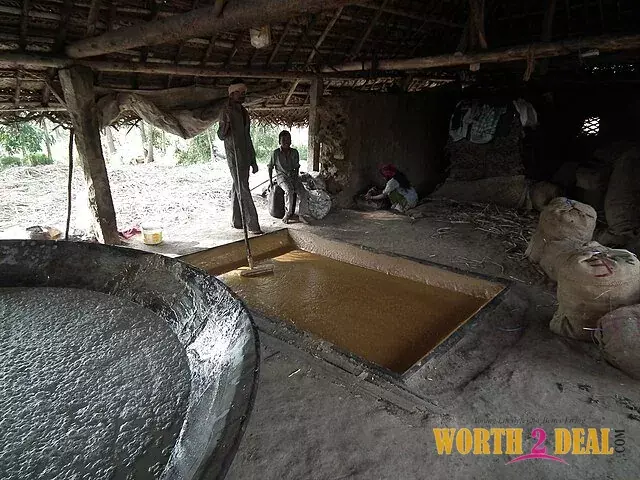
6. Pouring into Mango Bark Moulds: The thick syrup is immediately poured into square moulds made from mango bark — a traditional, zero-waste, fully natural moulding material used in Marayoor for generations. Mango bark prevents sticking without any chemical release agent.
7. Hand Pressing and Setting: Kandan presses the syrup firmly into the corners of each square mould with both palms. The blocks cool and set naturally — no refrigeration, no artificial hardening.
8. Demoulding: Once firm, the square blocks are turned out of the mango bark moulds. The surface carries the bark's natural grain and the press marks of the artisan's hands — both signs of authentic hand production.
Worth2Deal sources these exact blocks directly from Marayoor sheds — same mango bark moulds, same rettai nool padham test, same 400-year process. No middlemen. No relabeled counterfeits.
Three Pillars That Prove Marayoor Jaggery's Authenticity
Three Pillars That Prove Marayoor Jaggery's Authenticity
Pillar 1: GI Tag No. 613 — March 8, 2019
The Anchunadu Karimbu Ulpadhana Vipanana Sangham from Marayoor filed the GI application in March 2018 after years of watching cheap counterfeit jaggery — imported from Tamil Nadu and relabeled — undercut genuine produce at Rs 35–38 per kg wholesale. Cultivation area shrank from 2,700 acres to 1,200 acres. Farming families like Kandan's were leaving the trade.
The Geographical Indication Registry, Chennai awarded GI Tag No. 613 on March 8, 2019 — making Marayoor Jaggery the 31st GI product from Kerala and the second GI jaggery in the state after Central Travancore Jaggery. Every Worth2Deal block carries this certification.
Pillar 2: The Kerala High Court Sabarimala Ruling — 2002
Seventeen years before the GI tag, the judiciary had already recognised Marayoor Jaggery as India's highest purity standard for a sweetener. In 2002, the Kerala High Court ordered the Travancore Devaswom Board (TDB) to use Marayoor Jaggery exclusively at Sabarimala temple for the preparation of Aravana Payasam — the sacred rice pudding prasadam distributed to millions of devotees each year.
The Devaswom Board did not fully implement the order. G. Rajan, a Marayoor farmer who has been producing and selling jaggery since 1980, told reporters: "If Sabarimala and other temples decide to use Marayoor Jaggery, it will open a new market to the farmers and devotees will get pure prasadam from the temples."
The court order itself is the strongest possible institutional endorsement of Marayoor Jaggery's purity — a legal declaration that no other jaggery in India has ever received. Worth2Deal sells the same jaggery a High Court declared worthy of Sabarimala's altar.
Pillar 3: APEDA Dubai Export — January 13, 2022
On January 13, 2022, APEDA (Agricultural and Processed Food Products Export Development Authority) flagged off the first international shipment of GI-tagged Marayoor Jaggery from Marayoor, Idukki to Dubai, UAE — 2 metric tonnes, exported by Fair Exports India Pvt. Ltd. (Lulu Group International). APEDA Chairman Dr. M. Angamuthu IAS called Marayoor Jaggery a unique GI product the world needs to know.
Marayoor Jaggery now commands up to 30% premium pricing in international markets compared to non-certified jaggery. Worth2Deal brings this export-quality standard to your doorstep across India.
GI-certified. High Court endorsed. APEDA export-quality. Buy Marayoor Jaggery Blocks at Worth2Deal — 500g Pack, Delivered Across India →
Marayoor Jaggery Block Health Benefits: What the Nutrition Science Actually Shows
Marayoor Jaggery Block Health Benefits: What the Nutrition Science Actually Shows
Kandan does not talk about glycaemic indices. He talks about his grandmother breaking a small corner off the block after every meal, every day of her life. A 2025 peer-reviewed paper published in the Journal of The Institution of Engineers (India) confirmed what the Muthuvan community has practised for generations — describing the process as a fusion of science, skill, and cultural heritage that produces a nutritionally superior natural sweetener.
Iron Content — 11 to 26 Percent Naturally
Kerala Agricultural University data confirms Marayoor Jaggery contains 11–26% iron — completely absent in refined white sugar. Replacing white sugar with a small corner of jaggery block in daily chai, coffee, or morning porridge is one of the simplest and most practical dietary shifts for managing iron-deficiency anemia. Ayurvedic texts have documented jaggery as a blood-building food for centuries, and Kandan's family has used it this way for as long as anyone can remember.
Potassium, Calcium and Naturally Low Sodium
Marayoor Jaggery is rich in potassium and calcium and has a naturally low sodium content — a direct result of the region's microclimate. This is the nutritional reason behind the non-salty taste that distinguishes it from commercial jaggery, and it makes it a meaningfully better option for anyone managing blood pressure.
Digestive Benefits
In most Kerala households, a small corner broken from the jaggery block after a meal is standard practice — not because of a wellness trend, but because it works. Jaggery activates digestive enzymes and supports bowel regularity without the sharp insulin spike produced by refined sugar.
Ayurvedic Use: Chukku Kaapi and Natural Phytochemicals
"When someone in the family has a cold, we make Chukku Kaapi," Kandan said — dry ginger, black pepper, tulsi, sweetened by shaving a small piece from the block. Kerala Agricultural University confirms Marayoor Jaggery contains natural phytochemicals that enhance its role in Ayurvedic preparations beyond mere sweetness. This is documented chemistry, not alternative medicine marketing.
Important note: Jaggery is still sugar. Total sugar content in Marayoor Jaggery ranges from 77.87% to 96.52%. People with diabetes should use it in moderation and consult a healthcare provider before making it a daily staple.
How to Spot Fake Marayoor Jaggery Blocks: 4 Tests Anyone Can Do
How to Spot Fake Marayoor Jaggery Blocks: 4 Tests Anyone Can Do
"I can tell a fake block from across the shed," Kandan said, picking up a pale orange slab from a sample we had brought. "This colour. This smoothness. This is not us." He was right — it was Tamil Nadu jaggery relabeled in Marayoor packaging, selling at Rs 35–38 per kg wholesale and undercutting Kandan's blocks by nearly half.
1. The Colour Test — Dark Is Authentic
Authentic Marayoor Jaggery blocks are deep brown to dark chocolate throughout — unbleached, with natural molasses fully intact. Bright orange, pale yellow, or golden blocks have been treated with bleaching chemicals or are simply not from Marayoor. As Kandan put it: "The darker, the more real."
2. The Taste Test — No Salt, No Bitterness
Break a small corner and taste it directly. Genuine Marayoor Sharkara dissolves cleanly and purely sweet — the non-salty taste is formally documented in its GI specifications. Any saltiness or chemical bitterness is a definitive sign of a fake.
3. The Surface and Break Test — Texture Tells the Truth
Authentic hand-pressed Marayoor blocks carry slight surface impressions from the mango bark mould and Kandan's palms. The interior when broken should be dense and slightly granular. A perfectly uniform, glassy-smooth block has been machine-produced — not made in a Marayoor shed.
4. The GI Certification Check
Any genuine seller must confirm GI Tag No. 613 and trace origin to Marayoor or Kanthalloor Panchayath, Devikulam Taluk, Idukki District, Kerala. The name on the packet alone is not enough. And if the price is below Rs 60 per kg — that is your first warning before you even open the package.
How to Use Marayoor Jaggery Blocks in Your Kitchen
How to Use Marayoor Jaggery Blocks in Your Kitchen
The simplest starting point: break a small corner from the block and drop it into your morning chai instead of white sugar. The caramel depth is immediate and unmistakable. From there, the uses spread naturally:
• Kerala Payasam: Shave or break the block directly into the pot for Ada Pradhaman, Palada, and Semiya Payasam
• Chukku Kaapi: Dry ginger, pepper, and tulsi brewed together — sweetened by shaving a piece from the block. Kandan's family cold remedy, unchanged for generations
• Sharkaraperatti: Melt the block into a thick coating syrup for traditional jaggery-coated plantain chips — the authentic festive version only works with Marayoor Sharkara
• Morning Porridge: Grate or crumble over hot rice porridge or oatmeal — particularly nutritious with high-fibre parboiled brown rice
• Temple Offerings and Festival Sweets: Kozhukatta, Unni Appam, Neyyappam — break the block directly into the batter
• Tamarind Chutneys and Slow Curries: Shave a thin slice into tamarind-based sauces — the retained molasses adds depth no refined sugar can replicate
• After-Meal Piece: Break a fingernail-sized corner and eat directly after meals — the traditional Kerala digestive practice Kandan's grandmother followed every day of her life
Frequently Asked Questions About Marayoor Jaggery Blocks
Frequently Asked Questions About Marayoor Jaggery Blocks
Is Marayoor Jaggery block the same as regular jaggery?
No. Commercial jaggery blocks are often processed with bleaching agents, artificial colours, and sodium sulphite. Marayoor Jaggery blocks (GI Tag No. 613) use only lime for clarification, are moulded in traditional mango bark moulds, and carry a distinct non-salty sweetness unique to Idukki's geography and the Muthuvan tribe's methods. The comparison table above shows the full difference across 17 parameters.
What is the Sabarimala connection to Marayoor Jaggery?
In 2002, the Kerala High Court ordered the Travancore Devaswom Board (TDB) to use Marayoor Jaggery exclusively for Aravana Payasam preparation at Sabarimala temple — recognising its purity as the highest standard for sacred prasadam. The TDB did not fully implement the order, but the judicial recognition stands as the strongest institutional endorsement of Marayoor Jaggery's quality that any Indian food product has received.
What is the difference between Marayoor Jaggery blocks and balls (Unda Sharkara)?
Both are identical — same recipe, same mango bark moulding tradition, same GI-certified cane, same Muthuvan artisans. The ball (Unda) is the classic hand-rolled form for local and temple use. The square block is pressed into moulds for easier portioning, storage, and modern kitchen use. Worth2Deal supplies the square block form specifically for this reason.
How do I use a Marayoor Jaggery block in cooking?
Use a sharp knife or the back of a heavy spoon to break or shave the amount you need. It dissolves quickly in hot liquids. For recipes, grate it directly or melt a small broken piece in warm water first. One block goes a long way — start with a small corner in your chai and adjust to taste.
Can diabetics eat Marayoor Jaggery blocks?
Marayoor Jaggery has a lower glycaemic impact (~84 GI) compared to refined white sugar (~100 GI) and contains iron, potassium, calcium, and natural phytochemicals. Total sugar content is 77–97%. Diabetics should treat it as they would any sweetener — use sparingly and consult a doctor before making it a daily staple.
How should I store Marayoor Jaggery blocks?
Wrap in parchment or cling film and store in an airtight container in the refrigerator. Kerala's humidity causes surface moisture and softening at room temperature. Blocks stored correctly hold their shape, flavour, and quality for up to six months. Kandan refrigerates his own supply.
Is Marayoor Jaggery exported internationally?
Yes. On January 13, 2022, APEDA facilitated the first GI-certified shipment of Marayoor Jaggery to Dubai, UAE — 2 metric tonnes exported by the Lulu Group International. Marayoor Jaggery now commands up to 30% premium pricing in international markets.
Where can I buy authentic GI-tagged Marayoor Jaggery online?
Worth2Deal sources GI-certified Marayoor Jaggery blocks directly from artisan sheds in Marayoor, Idukki — no middlemen, no relabeled counterfeits. You can order the 500g Marayoor Jaggery block at Worth2Deal with delivery across India.
Why Buy Marayoor Jaggery from Worth2Deal?
Why Buy Marayoor Jaggery from Worth2Deal?
When our team sources Marayoor Jaggery blocks directly from the sheds, we watch for the same things Kandan taught us. The colour should stop you — that deep, unbleached brown that tells you nothing has been added to brighten it. The surface should carry the subtle texture of mango bark and the press marks of hand production. And the taste, when you break a corner, should be clean: intensely sweet, no salt, no chemical edge.
Every Worth2Deal block is:
• GI Tag No. 613 certified — origin traced to Marayoor or Kanthalloor Panchayath, Devikulam Taluk, Idukki District, Kerala
• Deep brown — not bleached, not brightened, molasses 100% intact
• Hand-pressed in mango bark moulds — surface texture and press marks are proof of authentic production
• Sourced directly from artisan sheds — no middlemen, no relabeled counterfeits
• Priced as a genuine premium artisanal product — not a suspiciously cheap imitation
As of 2026, the Marayoor region is subject to Kerala's new single-use plastic ban — with check-posts at all entry points. Choosing authentic Marayoor Jaggery from Worth2Deal is not just a health decision. It is direct support for 832 farming families whose 400-year tradition depends on consumers choosing the genuine block over the imitation.
The Kerala High Court recognised Marayoor Jaggery's purity in 2002. The GI Registry certified it in 2019. APEDA sent it to Dubai in 2022. A peer-reviewed journal documented its science in 2025. And Kandan is still pressing blocks by hand in his shed, planning to teach his son the rettai nool padham test next season.
Some things should not change.
Shop GI-Certified Marayoor Jaggery Blocks — Sourced by Worth2Deal directly from Kandan's Marayoor shed. Order Now — 500g Pack, Pan-India Delivery →
References & Sources
1. Thulasiraman, V. (2025). Scientific Understanding of Traditional Jaggery Making Process at Marayoor, Kerala. Journal of The Institution of Engineers (India): Series A, 106, 1037–1041. DOI: 10.1007/s40030-025-00891-z
2. Geographical Indication Registry, Chennai. GI Tag No. 613 — Marayoor Jaggery. Awarded March 8, 2019. https://ipindia.gov.in/girindia/
3. APEDA. First Shipment of GI-Tagged Marayoor Jaggery to Dubai, UAE. January 13, 2022. https://apeda.gov.in
4. Kerala Agricultural University. Nutritional Analysis of Marayoor Jaggery — Iron Content Data (11–26%).
5. Kerala High Court Order (2002). Travancore Devaswom Board directed to use Marayoor Jaggery for Aravana Payasam at Sabarimala temple.